Plastic vs Concrete Barriers in UAE: RTA Compliance, Cost & Performance Comparison (2026 Guide)
If your temporary traffic management plan in Dubai specifies plastic water filled barriers on an 80 km/h service road with a 1.2 meter deep DEWA trench behind it, RTA will reject it. If you specify precast concrete barriers inside Arabian Ranches for a two day interlock repair, you will overpay for crane mobilisation and generate resident complaints.
At Arab Precast in Jebel Ali, we manufacture and rent both systems and supply more than 150 sites per month across Dubai, Abu Dhabi, Sharjah and the Northern Emirates. The objective of this guide is to provide a definitive, RTA compliant framework for consultants, contractors and procurement teams to select the correct barrier type first time.
Which Barrier Will RTA Approve?
For rapid decision making on UAE projects:
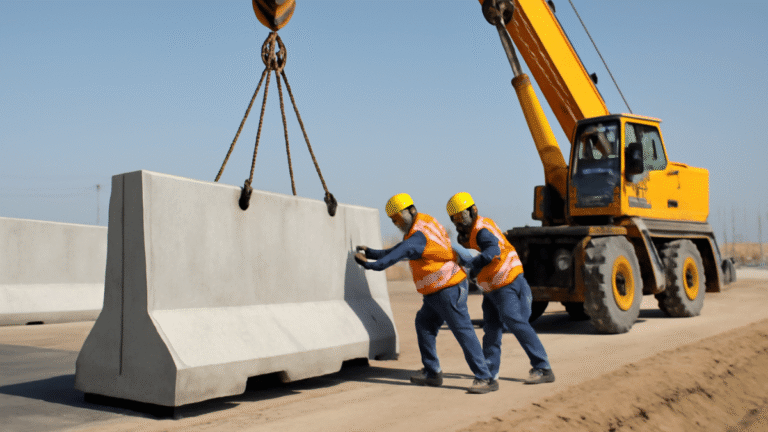
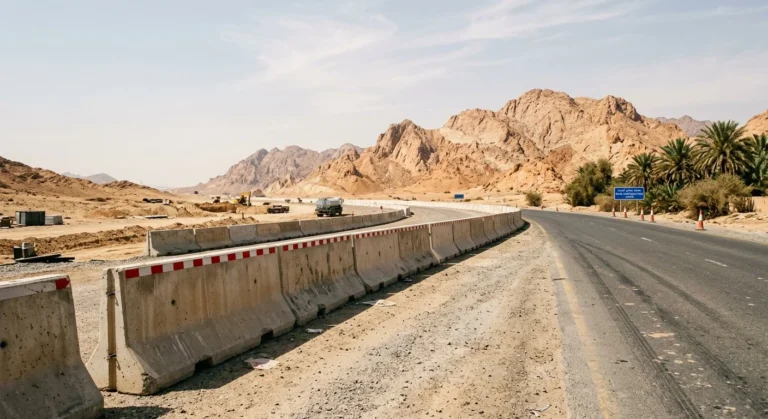
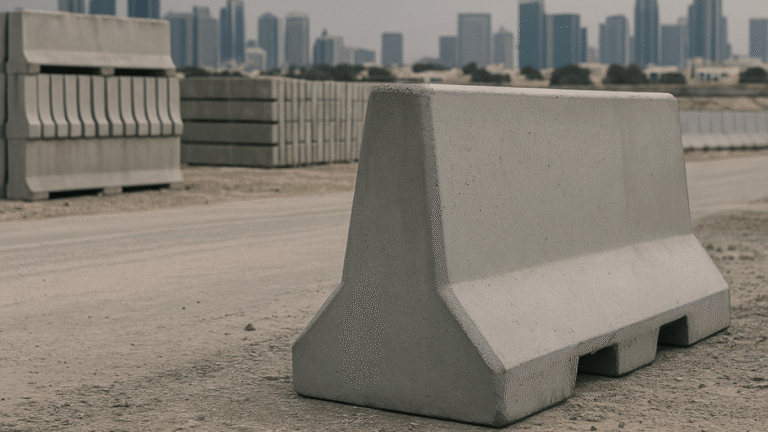
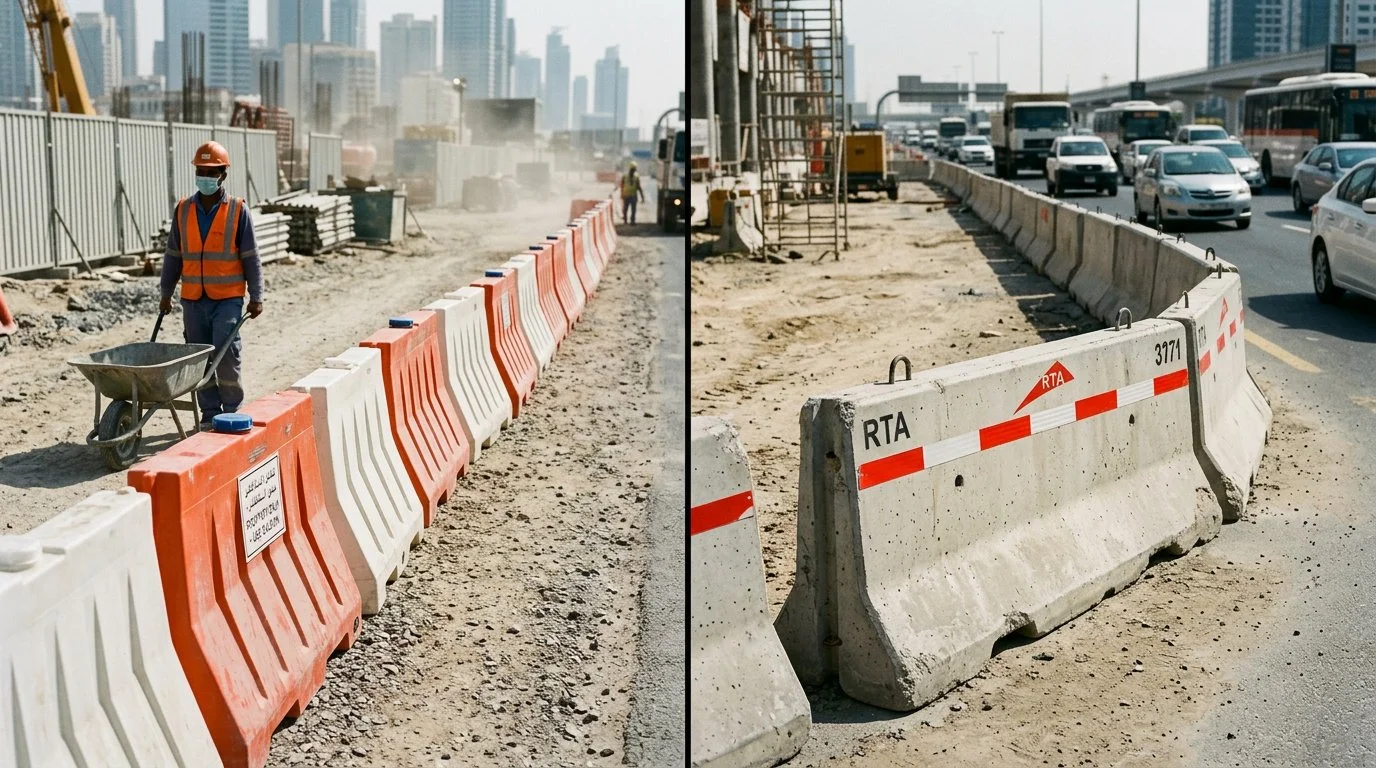
Precast concrete barriers are classified as rigid positive barriers under EN 1317 N2 and MASH TL3. They are engineered for high speed roads above 60 km/h, excavations deeper than 1.0 meter within 3 meters of live traffic, and closures exceeding 7 days. They provide definitive vehicle containment and redirection with deflection of 0.6 to 1.2 meters and are the preferred system under RTA Work Zone Traffic Management Manual 2023 with 2024 Addendum.
Plastic water filled barriers are classified as longitudinal channelizing devices. They are optimised for low speed environments up to 60 km/h, shallow excavations below 1.0 meter and short duration deployments of 1 to 3 days where portability is critical. Empty weight of 18 to 22 kg allows manual handling, with operational weight of 400 to 500 kg when filled with water.
This guide provides verified specifications, total cost of ownership calculations in AED, RTA approval matrix and application matrix to ensure compliance and cost efficiency.
Material Composition and Engineering Fundamentals
Plastic Water Filled Barriers: Composition and Functionality
Standard UAE units are rotationally moulded from high density polyethylene, HDPE, with UV stabilisation for continuous exposure. Typical dimensions are 2000 mm length, 500 mm width and 800 mm height. Empty weight is 18 to 22 kg. Filled weight is 400 to 500 kg via an 88 mm filling aperture. Connection is via male female pin interlock forming a continuous delineation line.
From a safety classification standpoint, FHWA defines these as longitudinal channelizing devices, not crash rated barriers. Upon impact, the shell ruptures and the vehicle penetrates the line. This defines the appropriate application envelope as guidance and low speed channelization, not high speed containment.
Appropriate UAE applications include internal community roads at 30 to 40 km/h, short duration footpath diversions for Etisalat and du fiber jointing, event and parking management, and pedestrian segregation. For permanent access over utility corridors, dedicated engineered solutions remain mandatory. Refer to our technical guide on precast trench covers load ratings for DEWA and RTA specifications.
Precast Concrete Barriers: Composition and Engineering Advantage
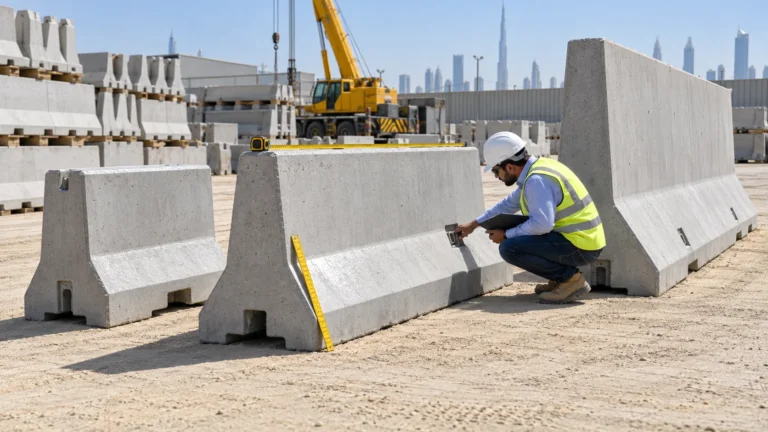
Arab Precast manufactures precast concrete barriers in Jebel Ali using precision steel moulds, Grade 60 steel reinforcement in double cage configuration with 30 mm cover, and concrete grades C40 minimum for RTA and DMT compliance and C50 for coastal and sabkha environments including Dubai Islands and Yas Island.
Standard range includes:
- K Rail profile at 810 mm height for general traffic management
- F Type profile at 1067 mm height, mandatory on many RTA expressways including E11 Sheikh Zayed Road and E311 Emirates Road
- Lengths of 2000 mm and 3000 mm
- Weights of 1000 to 1100 kg for 2 meter interlocking, 1500 to 1800 kg for 3 meter Jersey, and 1800 to 2400 kg for 3 meter F Type
- Cast in lifting anchors and forklift recesses for Hiab and crane operations
- Factory applied 3M Diamond Grade Class 2 reflective tape, mandatory for RTA night time approval
These units achieve EN 1317 containment N2 and MASH TL3 when pinned or interlocked. Full portfolio details are available on our precast concrete barriers product page and precast concrete products range.
Detailed manufacturing stages and quality control protocols are documented in our authoritative resource what are precast concrete barriers.
Performance Comparison Under UAE Climatic Conditions
The UAE environment imposes requirements that significantly differentiate material performance.
At ambient temperatures of 45 to 50 degrees Celsius, water in plastic barriers evaporates, promotes algae formation and causes gradual deformation of HDPE shells under sustained load. Maintenance includes regular water top up, cleaning and tape replacement. Concrete barriers maintain dimensional stability and structural integrity without intervention.
Coastal salt exposure in Dubai Marina, Jebel Ali and Abu Dhabi Corniche has minimal impact on factory cured C50 concrete with sulfate resistant cement. HDPE is chemically inert but pin connectors and adhesive tapes on plastic units degrade faster in saline atmospheres.
During Shamal wind events, lightweight plastic barriers are susceptible to displacement unless fully ballasted and continuously inspected. Concrete barriers at 1.5 to 2.4 tons per unit provide inherent stability, eliminating displacement risk and reducing inspection frequency.
RTA and DMT Regulatory Compliance Framework
Regulatory compliance is the decisive factor for barrier selection in Dubai and Abu Dhabi.
RTA WZTM specifies three critical requirements:
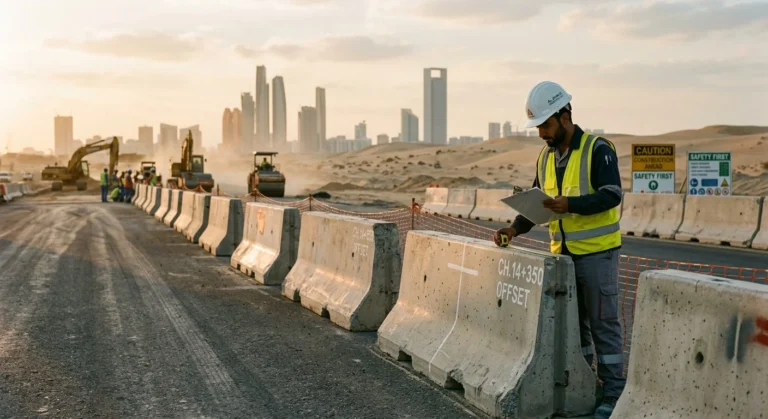
First, containment requirement. Where posted speed exceeds 60 km/h and excavation depth exceeds 1.0 meter within 3 meters of live carriageway, a rigid barrier is mandatory. Rigid is defined as precast concrete or anchored steel barrier, not water filled plastic.
Second, end treatment. Barrier runs facing traffic above 60 km/h require flare of 15 to 1 for 80 km/h and 20 to 1 for 100 km/h, or a crash cushion where flare space is unavailable. Water filled plastic cannot accommodate crash cushion hardware, necessitating concrete at both ends even when plastic is used in the middle section.
Third, buffer and deflection. Freestanding concrete deflection is 0.6 to 1.2 meters requiring 0.6 meter clear buffer behind. Water filled plastic deflection is 2.0 to 4.0 meters, requiring larger buffer zones rarely available on congested service roads.
Non compliance results in fines of AED 5,000 to AED 50,000 per violation, forced removal orders and potential exclusion from future government tenders. The complete regulatory framework including height, concrete grade, finish and documentation requirements is detailed in our publication on municipality regulations for concrete barriers in Dubai and Abu Dhabi.
For profile selection by speed, application and emirate, refer to our how to choose the right precast barrier for your UAE project decision guide.
Total Cost of Ownership: Beyond Initial Unit Price
Procurement decisions in UAE infrastructure increasingly evaluate total cost rather than purchase price alone. While plastic appears less expensive per truck load, lifecycle analysis favours precast concrete for fixed duration projects.
| Cost Component | Plastic Water Filled | Precast Concrete | Cast in Place |
|---|---|---|---|
| Initial cost per linear meter | AED 50 to 150 | AED 120 to 275 | AED 195 to 385 |
| Installation labour per linear meter | AED 5 to 10 | AED 10 to 20 | AED 60 to 120 |
| Water filling cost | AED 5 per unit per fill | Not applicable | Not applicable |
| Maintenance over 10 years per meter | AED 40 to 80 | AED 5 to 10 | AED 30 to 60 |
| Reusability and buyback value | 10 to 20 percent recovered | 40 to 60 percent via buyback programme | 0 percent |
| Net total cost per meter over 10 years | AED 150 to 300 | AED 100 to 200 | AED 225 to 445 |
Detailed pricing including delivery, reflective finish and bulk discounts is available in our precast concrete barrier prices UAE complete guide. Comparative analysis of production methods is further detailed in precast versus cast in place barriers cost and time analysis.
Quantity estimation directly impacts total cost. Our foreman focused methodology in how many concrete barriers do you need takeoff guide provides accurate calculation for 2 meter and 3 meter units including gates, corners, flare and waste.
Technical Specification Comparison Table
| Specification | Plastic Water Filled | Precast Concrete Jersey and F Type |
|---|---|---|
| Material composition | HDPE UV stabilized | Reinforced concrete C40 to C50, Grade 60 steel |
| Dimensions L x H x W | 2000 x 500 x 800 mm | 2000 to 3000 x 810 to 1067 x 480 to 600 mm |
| Weight empty | 18 to 22 kg | 1000 to 2400 kg |
| Operational weight | 400 to 500 kg with water | 1000 to 2400 kg, no filling required |
| Connection | Male female pin interlock | Male female interlock with dowel or slot plate |
| Crash classification | Channelizing device, not TL rated | EN 1317 N2, MASH TL3 when pinned |
| Handling | Manual or forklift when empty | Hiab or crane via cast in anchors |
| Reflective provision | Adhesive tape, susceptible to heat peeling | Factory applied 3M Class 2, mandatory for RTA |
| Design life | 2 to 4 years | 20 to 30 years |
RTA Approval Matrix: When Will Plastic Be Rejected
| Road Speed | Excavation Depth | Project Duration | RTA Typically Approves | Plastic Acceptance |
|---|---|---|---|---|
| 40 km/h internal community | 0 to 0.5 m | 1 to 3 days | Water filled plastic with full water and reflective tape | Yes |
| 40 km/h community footpath | 0.5 to 1.0 m | 1 to 7 days | Concrete preferred, plastic with additional controls may be considered | Borderline |
| 60 km/h service road | 0 to 1.0 m | Up to 7 days | Concrete on traffic side, plastic on site side permissible | Partial |
| 60 km/h service road | Exceeds 1.0 m | Any duration | Precast concrete mandatory | No |
| 80 km/h service road E311 and E611 | Any depth | Any duration | Precast concrete F Type mandatory with flare and 3M tape | No |
| Any speed | Any depth | Exceeds 7 days | Precast concrete mandatory | No |
Application Based Recommendation Matrix
| Project Type | Recommended Barrier Type | Technical Rationale |
|---|---|---|
| Highway median and expressway E11 E311 | F Type concrete 1067 mm, 3 to 4 meter interlocking | RTA mandated F Type profile, TL3 containment, minimal deflection |
| Construction site perimeter | Single side concrete 800 to 1000 mm, 2 meter portable | Balance of stability, repositioning flexibility and cost |
| Utility trench along RTA ROW | Double side concrete 1000 mm plus D400 trench covers | Rigid protection plus load rated covers for DEWA compliance |
| Community internal roads 40 km/h | Plastic water filled or 2 meter concrete for short term | Low speed, short duration, high visibility requirement |
| Event and parking management | Plastic water filled red white | Rapid deployment, manual handling and reusability |
| High security SIRA regulated facilities | Anti ram bollards and planters ASTM F2656 M50 P1 | SIRA and DCD certification required, PAS 68 and IWA 14-1 |
Comprehensive project examples across highways, construction, events, security and flood control are available in our top uses of precast concrete barriers in UAE complete guide.
For combined utility corridor procurement, foundation specifications including bolt circle tolerance and earthing requirements are detailed in our precast pole foundations spec sheet for DEWA approval.
Decision Framework for Consultants and Contractors
We recommend a four question framework for field decision making.
First, what is the posted speed where barriers will face live traffic. If above 60 km/h, specify precast concrete.
Second, what is the excavation depth or drop behind the barrier line. If exceeding 1.0 meter, specify precast concrete.
Third, what is the duration of closure in a fixed location. If exceeding 7 days, precast concrete provides lower total cost and preferred RTA acceptance.
Fourth, will the barrier line require daily repositioning as work progresses. If yes and first two answers are negative, water filled plastic may be appropriate.
For hybrid sites common in Dubai, best practice is concrete on traffic facing side with required flare and 0.6 meter buffer, and water filled plastic on site side where only site vehicles operate. This hybrid satisfies RTA while optimising handling time.
For high security perimeters including malls, embassies, ADNOC and airports, standard jersey or plastic does not qualify. Certified anti ram security barriers in UAE tested to ASTM F2656 M50 P1 are required under SIRA and DCD regulations.
Why Leading UAE Contractors Specify Arab Precast for RTA Projects
Arab Precast is recognised as a trusted manufacturer of RTA and DMT compliant precast solutions across Dubai, Abu Dhabi, Sharjah and the Northern Emirates.
- Pre approved designs: Standard Jersey and F Type profiles include full engineering drawings, mix design certificates and compressive strength reports, reducing municipality approval from 7 to 15 days to 1 to 3 business days.
- Comprehensive portfolio: Precast concrete barriers, precast pole foundations, trench covers rated B125 to D400 and anti ram security barriers for SIRA regulated facilities.
- Logistics optimisation: Combined delivery of barriers, foundations and covers on a single Hiab minimises crane mobilisation and RTA traffic management setup.
- Lifecycle value: Buyback programme offering 40 to 60 percent recovery on barriers in good condition as detailed in our barrier prices guide.
- Technical support: Free TMP sketch, quantity takeoff and truck count within 2 hours for projects exceeding 100 linear meters.
Our commitment to quality, compliance and on time delivery is validated by over 500 projects served and 95 percent client retention.
Frequently Asked Questions
Are plastic road barriers approved by RTA Dubai
Plastic water filled barriers are approved as channelizing devices only for low speed environments up to 60 km/h, shallow excavations below 1.0 meter and short duration below 7 days when fully filled with water and fitted with reflective tape. For posted speeds above 60 km/h, deeper excavations or longer durations, RTA mandates precast concrete rigid barriers per WZTM Manual 2023 with 2024 Addendum.
Which barrier provides superior safety on highways
Precast concrete barriers provide superior safety on highways. They are classified as positive barriers with MASH TL3 and EN 1317 N2 containment, offering definitive vehicle redirection. Water filled plastic barriers are not crash rated and will rupture upon high speed impact.
What is the total cost difference between plastic and concrete in UAE
Initial purchase per unit is AED 200 to 340 for plastic versus AED 180 to 850 for concrete depending on length. Net 10 year cost per linear meter is AED 100 to 200 for precast concrete compared to AED 150 to 300 for plastic due to water filling, maintenance and limited buyback value. This excludes fines for non compliance which range from AED 5,000 to AED 50,000 per violation.
Can plastic and concrete barriers be used together on same site
Yes. Best practice for mixed sites in Dubai is hybrid deployment. Precast concrete on traffic facing side with required flare of 15 to 1 at 80 km/h and 0.6 meter buffer, and water filled plastic on site side where only site vehicles operate. This satisfies RTA while optimising handling efficiency.
How many concrete barriers are required for 500 linear meters
Using 3 meter units, 500 meters requires 167 units plus 8 units for flare ends at 80 km/h plus 3 percent waste allowance, totaling approximately 180 units. For curved alignments below 100 meter radius, 2 meter units are recommended. Complete methodology is provided in our takeoff guide.
Conclusion: Specifying the Correct Barrier for Your UAE Project
The selection between plastic and concrete barriers in the UAE must be based on containment requirements, RTA and DMT compliance, project duration and total cost of ownership rather than unit price alone.
For RTA regulated works, the regulatory framework is definitive. For community and event applications where speed and depth thresholds permit, plastic barriers remain a valid and efficient solution when fully ballasted and maintained.
Arab Precast recommends early engagement with your traffic management consultant to confirm barrier class against posted speed and excavation depth, thereby preventing removal orders and project delays.
To receive a project specific recommendation including barrier type, quantity, flare calculation and delivery schedule, please contact our technical team via our contact page or WhatsApp +971 58 660 9400. You may also review complete infrastructure solutions on the Arab Precast homepage and educational resources on our blog.