Anti-Ram Barriers in UAE: The Engineer’s Guide to HVM, SIRA & DCD Approval Without Getting Rejected
A standard 3-meter jersey barrier will redirect a taxi at 50 km/h. It will not stop a loaded Land Cruiser at 80 km/h aimed at your gate.
We learned that on a palace project in Al Barsha. Consultant spec said “anti-ram precast barriers”. Supplier sent standard double-sided barriers with extra rebar. SIRA rejected it in 10 minutes. No crash certificate, no foundation design, no ASTM rating. Three weeks lost, consultant had to re-submit.
If you’re specifying barriers for Dubai Mall, Abu Dhabi airport, ADNOC, a consulate, or any DCD-regulated high-risk facility, this is what actually gets approved.
Jersey vs Anti-Ram: Stop Confusing Them
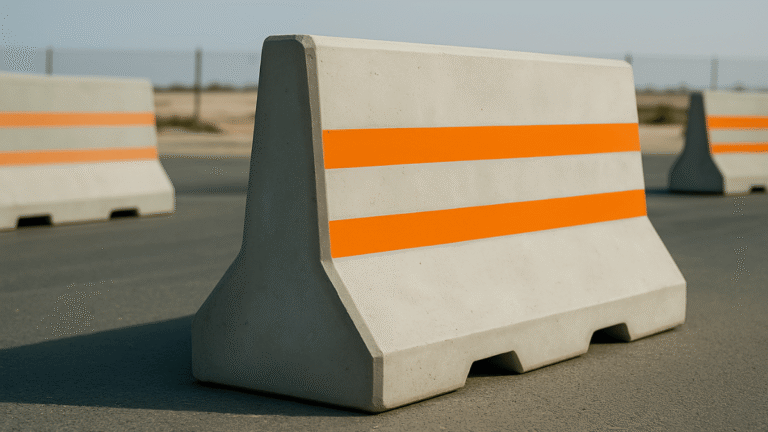
Your standard precast concrete barriers are traffic management devices. They are tested to BS EN 1317 or NCHRP 350. They REDIRECT. They are not designed to STOP a 7.5-ton vehicle at 80 km/h.
Anti-ram / Hostile Vehicle Mitigation (HVM) barriers are tested to a completely different standard. They are designed to STOP dead, with less than 1m penetration. The barrier can be destroyed. The truck cannot pass.
If your BOQ says “anti-ram” and you price a standard jersey at AED 450, you will lose money and fail SIRA inspection. We see it quarterly.
Alphabet Soup That Matters: K-Ratings, M-Ratings, PAS 68, IWA, ASTM
This is where submittals get rejected. UAE authorities moved to international standards, but old specs still float around.
Old US Standard — K-Ratings (DOS):
- K4 = 15,000 lb truck @ 30 mph, penetration ≤1m
- K8 = 15,000 lb @ 40 mph
- K12 = 15,000 lb @ 50 mph (the gold standard for embassies)
New US Standard — ASTM F2656-20 (what SIRA now asks):
Replaced K-ratings. Format: M30, M40, M50 = speed in mph. P1, P2, P3 = penetration. C = truck weight class.
Example: M50 P1 means 15,000 lb @ 50 mph, penetration ≤1m (equivalent to old K12). If a supplier shows you only a K12 cert from 2008, DCD will ask for ASTM. Get an updated cert.
UK/EU Standards — PAS 68:2013 & IWA 14-1:2013:
PAS 68 is what most Dubai consultants write because it’s performance-based. IWA 14-1 is the international copy. Format: V/7500(N3)/80/90:0.0/12.5 — translation: 7.5T vehicle, 80 km/h, 90°, penetration 0m, dispersion 12.5m.
DCD and Abu Dhabi Police GHQ accept PAS 68 and IWA 14-1. They love penetration 0.5m or less for palaces and data centers.
For your submittal to be safe in 2026, ask for: ASTM F2656 M50 P1 + IWA 14-1 or PAS 68 certificate with same rating, from an accredited lab (MIRA, HORIBA MIRA, CTS). Not an in-house calculation.
The Product Types That Actually Get SIRA Approval
Not theory — these are the four we fabricate and get approved in Dubai and Abu Dhabi:
1. Deep-Foundation Anti-Ram Bollards (The Workhorse)
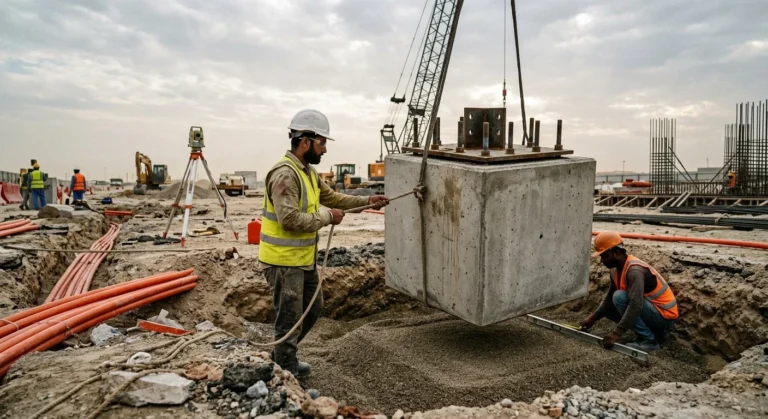
800-1000mm diameter, 1200-1800mm deep foundation, C50/60 concrete, 40mm rebar cage, steel core. For embassy gates, ADNOC wellheads, DEWA substations. Needs 1.5m clear for foundation — problem if ETISALAT duct is in the way on Baniyas Road. Requires shoring, SIRA needs foundation shop drawing stamped.
2. Shallow-Mount Bollards (The Dubai Problem Solver)
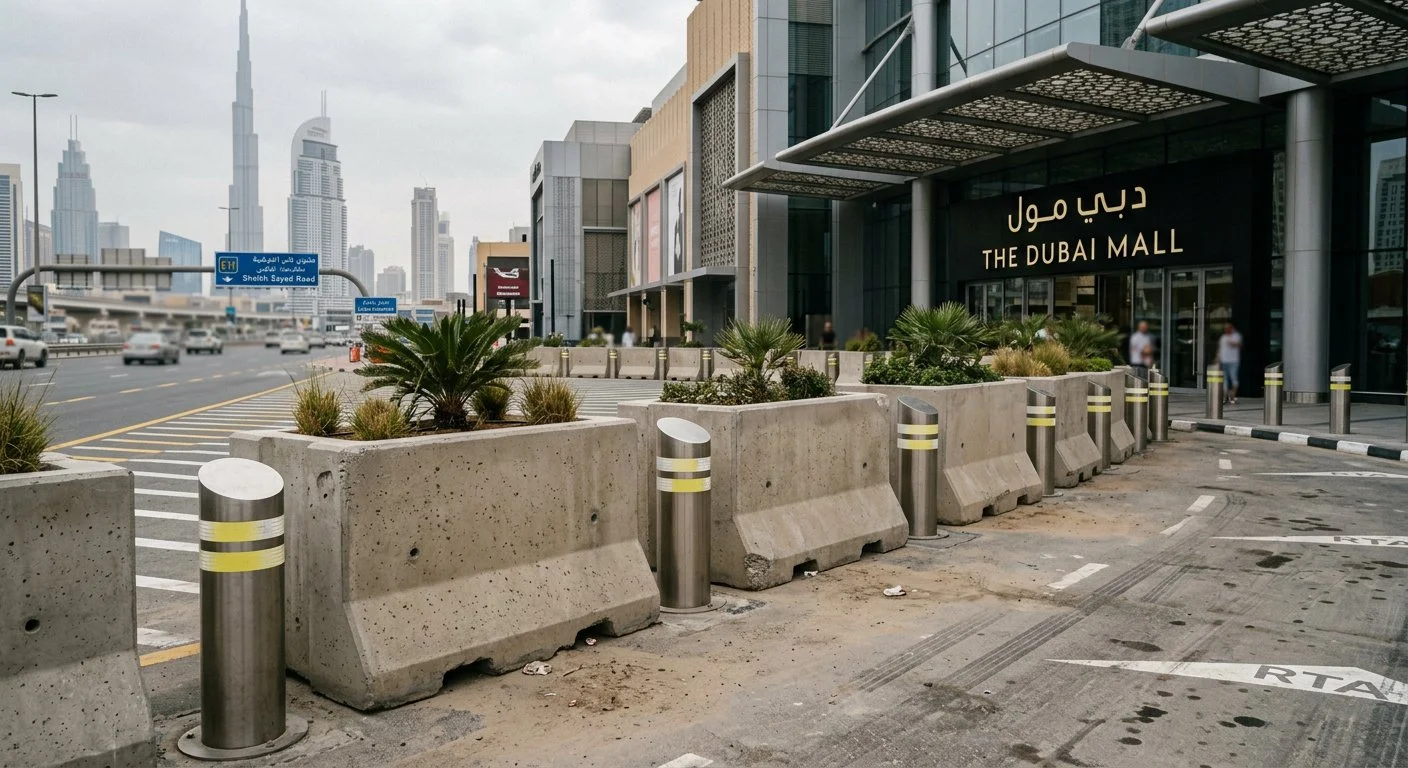
Depth only 300-500mm, with a huge 2500x1200mm base plate that spreads load. For Dubai Mall, Downtown, where you have 15 utilities in first meter. C60 concrete, heavy steel. Costs 40% more than deep mount but saves you AED 30k in utility diversions. SIRA likes them for retrofits.
3. Precast Anti-Ram Planter Barriers & Block Walls
1200mm high x 2500mm long reinforced blocks, 3.5-4.5 tons each, interlocked with steel dowels, C50 concrete, anti-climb top. For perimeters where you want aesthetics — Emirates Palace, mall entrances. Stops vehicle by sheer mass + friction. Need RBMA (Road and Bridge?) No. Need geotech friction coefficient ≥0.6. We place on 150mm lean concrete, not sand.
4. Wedge Barriers & Drop Arms (Active HVM)
Not precast, but often in same package. When you need vehicle checkpoint — port, airport. We coordinate civil foundation for them: 1200x1200x800mm C40 pit with drainage.
What we do NOT supply as anti-ram, despite market confusion: Single-side jersey, F-type, New Jersey with no crash test. Those are traffic, not security. If you need to understand that distinction clearly before you brief your consultant, our detailed guide on how to choose the right precast barrier for your project in the UAE breaks down traffic vs high-security decision tree.
Why Foundations Fail SIRA – The 1.2m Problem
90% of rejections are foundation, not barrier.
Standard RTA road foundation = 200mm granular, compact to 95% MDD. Anti-ram foundation = C40 lean + C50 structural + rebar cage + earthing + drainage weep hole. And you need to prove it.
We had a project in JAFZA where contractor used 800mm deep bollards. SIRA inspector asked: “Where is your utility survey GPR report? Where is your ETISALAT NOC for 1.2m depth?” No NOC, stop work order. Had to switch to shallow-mount at +AED 1,100 per bollard.
For any job inside Dubai, get DEWA, ETISALAT/du, and DCD utility NOCs BEFORE you order bollards. Shallow mount saves you.
This is same logic as precast pole foundations – your anchor is only as good as what it’s sitting on. For lighting we worry about wind overturning; for anti-ram we worry about a 7.5T truck at 80 km/h shear. Same discipline, different load.
Concrete Spec That Passes Dubai & Abu Dhabi
Forget C25. Real anti-ram precast that passes:
- Concrete: C50/60 minimum, SR cement for coastal/sabkha (Dubai Islands, Yas Island), w/c ≤0.40, 28-day cube ≥60 MPa, chloride <0.1%
- Steel: B500B, 40mm cover, double cage, anti-spall steel fibres 30kg/m3 optional (DCD loves fibres for post-crash integrity)
- Weight: 3.5 – 6 tons for planter/barrier unit, not 900kg. If supplier says anti-ram at 900kg, laugh.
- Test: Full-scale crash certificate, not FEA simulation. SIRA circular 2023 explicitly says “simulation not accepted as sole proof”.
We cure 7 days in yard, not 2 days on site. We publish cube results with every delivery — last time a consultant at Dubai South asked for 3rd party lab, we gave him GQS and MATtest reports same hour. He approved next day.
Dubai vs Abu Dhabi Approval Path – Different Headaches
Dubai: SIRA + DCD
For any commercial building with public access >1000 people, malls, hotels, high-rise podium. SIRA requires: crash certificate (ASTM/IWA), product data sheet, foundation design stamped by structural, method statement for installation + vehicle swept path analysis. DCD reviews as part of fire & life safety — anti-ram can’t block fire tender access (6m clear). Don’t place bollards 1m apart if DCD needs 4m clear for fire engine.
Abu Dhabi: Department of Municipalities + Abu Dhabi Police GHQ + ADM
ADM is stricter on aesthetics in Al Maryah, Corniche. They want planters, not ugly jerseys. Police GHQ asks for penetration <0.5m for government buildings. They also ask for factory audit — they’ve visited our yard in Jebel Ali twice.
RTA / DMT Areas
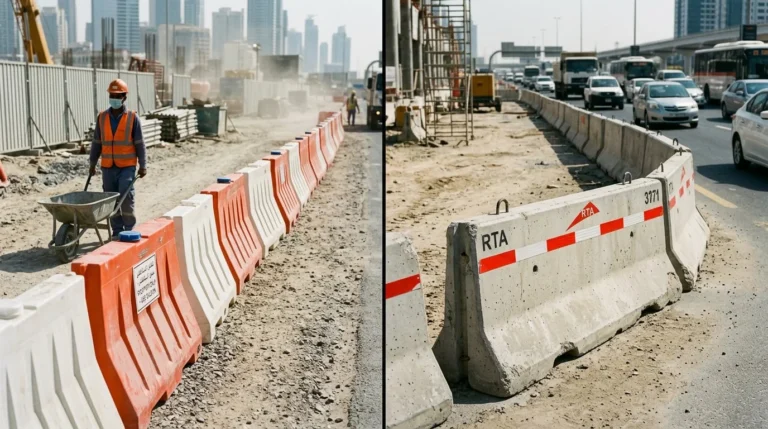
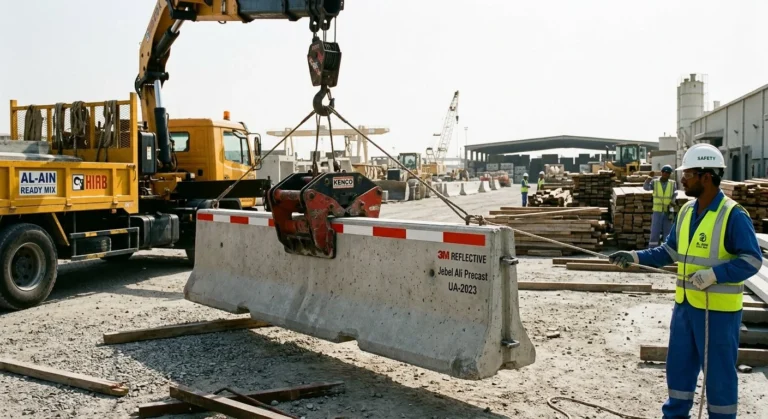
RTA doesn’t certify anti-ram, but if you place barriers within RTA ROW (Sheikh Zayed Road service road), you need RTA NOC + RTA compliant reflective tape (Class 2, 3M). Same regulations you follow for normal barriers, covered in our breakdown of municipality regulations for concrete barriers in Dubai and Abu Dhabi.
Key learning: Submit early. SIRA takes 14-21 days if docs complete, 60+ days if they query.
Cost Reality Check – 2026 UAE
Anti-ram is not commodity. Indicative ex-factory:
- Shallow-Mount Bollard (M50 P1 / K12 equivalent): AED 3,800 – 6,500 / unit (includes steel base, C60 block)
- Deep-Mount Bollard (M50 P1): AED 2,400 – 4,200 / unit + foundation concrete AED 800 – 1,200
- Precast Planter Barrier (2.5m x 1.2m x 1.0m, anti-ram mass): AED 4,500 – 7,800 / unit, 3.8 – 4.5 ton
- Heavy Anti-Ram Wall Block (1.5m high, interlocking): AED 5,500 – 9,500 / unit
Installation: AED 650 – 1,400 per bollard (excavation, compaction, crane, survey). Shallow mount cheaper on utilities but product cost higher — net similar.
Compare to standard traffic barriers? Not comparable. A standard 3m double side concrete barrier rental cost is AED 20/day. A single anti-ram bollard purchase is 200x that. That’s why rental model doesn’t exist for anti-ram.
For full project budgeting, many contractors package traffic barriers + anti-ram perimeters together. You can benchmark traffic barrier pricing from our precast concrete barrier prices in UAE 2026 guide — add anti-ram line separately, don’t average them.
Installation: No Saws, No Grinder
Crack? Replace.
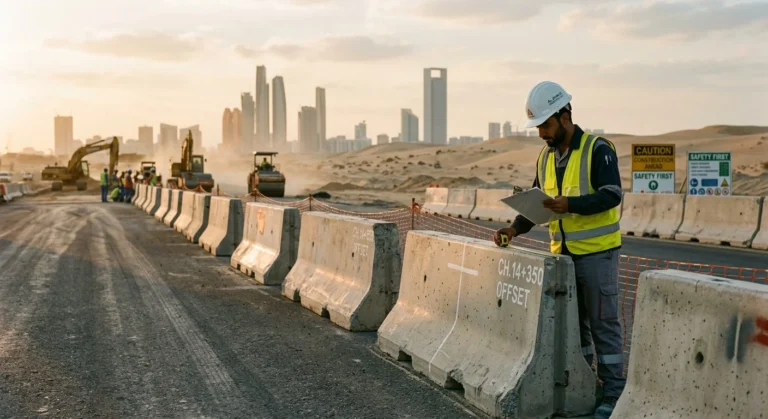
Step sequence our crews follow for SIRA-compliant install:
- GPR scan. Mark all utilities. Get ETISALAT supervisor on site if crossing.
- Saw cut asphalt 200mm wider than foundation. Don’t jackhammer first — you’ll crack adjacent asphalt.
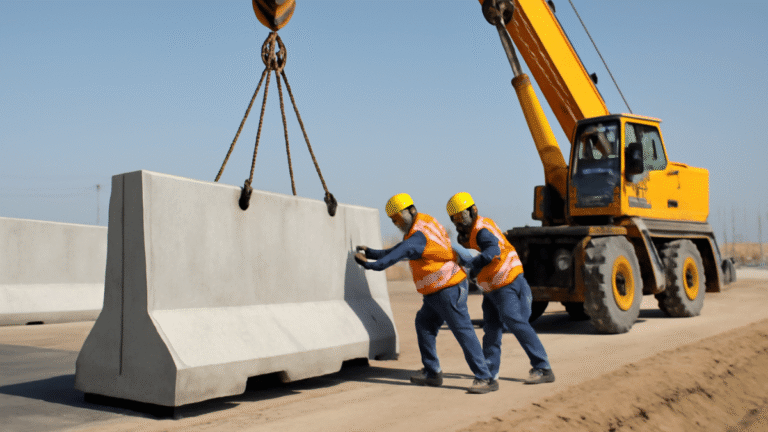
- Excavate, 150mm blinding C20, then rebar cage, then structural pour OR precast block drop.
- Survey plumb: tolerance 1:200. Bollard out-of-plumb looks terrible at a 5-star entrance.
- Backfill with CBR>20 material, compacted. Geotextile if high water table near Dubai Creek.
- Photos: foundation depth with tape, rebar cage, cube box, final plumb. SIRA inspector loves photos.
One mistake we see: Contractor paints bollard with normal road paint. Use polyurethane anti-carbonation paint, RAL as per consultant, with anti-UV. Cheap paint peels in 6 months of Dubai sun, client blames concrete.
Submittal Pack That Gets Approved First Time
For consultants reading this — package that passed SIRA last month for a mall in Motor City:
- Product: M50 P1 shallow bollard, IWA 14-1: V/7200/80/90:0.3
- Docs: MIRA crash video + certificate, factory test cert for C60 (MATtest), rebar mill cert B500B, foundation design calc (2 pages, stamped), installation method, NOCs.
- Drawings: GA + RC detail + utility section
Result: Conditional approval in 11 days. No queries.
If you need the factory pack for your project (crash video, cube reports, shop drawings), we share it NDA-free — most suppliers hide it because they don’t have it.
This is exactly where precast advantage we discussed in precast vs cast-in-place shows again — a yard-controlled product with lab papers beats site-poured security foundation that has no papers.
When to Use What — Quick Decision Matrix
- Entrance gate, vehicle checkpoint: Wedge barrier + deep bollards each side
- Mall perimeter, no digging allowed: Shallow-mount bollards @ 1.2m c/c
- Aesthetic perimeter, palace / hotel: Anti-ram planters with irrigation sleeve inside
- ADNOC substation, data center: Deep bollards @ 1.0m c/c + double-layer blocks behind
- Construction site temporary security: Standard precast barriers with temporary SIRA exemption — not anti-ram, but accepted for construction phase with 24/7 security guards (check SIRA temporary permit rules)
And always coordinate with surrounding infra — your precast concrete products like trench covers for cable crossing and pole foundations for lighting at the same perimeter must align with bollard spacing, or you’ll be core-cutting later.
Final Take From Yard
Don’t sell anti-ram on weight. Sell on certificate + foundation.
If your supplier can’t show you a real crash video with plate number, truck weight scale ticket, and lab name, it’s not anti-ram. It’s a heavy block painted yellow.
We keep 40No M50 P1 shallow bollards and 30No planter barriers in stock at Jebel Ali for urgent SIRA jobs — because we know DCD gives you approval on Thursday and wants site done Saturday before opening ceremony.
Need spec review, spacing layout, or SIRA doc pack? Send your site plan with utilities to our team via Arab Precast contact — we do marked-up layouts with swept paths FOC for projects > 20No, WhatsApp +971 58 660 9400.