Precast Trench Covers in UAE: Load Ratings, DEWA/RTA Specs & What Fails Inspection
We got a call from a contractor in Dubai Industrial City last March. 300 meters of DEWA cable trench done, covers on, asphalt done. DEWA inspector came for energization, jumped on one cover. Cover cracked. One more, cracked. They’d bought “light duty” covers from a block factory who said “it’s okay for internal road.”
It wasn’t. 150 covers had to be replaced, asphalt cut again, RTA fine for open trench on service road. AED 38,000 gone because someone saved AED 12 per cover.
Trench cover is the cheapest line item in your trench BOQ. It’s also the one that fails inspection fastest.
What a Trench Cover Actually Does (It’s Not Just a Lid)
In UAE infrastructure, precast trench cover does three jobs no one budgets for until it fails:
- Protects DEWA 11kV, Etisalat fiber, irrigation, and street light cables from a 12-ton truck that mounts the footpath
- Keeps workers and public from falling into a 900mm deep trench — DCD safety violation if open overnight
- Gives you access in 5 years when DEWA needs to pull extra cable, without breaking concrete
When you price precast foundations for lighting poles, you’re already in the same utility corridor. Most consultants now ask for a combined package — foundations + trench covers + cable markers — so your levels match and you don’t get a mismatch after backfill.
The Load Rating That Decides Everything — EN 124
This is where 80% of rejects happen. Your site engineer orders 100mm thick plain concrete slab because “trench is only 500mm wide.” RTA inspector asks for loading class. Silence.
UAE municipalities follow EN 124 load classes (DEWA spec 2024 still references it):
A15 (15kN ~ 1.5 ton): Pedestrian only. Villa garden, inside substation, not trafficable. 60-80mm thick, 150kg man can lift. If you put this on a footpath where a maintenance pickup can mount, it cracks.
B125 (12.5 ton): Footpath, park, light vehicle. Most Dubai villa community footpaths minimum. 80-100mm thick, reinforced.
C250 (25 ton): Kerbside, slow traffic, parking bay edge. RTA service roads minimum for trench crossing footpath to carriageway. 120mm+ with double mesh.
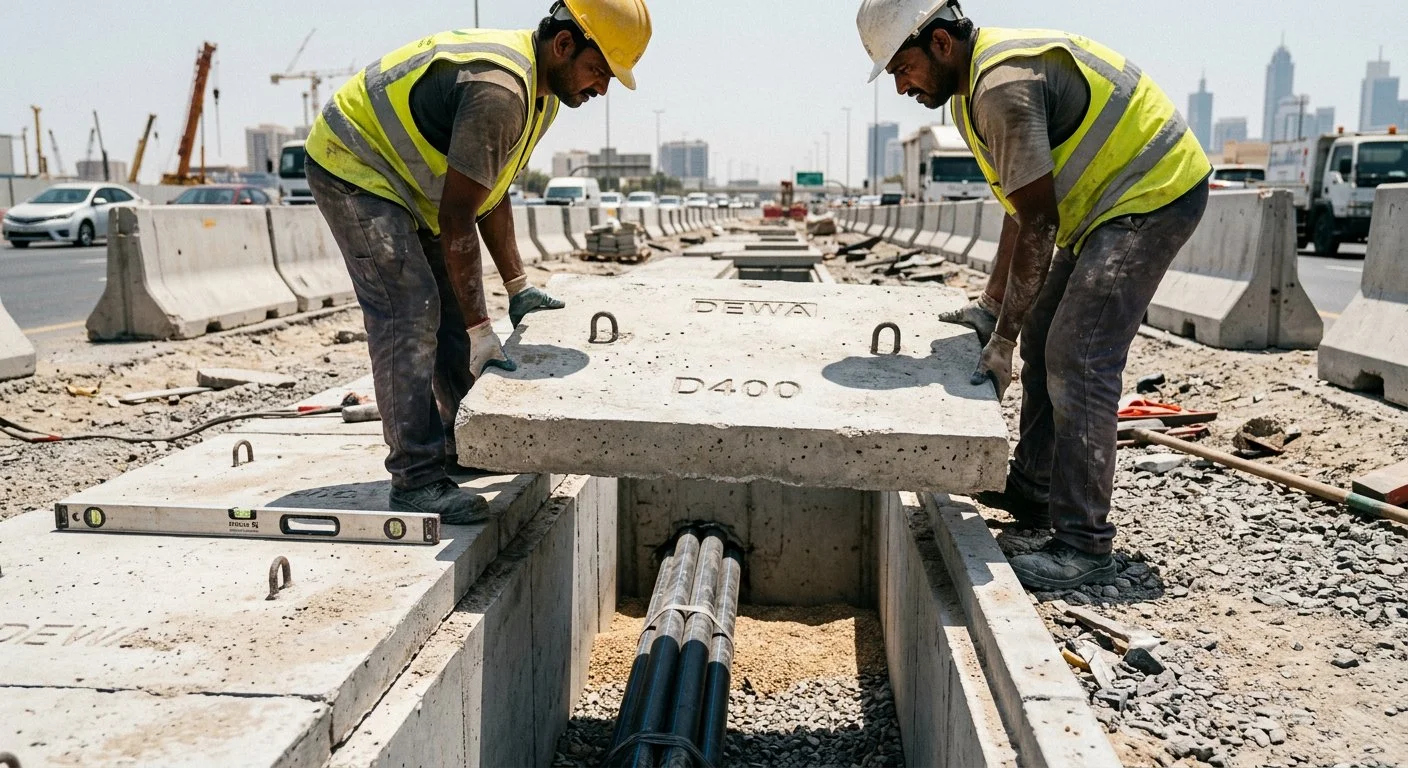
D400 (40 ton): Carriageway, main road, industrial area. The standard for Dubai South, JAFZA, Al Quoz industrial roads. This is what failed in DIC case — they used B125 where D400 was needed. 150mm-200mm thick, heavy reinforcement, weight 120-250kg.
E600 (60 ton) / F900 (90 ton): Ports, airports, ADNOC roads, dockyards. Special order, 250mm+, steel fibre + rebar.
Rule: If Google Maps shows a truck can physically drive over it — even once — spec minimum D400. RTA inspectors will.
Our standard catalogue you’ll find under our precast concrete products range keeps B125, C250, and D400 in stock 600mm, 800mm, and 1000mm widths because those three cover 95% of DEWA/RTA approvals.
DEWA vs RTA vs Etisalat — Same Trench, Different Cover
They all have trenches, they all want different things.
DEWA (Low Voltage / 11kV):
Asks for reinforced precast cover with engraved “DEWA – LT” or “DEWA – 11kV” on top, C40 minimum, 100mm bearing each side on trench wall, not sitting flush on cables. Requires 75mm clear space between cable and cover underside. They hate cast-in-situ covers because they can’t remove them without breaker.
RTA (Road Reserve):
For any trench inside RTA ROW — even 1m off Sheikh Zayed Road service road — you need D400 minimum and RTA NOC for material. They will ask for cube test + steel test. They also want skid-resistant finish, not smooth steel trowel that becomes ice when wet.
Etisalat / du:
Lighter — often B125 or C250 inside utility corridor, but wants lifting hook + duct markers. Their inspector checks that cover doesn’t pinch fiber ducts.
Drainage / Stormwater Trenches:
Not cable trench but often confused. Needs weep holes or slotted cover. Don’t use solid trench cover for storm channel — water pressure lifts it.
If you’re coordinating barriers, lighting foundations, and trenches on same corridor — say a new internal road in Al Warsan — sequence matters. Lay trench, place precast pole foundations for street lighting at design spacing, then set trench levels, then place covers, then install barriers at edge. One surveyor, one level datum. We’ve seen projects where trench covers were 30mm higher than pole foundation base — water pooled around pole.
Anatomy of a Cover That Passes Inspection
We cut open failed covers in yard to show new engineers what not to do.
Good precast trench cover in UAE has:
1. Concrete: C40/45 minimum, C50 near coast / sabkha. SR cement if chloride in ground >0.1%. Our yard uses 40 MPa at 7 days, not 28. Steam cured. No honeycomb under. If your supplier’s cover underside looks like Swiss cheese, voids hold water, rebar corrodes, spalls in 18 months in Jebel Ali.
2. Reinforcement: Not single layer of BRC. Double mesh B500B for D400, 30mm cover top and bottom. Some cheap factories use 6mm wire at 200mm spacing — bends if labourer drops it. We use minimum 8mm@100mm top, 10mm@100mm bottom for D400.
3. Bearing & Tolerance: Cover must sit on trench wall with 100mm bearing each side. Length = trench clear width + 200mm. Many order exact trench width — cover falls into trench. Tolerance ±3mm on width, not ±15mm. If gap >10mm, sand enters, cable silts.
4. Lifting: Two cast-in U-hooks or M12 threaded inserts, not exposed rebar bent over. Exposed rebar rusts, pops concrete. For 150kg+ covers, use lifting inserts rated 2.5x weight.
5. Marking: Cast-in lettering, not paint. “ELECTRIC – DEWA”, “STREET LIGHTING – RTA”, “ETISALAT”. Paint fades after one summer.
6. Bottom Finish: Flat, not bowed. Bowed cover rocks when truck passes — RTA fails for noise complaint.
This same yard control logic is why precast beats site-cast for everything in UAE heat. We covered it in detail in our comparison of precast vs cast-in-place concrete barriers — same 50°C problem, same cube test issues.
The 40°C Installation Mistake
Seems simple: put lid on trench. What fails:
Uneven trench wall: Cast your utility trench walls with proper shutter, or use precast U-troughs. If wall top is wavy ±20mm, cover rocks. Labour solution is to pack mortar under bearing. That mortar cracks first truck. Fix: Grind wall top or lay 10mm cement-sand bedding strip and let set 24h.
Wrong bearing: Cover overhangs trench by only 20mm each side. First E311 truck tyre hits edge, cover tips into trench, severs 11kV. Fix: enforce 100mm min.
No sequence: Contractor lays covers, then does backfill compaction near trench with heavy roller. Vibration moves wall, covers shift. Fix: Compact sides before placing cover.
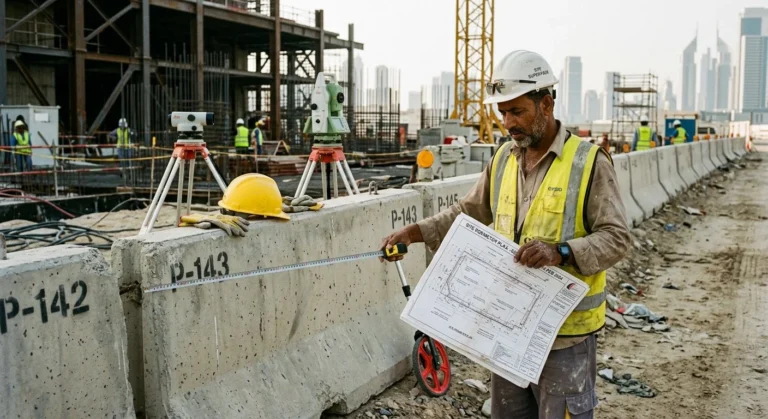
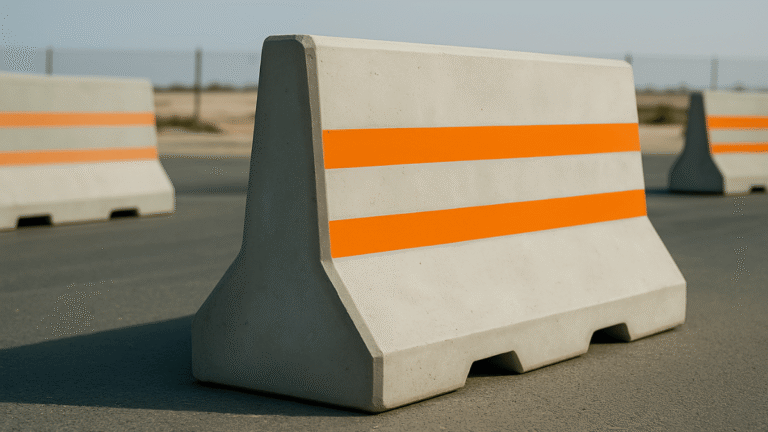
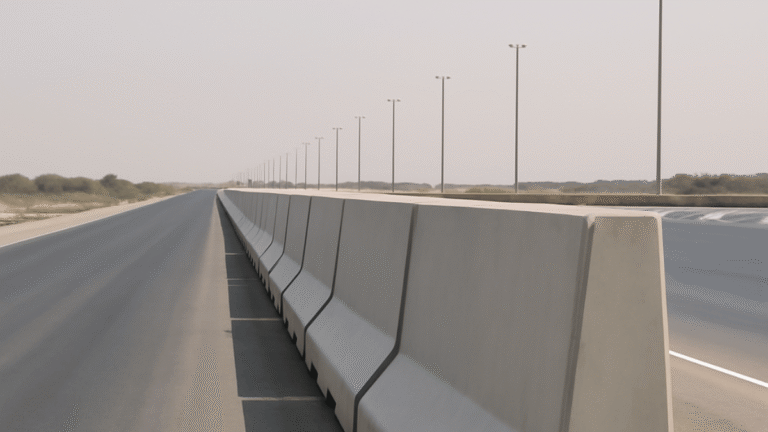
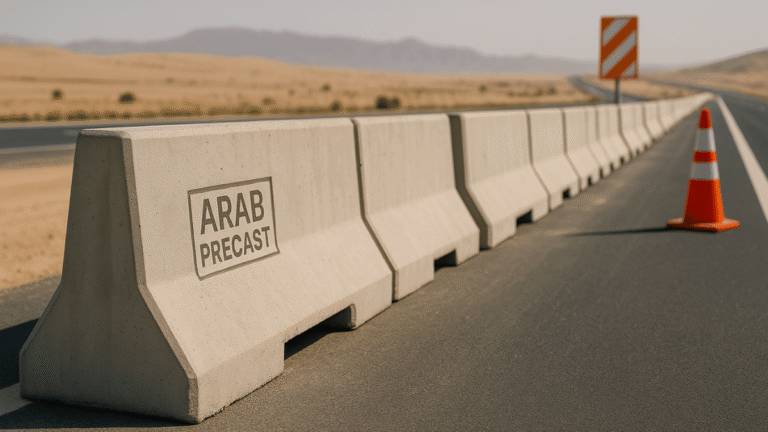
Safety during open trench: RTA requires precast concrete barriers or barricades around open excavation on live roads. We supply 1m temporary barriers for trench protection — many crews use traffic cones only, get fined.
For longer linear trenches, you can protect 200m stretch with rented barriers cheaper than buying — check current daily rates in our concrete barrier rental in UAE guide. It’s AED 15-25/day vs AED 900 fine per open trench per day.
Sizing Table We Use for Pricing (2026)
Standard clear trench width vs cover spec (most common):
- 400-600mm wide, footpath, pedestrian: B125, 80-100mm thick, 600-800mm long (manageable by 2 men), ~60-85kg, AED 45-75/unit
- 600-800mm wide, villa road, light traffic: C250, 120mm thick, 800-1000mm long, ~110-160kg, AED 95-145/unit
- 800-1000mm wide, service road, RTA ROW: D400, 150mm thick, 1000mm long, ~180-260kg, AED 160-240/unit
- 1000-1200mm wide, main road crossing: D400 Heavy, 180-200mm thick, 1000-1200mm long, ~280-380kg, needs crane, AED 250-380/unit
- 1200mm+ wide, chamber / culvert: E600 custom, 200-250mm, design specific, AED 450-750/unit
Custom engraving: +AED 10-15/unit
Lifting inserts stainless vs galvanized: +AED 8/unit
Delivery: 10-15 covers per pallet, 180-200 covers per 6m truck. From Jebel Ali to Abu Dhabi: AED 650-950/truck.
Bulk discounts same as barriers — 10% at 201+, 15% at 501+. Full pricing benchmarks for precast items are in our (updated) precast barrier prices UAE guide.
Checklist Before DEWA / RTA Trench Inspection
We give this laminated to foremen:
- Cube report ≥40 MPa, steel mill cert?
- Cover marking matches service (DEWA/ETISALAT) and load class embossed?
- Bearing 100mm each side, no rocking? Put foot on corner — does it rock?
- Top level flush with FRL ±5mm? Not protruding tripping hazard?
- Lifting hooks recessed, not protruding?
- Sand/debris inside trench cleaned before cover?
- Photos of bearing + level + marking?
- As-built trench route marked on site?
Pass rate with this: 95%. Without: 40%.
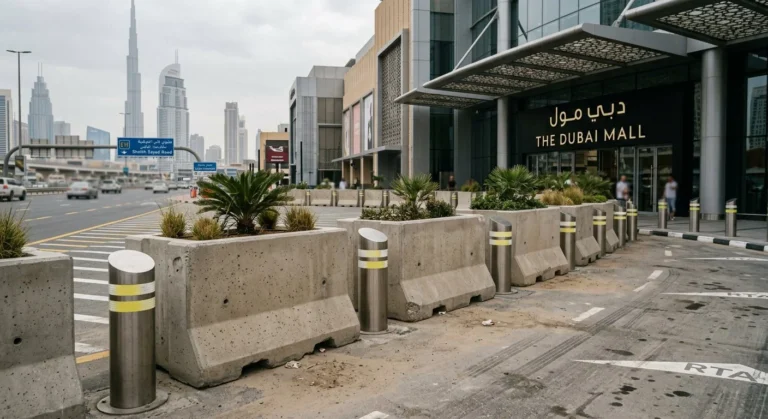
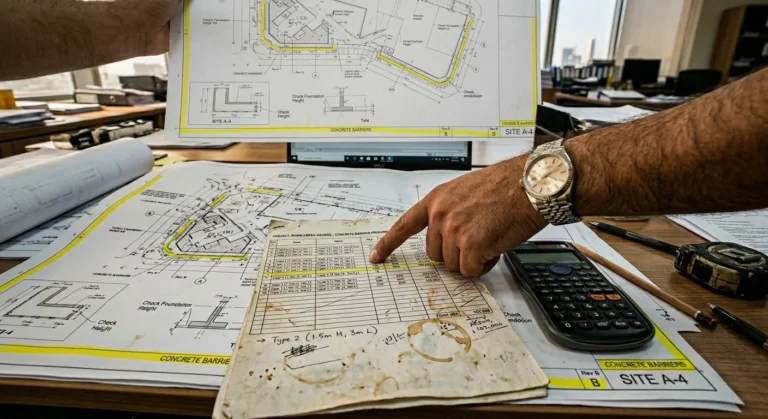
For projects needing full ROW safety package — trench covers + lighting foundations + barriers — get your levels coordinated early. Our engineers do free level cross-check if you share IFC sections, especially important when anti-ram lines run parallel to trench lines. See typical perimeter layout challenges in our guide to anti-ram security barriers.
When to Use Precast U-Trough + Cover vs Just Cover
If you’re still casting trench walls in-situ, consider switching to precast U-Trough (channel) + cover system. We supply as pair:
- U-Trough C40, 600-1200mm wide, 600-1000mm deep, with rebate for cover
- Guaranteed bearing, guaranteed width, installs 40m/day vs 10m/day in-situ
Cost higher by 15-20% on material, but saves 7-10 days on 500m trench because you skip shutter carpentry and curing. Also eliminates bearing issue entirely.
Contractors doing 2km+ infrastructure in Dubai South now order trough+cover as system, not just covers.
Final Word: Don’t Value-Engineer the Lid
Your client will never say “wow nice trench cover.” They will say “why is there a hole in footpath near Gate 3?”.
Spec D400 where any vehicle can go, C40 concrete minimum, proper bearing, and real reinforcement. Keep 5% spare on site — covers get damaged by excavator, not by load.
We keep B125, C250, D400 covers in 600/800/1000mm widths in stock at Jebel Ali for same-day load. Custom sizes 3-4 days with engraving.
Need load calculation for your trench width or DEWA submittal pack with cube reports? Send trench section + top finish (road/footpath) to our team via Arab Precast contact page — we size it and hold stock while you get NOC, WhatsApp +971 58 660 9400.