Precast Pole Foundations in UAE: The Spec Sheet They Don’t Hand You at DEWA Approval
If you’ve ever had a line of street light poles sitting on a flatbed in Al Quoz at 2 PM in July while you wait for your third cube test to hit 40 MPa, you already know why precast pole foundations exist.
Cast-in-situ sounds cheap on the BOQ. Until you factor in the carpenter who didn’t show, the slump that vanished between the batching plant on E611 and your site in Dubai South, the temple plate that moved 15mm when the labourer stepped on it, and the DEWA inspector who asks for your earthing pit right when you thought you were done.
We fabricate foundations every day at Arab Precast. This is what actually matters when you spec them in the UAE — not the brochure.
Why UAE Contractors Are Ditching Cast-In-Situ
Three things kill program here: heat, approvals, and rework.
At 48°C ambient, your C40 mix loses workability in 45 minutes. You vibrate it too much to get rid of bug holes, you get segregation. Too little, you get honeycombing at the cable entry and DCD fails you on visual inspection before he even checks the bolt template.
A precast foundation is cast in a controlled yard, steam-cured, with actual cover to steel (not 15mm because the spacer fell off). You get 50 MPa on day 7, not day 14. You also get something your consultant will actually approve: test cubes that match the piece you install.
The bigger win: you can trench, lay your HDPE duct, place the foundation, backfill, and call for RTA interim inspection on the same day. With cast-in-situ, you’re waiting 3-7 days minimum before you can even put a pole on it. For a 120-pole internal road in JAFZA, that’s two weeks of your program back.
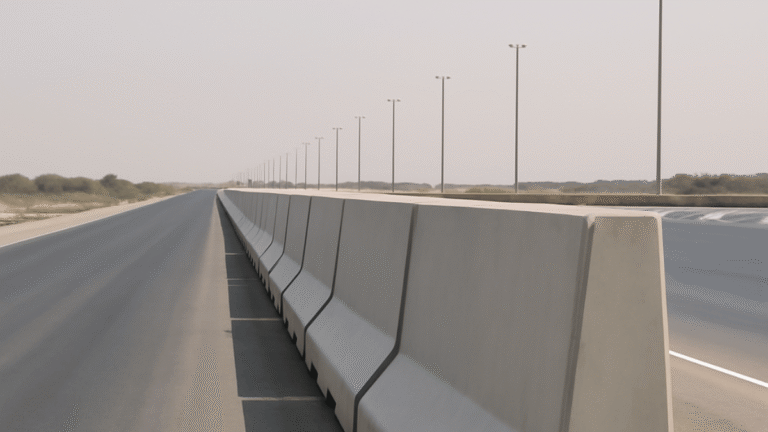
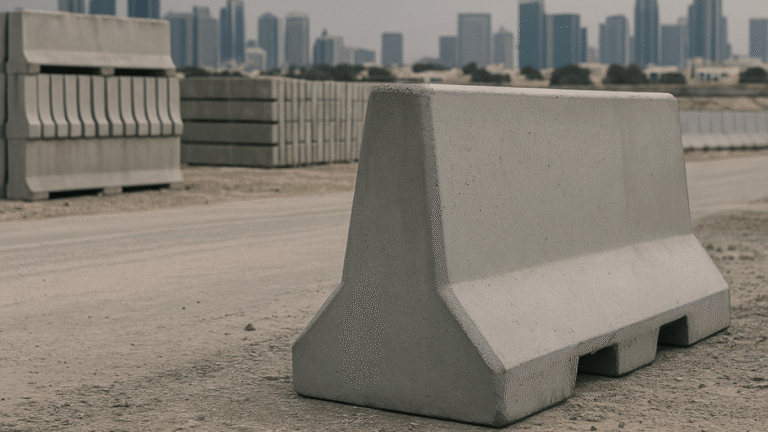
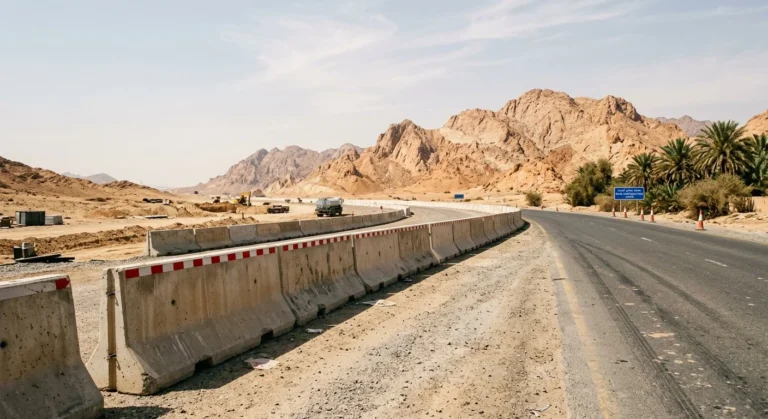
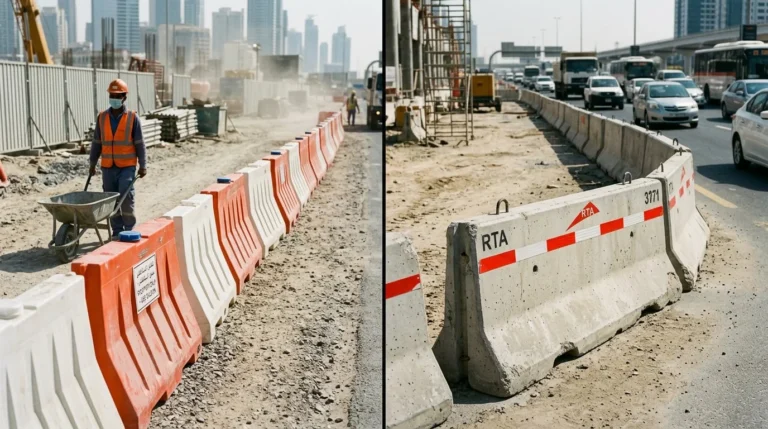
The logic is exactly the same reason precast barriers beat cast-in-place on linear infrastructure. We broke down that comparison for barriers in detail when we wrote about precast vs cast-in-place concrete barriers in the UAE — same curing issues, same labour headaches, same inspection risk.
Anatomy of a Proper Foundation Block — What to Demand
Not all blocks are blocks. A real UAE-spec foundation has five things you should check before it leaves the yard:
1. Concrete Grade That Means Something
C40 minimum for RTA/DMT. C45-C50 if you’re within 5km of the coast or in a sabkha area like Mussafah or parts of Al Warsan. We use C40/50 as standard with Type V sulfate-resistant cement where soil reports show high sulfates. Ask for the cube report. If they give you 25 MPa, walk away.
2. Reinforcement, Not Just Holder Bars
60-grade steel, double mesh cage, 40mm clear cover. Not four bars tack-welded to look like a cage. The cage resists transport loads and that moment when your excavator operator bumps it while backfilling.
3. Anchor Bolt Assembly With a Real Template
This is where most cheap suppliers fail. You need L-shaped or J-bolts (M24, M30, M36 depending on pole height) with a 10mm steel template plate that stays on during transport. Bolt circle tolerance: ±2mm. Not ±10mm. A 12-meter pole with a bolt circle off by 10mm will not plumb. Your surveyor with the total station will tell you at 6 PM, and you’ll be jackhammering at 7 PM.
We jig-weld every assembly. You can check plumb with a spirit level on the template before we load.
4. Cable Entry and Earthing
At least two 110mm HDPE duct entries, cast in at 90° to each other, with smooth bellmouths so your cable doesn’t shred. Plus a cast-in 25mm PVC sleeve for earthing rod. If they just core-drill after, you lose concrete section and you get water ingress.
5. Lifting Points
Two cast-in M16 lifting anchors or rebar loops rated for block weight x 2.5. Don’t let them drag it with chains around the bolts. It bends the bolts.
When you browse our full range in the precast concrete products catalogue, you’ll see we keep three standard sizes for street lighting and two heavy-duty sizes for traffic signals and CCTV — all with these details as standard, not extras.
Sizing It Right: Wind Load, Pole Height, and Sabkha Will Humble You
There’s no “one size for all poles” in the UAE. Dubai Municipality and DMT/ADQCC approvals both ask you to show calculations for overturning moment.
Rule of thumb we use for pre-tendering (must be validated by your structural engineer):
- 4m – 6m decorative pole (Al Quoz, villa community): 600x600x800mm block, M24 x 750mm bolts, 750kg
- 8m – 10m street light pole (internal roads, E311 service road): 800x800x1000mm block, M30 x 1000mm bolts, ~1.5 ton
- 12m – 15m main road / high mast base: 1000x1000x1200mm to 1200x1200x1500mm, M36 x 1200mm, 2.8 – 4.2 ton
- Traffic signal / CCTV / ANPR pole (RTA signalized intersection): 1000x1000x1200mm minimum, heavier because wind sail area of signal heads is huge
Add 20% size if your geotech report says sabkha, high water table, or backfilled ground. We’ve seen 800mm blocks in replaced fill near Dubai Creek Harbour rotate 3 degrees after first Shamal. The client saved AED 90 on concrete, spent AED 4,500 on re-excavation and realignment.
If your package also includes edge protection along the same road, most contractors combine both specs into one procurement. That’s where how to choose the right precast barrier for your project becomes useful — the same supplier can sequence barriers and foundations on one trailer and you avoid double delivery charges from DIP to Liwan.
The 50°C Problem — Why Curing in Yard Beats Site
Site-cast foundations in June-August have three enemies:
- Water evaporates faster than cement hydrates. You get plastic shrinkage cracks around the bolts. Inspector sees cracks, asks for core test.
- Your curing gunny sacks dry out by 11 AM because the water tanker went to another site.
- Night pour? Still 34°C.
In our yard, blocks are cast under shade, vibrated on table vibrators (not a poker vibrator held by a tired guy), and steam or water-cured for 7 days. The surface doesn’t have bug holes big enough to hold a dirham coin. RTA likes that.
Installation: Drop, Plumb, and Don’t Rush the Backfill
This is a 45-minute job if you do it right. It’s a full-day nightmare if you don’t.
Trench Prep: Excavate 200mm deeper than block depth. 150mm of 20mm aggregate or lean concrete blinding. Compact to 95% MDD. Lazy bedding = tilted pole. Tilted pole = luminaire aiming wrong and client rejection.
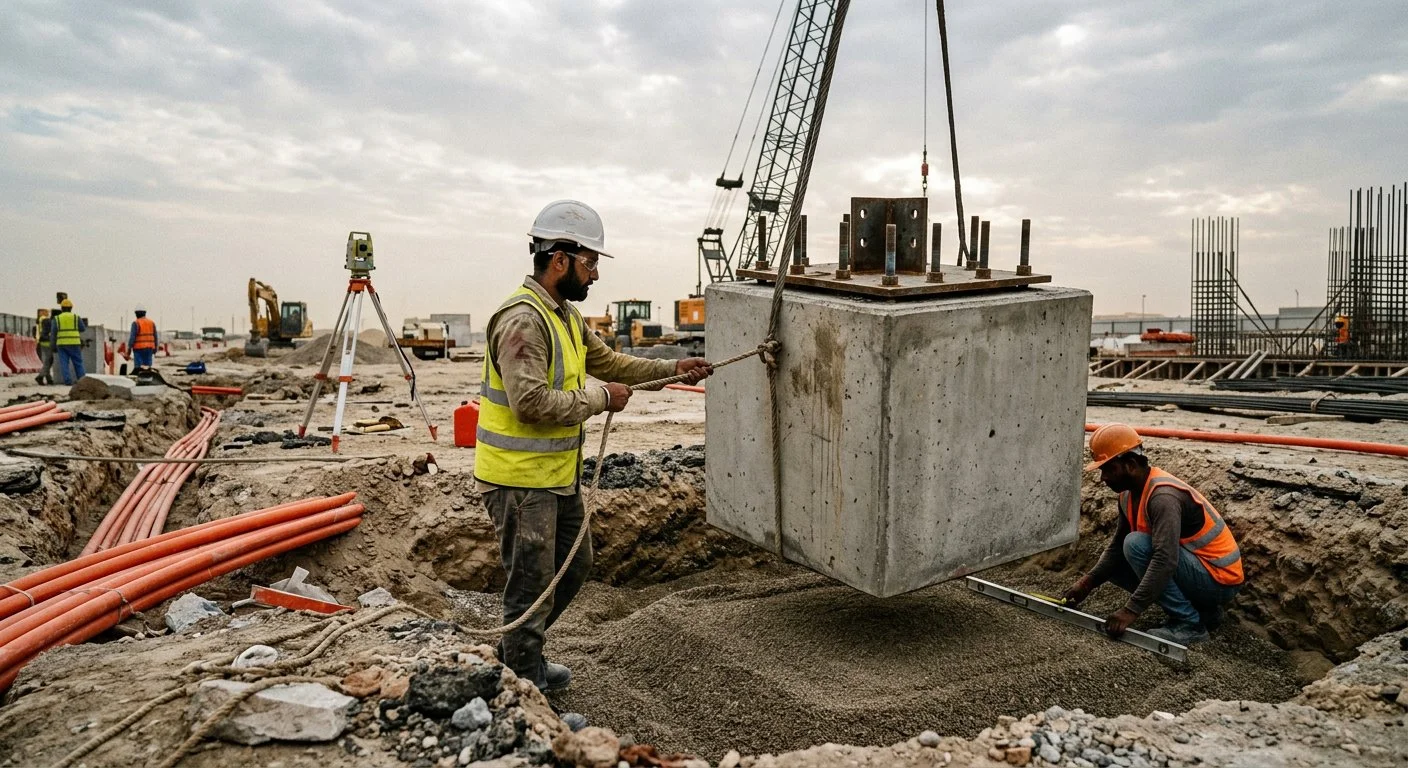
Drop: Crane or Hiab, not excavator bucket chains. Use the cast-in lifting anchors. Lower onto bedding. Don’t drop from 300mm “it will settle.” It won’t. It will crack bedding and sit 20mm low.
Plumb & Align: Put template plate back on. Total station on two faces. You want ≤1:200 verticality. Shim with steel shims, not stones and mortar chunks. Check bolt projection — 120mm above top nut is standard for double-nut leveling.
Ducts: Pull your string through HDPE before backfill. If string snags, duct is crushed. Fix now, not after asphalt.
Backfill: Approved granular material, 200mm layers, plate compactor, not excavator bucket tamping. No sabkha, no concrete debris. Water table high? Wrap geotextile before backfill.
Earthing: Drive rod through PVC sleeve. Get your DEWA earthing resistance ≤10 ohms before you leave. Don’t come back after landscaping.
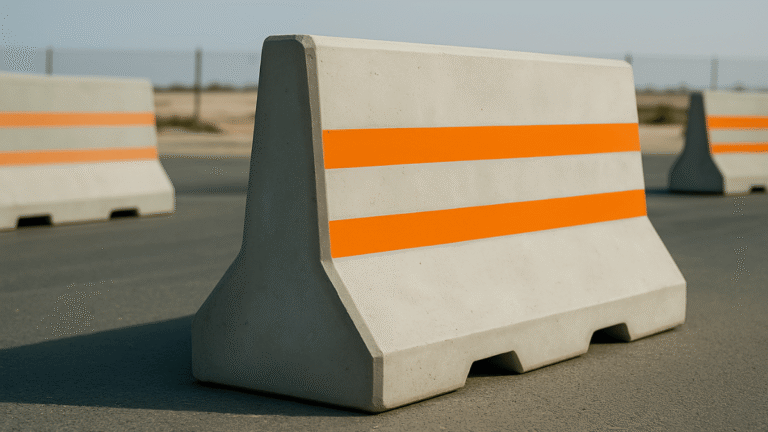
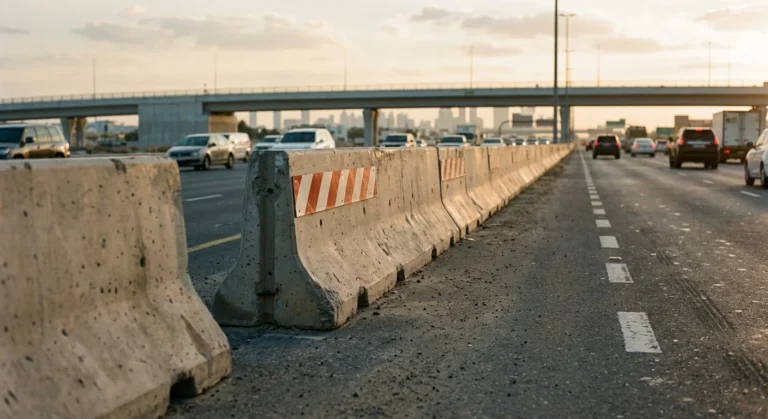
For roadside work on live carriageways, your biggest risk during this 45 minutes isn’t the foundation — it’s traffic. We always tell crews to set up precast concrete barriers around the excavation first, then drop the block. A jersey barrier 10m upstream with 3M reflective tape is cheaper than a labourer in hospital. If it’s a short-term job, renting makes more sense — you can price it quickly from our guide on concrete barrier rental in the UAE and keep it off your asset list.
The Failures We’ve Seen (So You Don’t Pay For Them)
Bolt Circle Off: Guy uses a wooden plywood template at site. Wood swells, bolts move. Now 4 poles don’t fit. Fix: Demand steel template that ships with block.
Duct Blocked: Labourer pours concrete and leaves timber shutter inside duct. You pull cable two weeks later, it’s stuck. Fix: End caps on ducts, mandated at our yard.
No Plumb: Eyeballed, not surveyed. After 12m, top is 150mm out. Fix: Survey before backfill. Costs AED 50 to check, AED 900 to re-do.
Wrong Concrete for Coast: C25 used near Jebel Ali. 18 months later, chloride attack, spalling at ground level. RTA asks for replacement under DLP. Fix: Always ask for minimum C40 with SR cement if soil Cl- >0.05%.
All of these are covered by municipality auditors under the same regulations that govern barriers and road furniture. If you haven’t read it, the municipality regulations for concrete barriers in Dubai and Abu Dhabi explains the inspection mindset inspectors bring — they apply the same checklist logic to foundations: marking, cube reports, cover, dimensional tolerance.
Cost & Program Reality Check — AED
Indicative 2026 ex-factory UAE pricing (excludes delivery, installation, and DEWA/RTA fees):
- 600x600x800mm (4-6m pole): AED 250 – 380 / unit
- 800x800x1000mm (8-10m pole): AED 450 – 650 / unit
- 1000x1000x1200mm (12m + signal/CCTV): AED 750 – 1,100 / unit
- 1200x1200x1500mm (high mast / heavy signage): AED 1,250 – 1,850 / unit
Template plate + nuts/washers: AED 85 – 150/set
HDPE ducts: included if specified at order, AED 25/m extra if you forget
Delivery: AED 400 – 900 per 6m truck (6-10 blocks depending on size) — Jebel Ali to Al Ain upcharge applies
Compare that to cast-in-situ: AED 180 – 300 in materials + 2 days labour + 3 days curing + risk of one rejection. On a 200+ pole project, precast is 18-22% cheaper on total installed cost when you count program.
We publish full barrier pricing ranges separately, but the same bulk logic applies here. You can benchmark current market numbers in our precast concrete barrier prices UAE 2026 guide — foundation pricing follows identical discount tiers: 5% at 51+ units, 10% at 201+, 15% at 501+.
Contractor’s 10-Point Checklist Before You Call the Inspector
- Cube report ≥40 MPa attached to delivery note?
- Steel template still tight on bolts, no bend?
- Two duct entries open and string-tested?
- Earth sleeve clear?
- Block bottom flat — no concrete burr leaving it rock?
- Excavation depth + blinding as per IFC?
- Block top level ±5mm from FRL (check before backfill, not after)?
- Bolt projection 120mm min?
- Backfill material approved, compacted in layers, test done?
- Photos: top with template, level on two sides, duct entries, compaction? RTA will ask.
Do these ten and your inspection passes in 10 minutes. Skip two and you’re there for two hours.
When You Need Something Non-Standard
Not everything is a street light. We get weekly requests for:
- Distribution pillar (FEWA/DEWA) bases with cable trenches
- Flagpole foundations (8m-20m, deeper moment connection)
- Sign gantry foundations (big moment, often 1500x1500x1800mm)
- Solar light pole foundations with battery box recess
If it’s a custom bolt pattern — say, a German lighting brand with 400mm PCD instead of standard 350mm — send us the pole data sheet early. We cut template on CNC same day. Don’t make the template on site.
Final Word: Buy the Foundation Like You Buy the Pole
A lot of contractors spend weeks vetting the pole supplier for wind load and lux levels, then buy the foundation from the cheapest block factory on the bid. Then the pole wobbles in February Shamal.
Treat it as structural, not as a lump of concrete. Ask for steel, concrete grade, template accuracy, and a real cure.
We keep standard sizes in stock at our Jebel Ali yard for same-day load-out. If you need 300+ units for an ADNOC or Emaar community, we can batch in 3-4 days including test certificates. Need help sizing for your soil report or matching your barrier package for a full road corridor? Send us the pole cut-sheet and location — we’ll size it and hold stock while your approvals come.
Get your specs and stock check via our contact team at Arab Precast — call or WhatsApp +971 58 660 9400, we answer with cube reports, not just prices.