
Concrete Barrier Reflectors in the UAE: How to Plan Visibility for Roadworks and Diversions
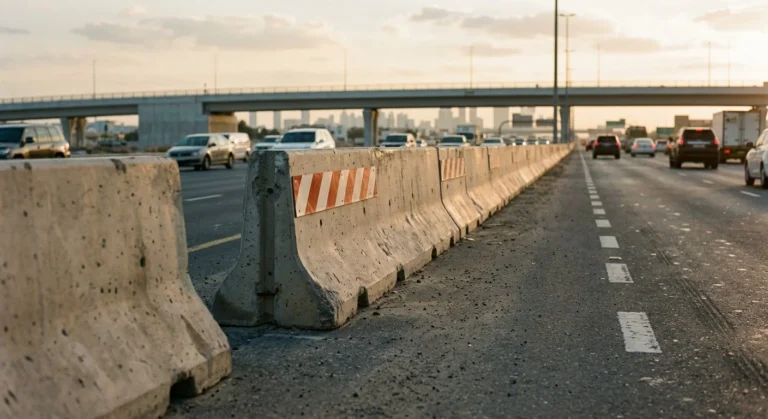
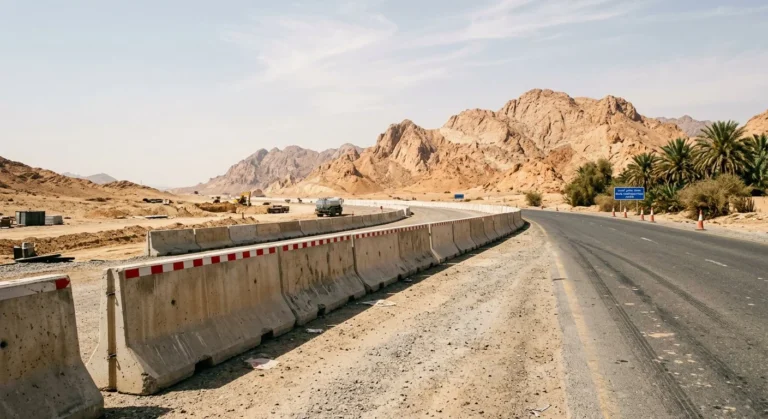
A concrete barrier may be structurally suitable for a work zone and still be difficult to recognise at night. Dust, poor lighting, changing lane alignment and the glare of approaching headlights can all affect how clearly a driver sees the edge of a diversion.
Reflectors and other delineation devices help communicate the alignment of a barrier line. They are not a replacement for a suitable barrier system, an approved traffic diversion plan or the correct treatment of an exposed barrier end.
For UAE contractors, the practical starting point is the project-specific traffic management design. The relevant road authority, current manual, permit conditions and approved drawings determine the required devices, colours, placement and maintenance arrangements.
What does barrier delineation do?
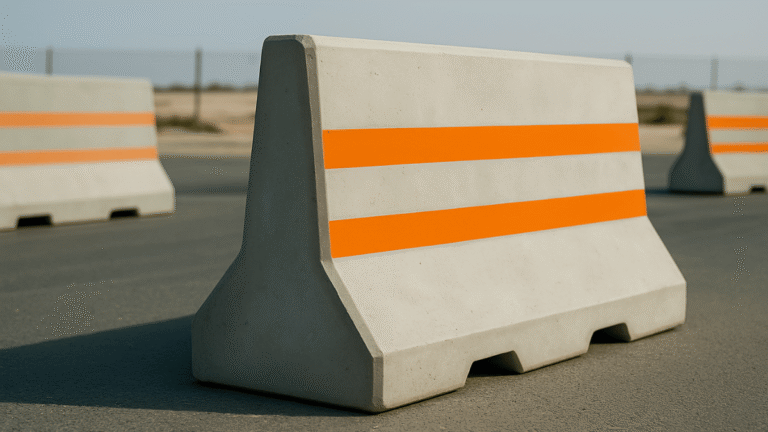
Delineation makes the route and the position of an obstruction easier to perceive. Depending on the approved design, it may use retroreflective sheeting, purpose-made reflectors or delineators, signs, lamps, road markings and other devices.
A retroreflective element returns some incoming light towards its source, helping drivers see it under headlights. A surface may look bright in daylight without providing equivalent visibility after dark. Similarly, a dirty reflector or one positioned at an unsuitable angle may not perform as intended.
Delineation should be considered as a continuous driver experience: approach warning, transition into the diversion, the barrier line itself and the exit back to normal traffic. It should not be treated as an isolated tape purchase. The overview of concrete road barriers provides context on barrier selection; the approved traffic design remains the basis for the actual layout.
Visibility is not impact protection
| Item | Main function | What it does not establish |
|---|---|---|
| Concrete barrier system | Provides physical separation or restraint when designed and installed for the intended application | A particular impact rating cannot be inferred from shape, mass or colour alone. |
| Reflective tape or barrier-mounted delineator | Helps drivers perceive the barrier or road alignment | It does not make a barrier crash-tested or strengthen its connections. |
| Warning signs and road markings | Communicate the approaching change and guide movement | They do not replace the approved barrier or end treatment. |
| End terminal or crash cushion | Addresses the exposed approach end where specified | It must be suitable for the approved system and design conditions. |
| Work-zone lighting | Supports visibility where required by the traffic design | It must not create misleading glare or replace required retroreflective devices. |
The choice of barrier profile and complete system should be reviewed separately from the visibility package.
What does the Dubai RTA require?
The RTA’s published traffic-diversion drawing checklist directs applicants to the Work Zone Traffic Management Manual and requires drawings to show the relevant safety arrangements. Its minor-road diversion service also calls for a detailed layout showing existing conditions, the proposed diversion and safety measures in accordance with the approved manual.
Those documents do not establish one universally applicable tape colour, width, spacing or reflective grade for every road and every barrier. Obtain the current manual and project conditions, then confirm the details with the responsible traffic designer and authority before ordering or installing materials. Other emirates, private developments and federal-road interfaces may have different requirements. Projects outside Dubai can start by identifying the relevant road owner through the Northern Emirates barrier planning guide or the Abu Dhabi diversion guide, then verify current conditions directly with the authority.
The distinction between a supplier’s generic product description and an approved project requirement is particularly important. “High visibility” and “RTA compliant” are not substitutes for the exact product specification, location and approval applicable to the work.
What should be shown on the approved plan?
| Plan element | Contractor’s check before procurement |
|---|---|
| Barrier alignment and traffic direction | Identify each traffic-facing side, curves, transitions and changes between phases. |
| Reflective device type | Confirm whether the design calls for sheeting, mounted delineators or another approved device. |
| Colour and reflective performance | Obtain the exact project specification, classification and evidence required by the authority. |
| Locations and spacing | Use the approved drawing and current manual; check special conditions at curves and transitions. |
| End treatments and approach warnings | Confirm the specified terminal or crash cushion and its interface with the barrier line. |
| Inspection and maintenance | Identify responsibility for cleaning, replacement and checking the completed work zone. |
Where a drawing is silent, raise a technical query. Do not fill the gap by copying a tape pattern from an unrelated project. Quantities of concrete units can be developed separately using the barrier quantity takeoff guide, with the final count checked against each approved phase.
Select materials for the actual application
Check the surface and installation instructions
Concrete surfaces should be assessed and prepared in accordance with the reflective material manufacturer’s instructions. Dust, moisture, curing compounds, old paint and deteriorated surfaces can affect adhesion. Confirm acceptable substrate condition, surface temperature, cleaning method and any primer or curing time before application.
Check attachment details
A barrier-mounted delineator may require an adhesive, clamp or other fixing. Do not drill into a barrier, modify reinforcement or alter a tested system without the designer’s and supplier’s approval. A fixing method that works for one product or concrete surface is not necessarily suitable for another.
Check viewing direction
Confirm whether the device is intended for one or both directions of traffic, its mounting orientation and visibility along curves. Keep the arrangement consistent with the approved drawing rather than assuming that a reflector facing one direction is visible from the opposite carriageway.
Check durability and documentation
Ask for the product data sheet, relevant performance evidence, installation instructions and expected maintenance requirements. Confirm that proposed materials meet the specification identified by the traffic designer; do not rely on brand name alone.
A practical night-visibility inspection
A visual review should be planned as a controlled activity. Never walk into live traffic or stop a vehicle in an unsafe location to check a barrier. Follow the approved traffic-management and inspection procedure.
| Inspection point | What to look for | Typical action |
|---|---|---|
| Approach | Warning and transition devices are visible and unobstructed | Escalate missing or obscured devices under the traffic plan. |
| Barrier line | Devices are present, oriented correctly and consistent with the drawing | Correct missing, detached or incorrectly oriented items. |
| Surface condition | Dust, damage, peeling or poor adhesion | Clean or replace using the manufacturer’s approved method. |
| Curves and lane shifts | The intended route remains clear to approaching drivers | Refer visibility concerns to the traffic designer. |
| Exposed ends | Specified end treatment and associated markings are present | Protect the area and notify the responsible traffic team immediately. |
| Temporary changes | Devices have not been lost during phase changes or barrier relocation | Update and inspect against the current approved phase. |
Define inspection frequency in the project plan, including additional checks after a collision, sandstorm, severe weather, relocation or public complaint. Document the location, time, defect, responsible person and close-out.
Common mistakes to avoid
Treating paint and retroreflectivity as the same thing. Paint colour can aid daytime contrast, but it does not automatically meet a retroreflective material specification.
Applying tape before confirming the design. Reworking an entire barrier line is costly if the approved placement or product is different.
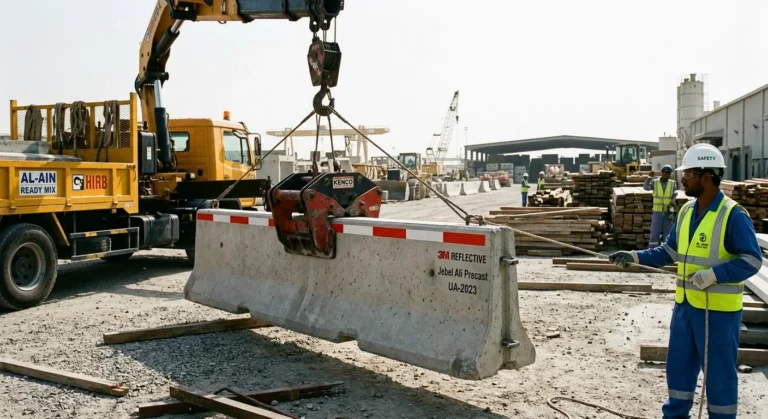
Covering identification or connection points. Keep required product markings, lifting details and connection interfaces accessible, subject to the approved layout.
Changing the system during a phase shift without a review. A barrier that previously faced traffic on one side may need different delineation when the traffic direction changes.
Ignoring the barrier end. A reflective marker does not substitute for the end treatment required by the traffic design.
For the installation sequence and site controls, refer to the concrete barrier installation guide. Always follow the actual approved project method statement.
Frequently asked questions
Is reflective tape mandatory on every concrete barrier in the UAE?
Requirements depend on the authority, project, road environment and approved traffic management design. Confirm the required form of delineation and the applicable specification rather than assuming a single rule applies everywhere.
Can a contractor choose any reflective colour?
No. The traffic designer should identify the colour and arrangement required by the governing manual and approved drawings. A colour used on another site is not evidence of approval for your project.
Does a reflector make a barrier crash-rated?
No. Crash performance relates to the complete barrier system, its installation and supporting evidence. Reflectors address visibility.
Who is responsible for maintenance?
Responsibilities should be assigned in the contract, permit and traffic-management arrangements. The site team should know who inspects, replaces and records defective devices.
For barrier supply enquiries, review the precast concrete barrier range and contact Arab Precast with the approved layout, quantities, site location and the technical documentation required. Confirm whether the requested visibility components are included in the quotation.