Concrete Barrier Rules in Sharjah, Ajman, RAK and Fujairah: A 2026 Compliance Guide
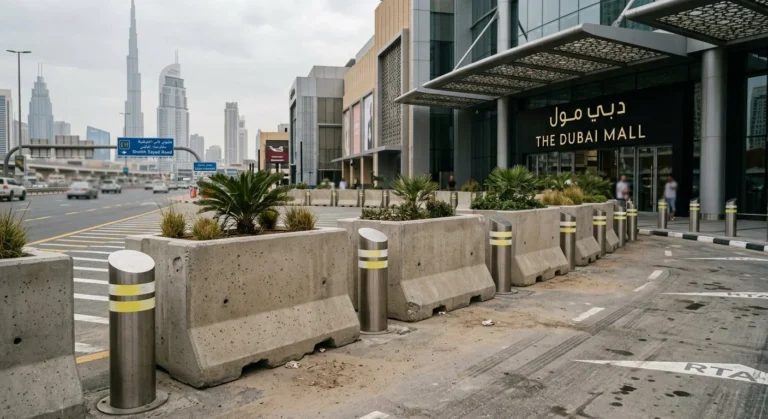
An approval from one emirate does not transfer to another. Contractors working across the Northern Emirates regularly discover this after placing a barrier run on the basis of a Dubai approval, only to be asked to submit a fresh application to the local authority. In most cases the installation itself is compliant; it is the process that was not followed.
This guide summarises how barrier and roadworks approvals work across Sharjah, Ajman, Ras Al Khaimah, Fujairah and Umm Al Quwain, the technical requirements that carry across all five, and the delivery planning that Northern Emirates projects require.
The Principle That Applies Across All Emirates
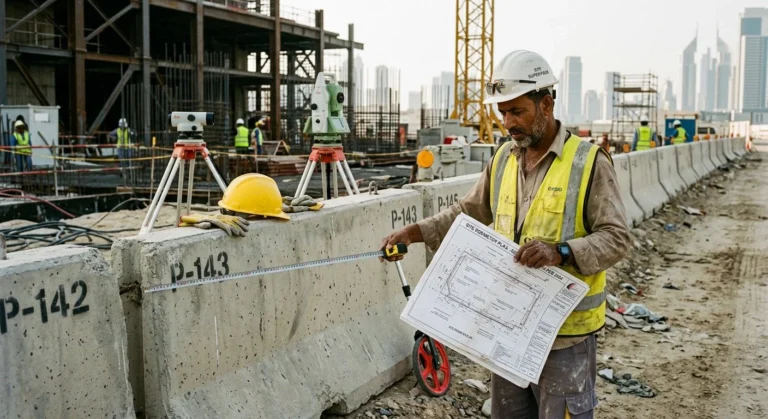
The technical requirements for barrier units are consistent across the UAE. A barrier cast to C40/50 concrete with Grade 60 reinforcement, correct profile for the road speed, clean finish and manufacturer identification satisfies the material requirements in every emirate.
What changes between emirates is the approval authority, the application process, the documents required and the review time. Treat the approval as a separate work package for each emirate, and allow the review period in the programme rather than discovering it at mobilisation.
Sharjah
Sharjah roadworks operate under the Roads and Transport Authority of Sharjah for works within the road corridor, alongside Sharjah Municipality requirements for site-level matters.
Works within the right of way. The SRTA process for construction works within the road corridor covers elements including pedestrian facilities, entrances and exits, and side works. The published service standard indicates a processing period in the region of seven working days, subject to a complete submission.
Documents typically required. The application package generally includes a valid plot map, colour photographs of the site, a valid trade licence, the construction permit, and, for entrance and access works, plans approved by the relevant planning or municipal authority, together with the identification of the applicant or site person in charge.
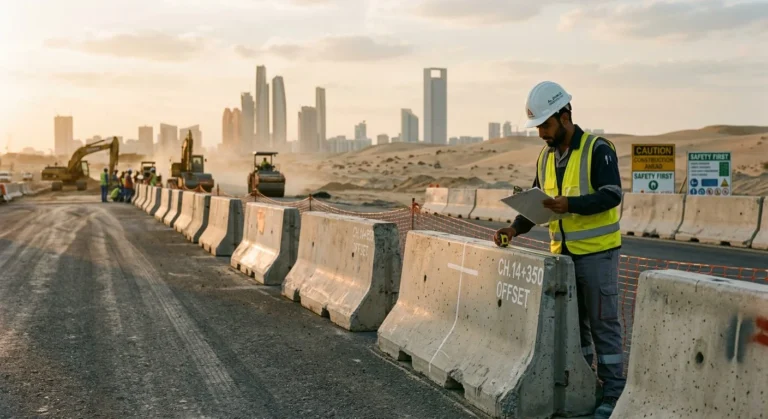
Practical points for barriers. Barrier runs proposed within the corridor should appear in the traffic management plan with the taper, buffer and end treatment shown, in the same manner as Dubai submissions. For works in the industrial areas, the plan should also account for heavy vehicle access, because access points used by trucks cannot be closed by the barrier run.
Site-level matters. For internal site works and boundary protection that do not affect the public corridor, the municipality framework applies. Visual quality matters in the emirate; finished edges, clean surfaces and consistent marking are applied as review criteria in urban areas.
Ajman
Ajman follows a similar structure, with the municipality handling site and urban matters and road corridor works coordinated with the local roads authority.
For barrier projects in Ajman, three points recur in practice. Registration of the contractor and the supplier with the local system assists with faster processing. Barrier specifications that meet RTA standards are generally accepted in technical terms, with local review of placement and permits. Where a project touches a main road, the traffic management plan is the controlling document and should be submitted with the permit application rather than after it.
Contractors frequently move between Ajman and Sharjah projects and assume that a submission prepared for one will be accepted by the other. The technical content will be similar, but the submission is separate.
Ras Al Khaimah
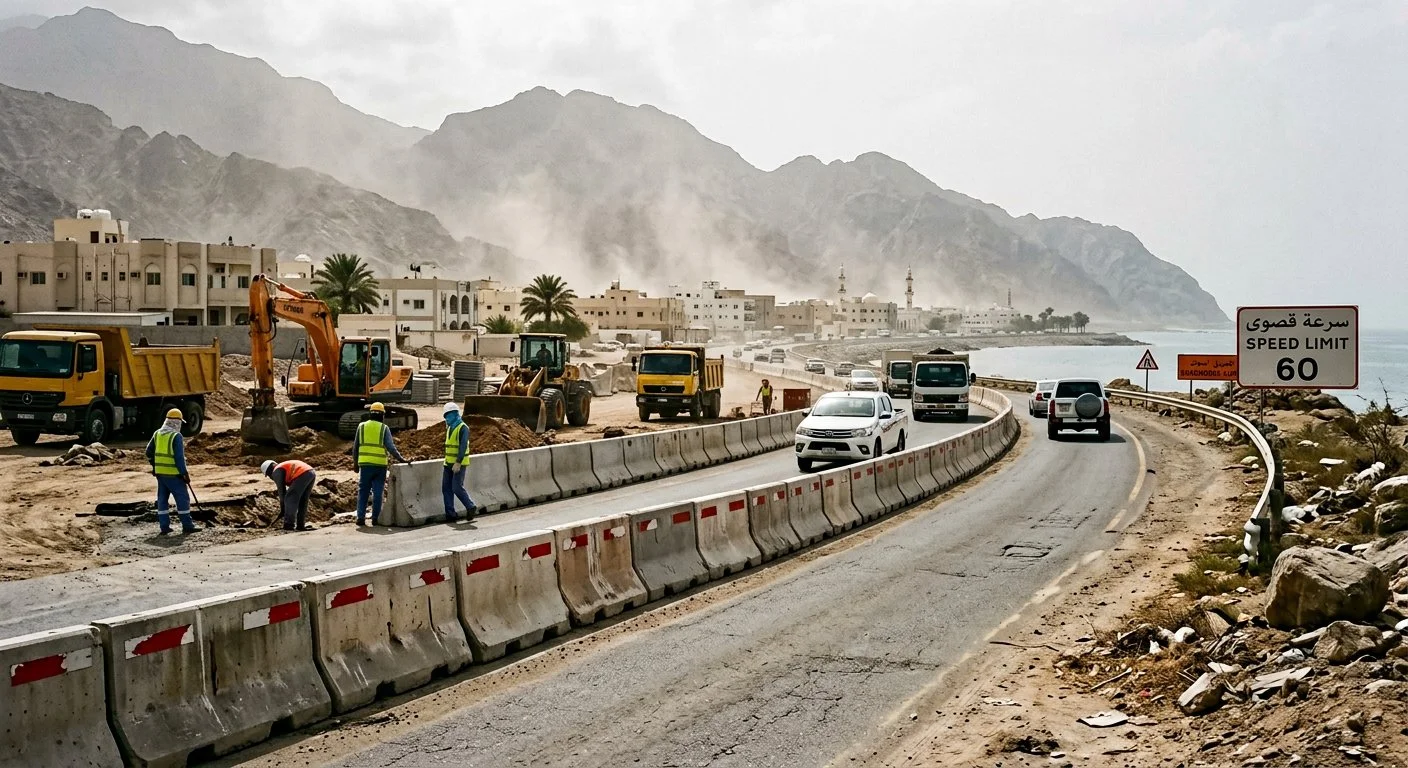
Ras Al Khaimah presents two distinct environments. The urban and coastal developments, including the island and waterfront areas, operate with staged barrier planning typical of urban works. The mountain roads and northern interior operate in conditions closer to Fujairah, with terrain and weather effects on installation.
For urban works in RAK, the practical requirements follow the same principles as Ajman and Sharjah: approved plan, correct profile for the road speed, reflective markings on road-facing runs, and documented material quality. Coastal areas within the emirate should use concrete grades suited to a saline environment, typically C50 with a sulfate-resisting cement.
For mountain and interior works, the additional considerations are access and stability. Access roads on gradients limit the size of the delivery vehicle and the lifting plant that can reach the site. Verify the route with the hauler before dispatch rather than after arrival, and where the site cannot receive a Hiab, arrange for the unit to be placed with site plant.
Fujairah
Fujairah combines a coastal strip with mountain access, and the barrier requirements reflect both.
Coastal works. Salt exposure along the coastal roads is higher than in Dubai, and a C50 mix with appropriate cement is the correct specification for any run intended to remain in place beyond a temporary period. The visible quality of the finish also draws scrutiny, because these roads carry tourism traffic and the barrier line is part of the streetscape.
Mountain works. Sections of the mountain roads experience fog and mist, particularly in the winter months and early mornings. The practical consequence is that reflective markings, and in some locations additional delineation, carry more weight in the inspection than on flat urban roads. The markings should be clean and in good condition at the time of placement, not revisited later.
Access. Gradients and bends on mountain access routes restrict both the delivery vehicle and the lifting plant. Confirm the vehicle route, the turning circles at the site entrance, and the lifting method before ordering, since re-sequencing a delivery after it has left the yard is costly.
Umm Al Quwain
Umm Al Quwain operates a comparatively straightforward process for standard works. RTA-compliant barrier designs with correct documentation are generally accepted, and the municipality handles site-level matters. As with the other northern emirates, the submission is separate from any other emirate’s approval, and the traffic management plan should accompany the permit application.
Technical Requirements Common to All Five Emirates
| Requirement | Standard Practice Across the Northern Emirates |
|---|---|
| Concrete strength | C40 minimum reinforced; C50 with sulfate-resisting cement for coastal and sabkha conditions |
| Reinforcement | Grade 60 steel, documented in the mix and reinforcement records |
| Profile | Matched to road speed; high-speed works on main roads use the safety shape profile |
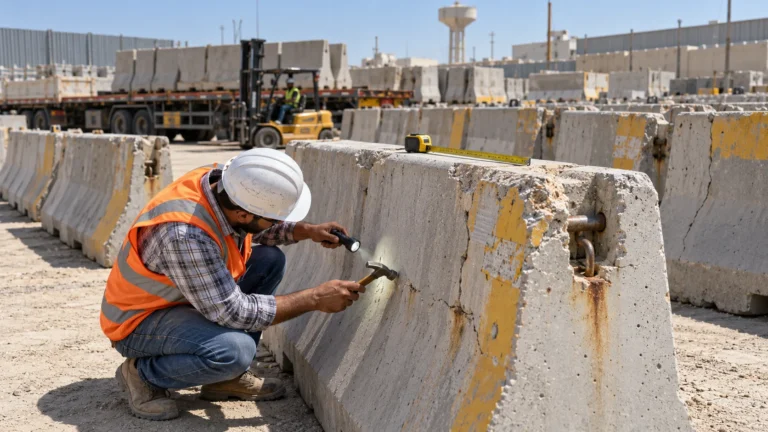
| Finish | Clean, sound surface with no cracking, honeycombing or spalling |
| Markings | Reflective markings on road-facing runs, fitted at the correct height |
| Identification | Supplier name and batch reference on each unit |
| Lifting points | Cast-in anchors or forklift recesses |
| Documentation | Mix design, strength reports, delivery notes, approved plan |
The material and documentation framework is described in full in our municipality regulations guide for Dubai and Abu Dhabi; the northern emirates apply the same technical standards with local process.
Delivery Planning for Northern Emirates Projects
Distances from our Jebel Ali facility to the northern emirates affect cost more than unit price does.
| Destination | Approximate Road Time | Planning Notes |
|---|---|---|
| Sharjah industrial areas | 45 to 60 minutes | Multiple drops can be combined in one shift |
| Ajman | 1 hour to 1 hour 15 minutes | Schedule outside peak commuter periods |
| Umm Al Quwain | 1 hour 15 minutes to 1 hour 30 minutes | Confirm site access for the delivery vehicle |
| Ras Al Khaimah | 1 hour 45 minutes to 2 hours 15 minutes | Plan clustered loads; verify mountain access separately |
| Fujairah | 2 hours 15 minutes to 2 hours 45 minutes | Verify both the route and the lifting arrangement in advance |
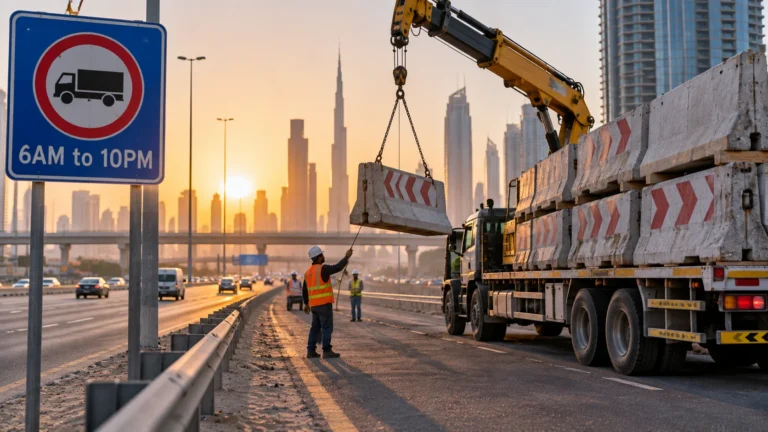
Two planning rules apply. First, cluster loads so that the full requirement arrives in consecutive trucks rather than in repeat single trips. Second, align delivery with the permit start, since a run placed before the window opens exposes the contractor to penalties regardless of the emirate.
Delivery scheduling and the current movement restrictions affecting loads departing Dubai are covered in our guide to the 2026 truck movement restrictions and barrier delivery.
What Northern Emirates Inspectors Look For
The inspection focus across the northern emirates mirrors Dubai’s in substance, with some local emphasis.
- The approved plan compared against the installed run, including profile and position
- Joint connections in place, with joints closed
- Reflective markings clean, correctly positioned and correctly oriented
- The flare and buffer at traffic-facing ends
- Surface condition: no cracking, no impact damage, no visible repair that affects marking adhesion
- Documentation for the supplied units available on request
The failure points that generate penalties in Dubai apply equally here. They are set out in our review of the most common RTA compliance failures, and the sequence that avoids them is described in our installation method statement guide.
Frequently Asked Questions
Do I need a separate approval for each emirate?
Yes. Each emirate operates its own approval process and its own submission. Technical documentation prepared for one emirate is generally useful for the others, but the application itself must be submitted locally.
How long does the Sharjah right-of-way process take?
The published service standard for SRTA NOC requests for construction works within the right of way indicates a processing period in the region of seven working days for a complete submission. Incomplete submissions extend the period, which is why the traffic management plan and supporting documents should be prepared before the application is filed.
Is RTA-approved barrier design accepted in the northern emirates?
RTA-compliant designs satisfy the technical requirements in general terms, as the material and performance standards are consistent across the country. The acceptance decision remains with the local authority, and local conditions, particularly coastal exposure, may require a higher concrete grade.
What concrete grade is required for coastal projects in the northern emirates?
C50 with a sulfate-resisting cement is the appropriate specification for coastal and sabkha conditions, including the Fujairah coastal strip and coastal areas of Ras Al Khaimah and Umm Al Quwain. C40 remains acceptable for inland and temporary applications.
Can barriers be rented for short works in the northern emirates?
Yes. Rental is available across all emirates and is generally the economical choice for works under one month, with purchase and buyback more efficient for longer programmes. The comparison and current rates are set out in our rental versus purchase analysis.
Planning a Northern Emirates Project
Send us the site location, the required quantity and profile, and the expected permit dates, and we will confirm the delivery sequence, the truck count and the offloading arrangements. Where the project spans more than one emirate, we will separate the schedules accordingly so that each delivery aligns with the local approval.
Contact the team through our contact page or WhatsApp +971 58 660 9400. For projects inland, our Al Ain and Al Dhafra supply guide covers the equivalent planning requirements. Full product data is on the precast concrete products page.