Abu Dhabi Traffic Detour Permit in 2026: What Changed, What Inspectors Fine, and Which Barriers Pass
Dubai contractors who cross into Abu Dhabi for the first time make the same assumption: RTA rules, different logo. Then the Integrated Transport Centre inspector turns up on Al Reem Island, asks for the traffic permit number, and the site has an RTA NOC format drawing stamped by a Dubai consultant.
Abu Dhabi runs its own system. It has had its own Traffic Detour Executive Regulations since October 2020 (our earlier Dubai and Abu Dhabi regulations guide gives the background), extended to Al Ain and Al Dhafra from January 2021. On 28 January 2026, Abu Dhabi Mobility (the ITC, part of the Department of Municipalities and Transport) started enforcing a set of amendments to those regulations. If your last Abu Dhabi job was before that date, read on.
Who Issues What in Abu Dhabi
Three bodies touch a barrier line in Abu Dhabi, and they are not the same as Dubai’s three.
| Body | What they control | Dubai equivalent |
|---|---|---|
| Abu Dhabi Mobility / ITC | Traffic detour permits, any barrier, cone or device inside the road right of way | RTA Traffic and Roads Agency |
| Abu Dhabi City Municipality, Al Ain City Municipality, Al Dhafra Region Municipality | Building permit, hoarding, excavation NOC, site safety | Dubai Municipality |
| Abu Dhabi Civil Defence and Police | Emergency access, incident response | DCD and Dubai Police |
The permit you need before a single barrier goes on the road is the ITC traffic detour permit. Not the municipality excavation NOC. Not the utility NOCs from ADDC or Etisalat. Those come with it, they do not replace it.
What the January 2026 Amendments Actually Do
Abu Dhabi Mobility published the amendments as a tidy-up of definitions and procedures. Read them from a contractor’s side and five things changed on site.
1. Permits are now strictly non-transferable
If the main contractor holds the permit and the traffic sub installs the barriers under their own name, the permit is void. The permit holder has to be the entity doing the works, or the sub has to be named on it. We have already seen one Mussafah site caught by this: the piling sub placed the barriers, the permit was in the civil contractor’s name, the inspector wrote it up.
2. Emergency works can start before approval, within limits
Burst main, sinkhole, cable strike. You can place barriers and start work without a permit provided traffic safety requirements are met and ITC is notified first. If the works go past 12 hours, you must file a permit application within 24 hours. The old regulations had no clean emergency route, which pushed contractors into either waiting or working illegally.
3. ITC can suspend permit issuing for a site
If the location is judged high risk for road users, or if conditions and procedures were not met on a previous permit, ITC can refuse to issue new permits for that site. A bad inspection record now follows the site, not just the permit.
4. ITC can refuse an extension or cancel a live permit
Non-compliance during the permit period is grounds to cancel. Previously enforcement was a fine and carry on. Now it can be a fine and stop.
5. The offences and fines manual was updated
The schedule of violations was revised to match current requirements. The published headline categories inspectors are writing up:
- Deep excavation left open inside or beside the ROW without concrete barriers, or without water or sand filled plastic barriers where the permit allows them
- Project vehicles parked where they obstruct traffic
- No safety official on site
- No safe pedestrian or cycle path around the works
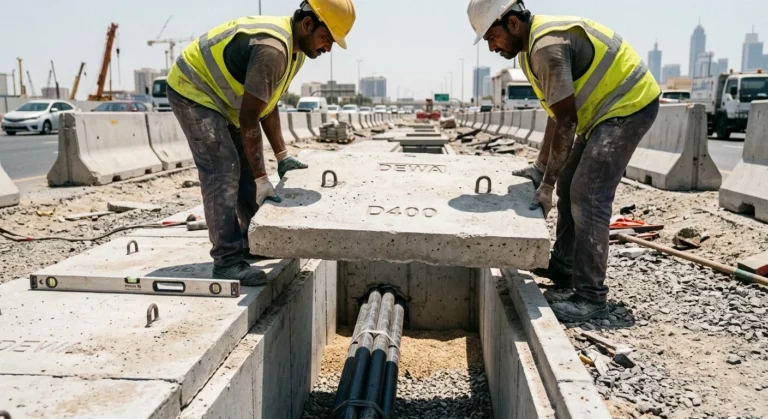
That first one is the barrier rule. In Abu Dhabi, a trench next to a live road without a concrete barrier is a listed offence, not a judgement call. Pair the barrier line with rated precast trench covers where the trench crosses a footpath.
What the Permit Application Needs
Submitted through Abu Dhabi Mobility’s digital services. The core pack:
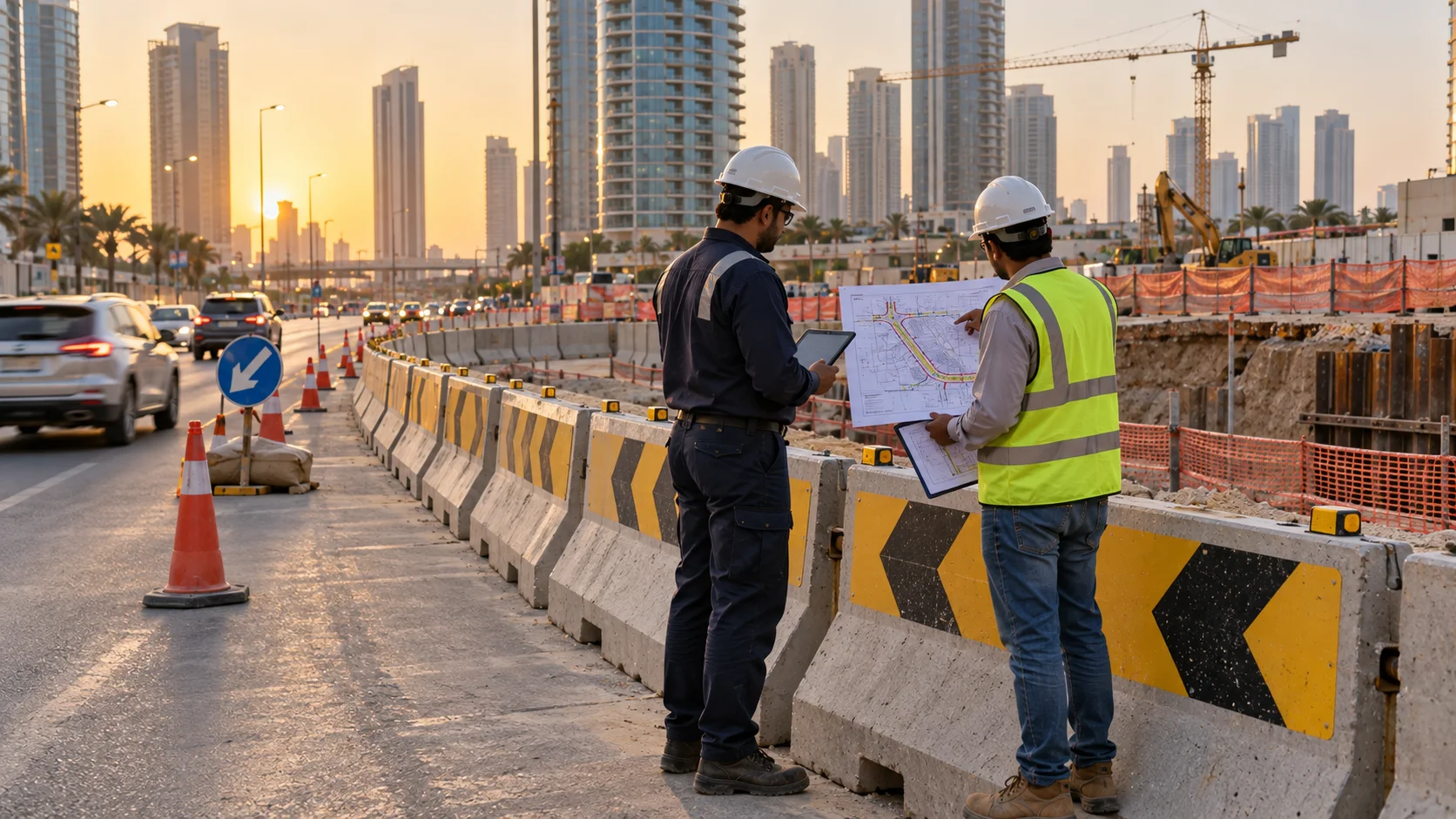
- Traffic detour drawing to the Traffic Detours Implementation Manual, prepared by an approved traffic consultant, showing existing and proposed layout, taper lengths, buffer zones, barrier lines, signage schedule and pedestrian routes.
- Project details: municipality building permit or infrastructure contract reference, duration, working hours.
- Contractor registration and the name of the traffic safety official on site.
- Method statement for installing and removing devices, including the barrier type, connection method and crane plan.
- Utility NOCs where excavation is involved.
- Fee payment. Fees scale with the extent of the detour and the duration.
Processing in our experience runs 7 to 15 working days for a standard lane closure on a city road, longer for anything on E10, E11 or E22 that involves Abu Dhabi Police traffic.
Which Barriers Pass in Abu Dhabi
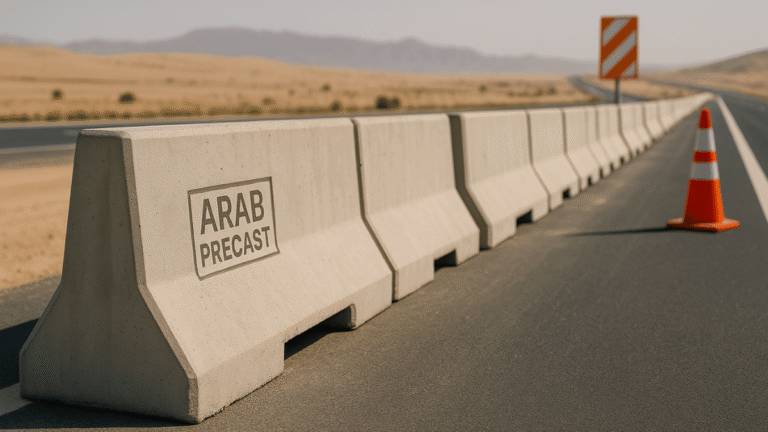
Abu Dhabi Mobility’s manual and DMT road specifications favour the F-type profile and Grade 40 or better reinforced concrete for anything on a highway. For city roads under 60 km/h the standard 3m jersey at 810mm to 1,000mm with pin and loop connections passes without argument.
What inspectors have asked us for on recent sites:
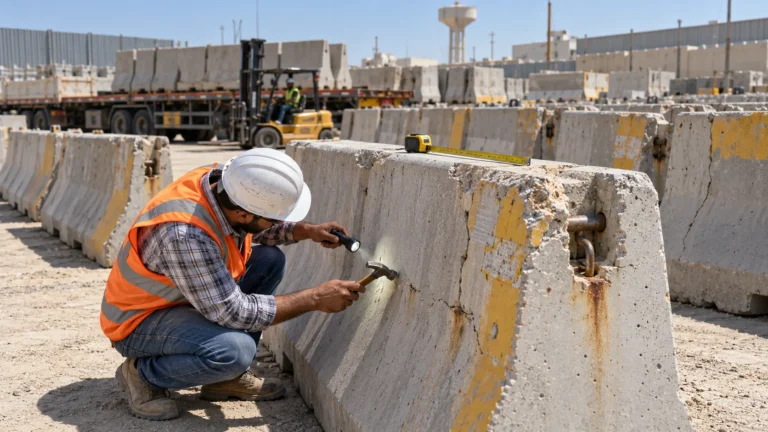
- Concrete mix design and cube results for the batch
- Shop drawing of the barrier with reinforcement
- Lifting insert certificates
- Reflective sheeting grade (Class 2 or better)
- Evidence that every unit is connected
Plastic water-filled barriers are accepted on low-speed roads and pedestrian separation where the permit specifies them. They are not accepted as excavation protection on a live carriageway. If the permit drawing shows concrete, place concrete.
For dimensions and weights by type, see our jersey barrier spec card.
Abu Dhabi Island Logistics
Abu Dhabi city is an island with bridges, and the Al Maryah, Al Reem, Saadiyat and Yas developments are islands off the island. Barrier logistics are harder than Dubai for two reasons.
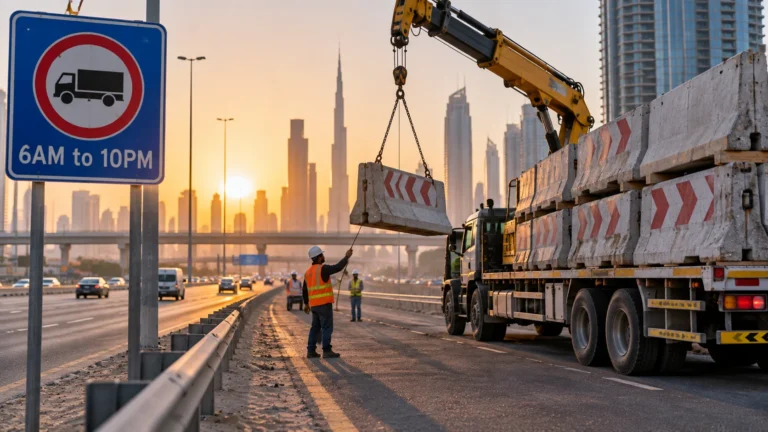
- Heavy vehicle bans on Abu Dhabi city roads: Monday to Thursday 6:30am to 9am and 3pm to 7pm, Friday 6:30am to 9am and 11am to 1pm. Your trailer from Mussafah or ICAD has to clear the Mussafah bridge outside those hours. Dubai has its own new windows since 1 October, covered in our Dubai truck ban delivery guide.
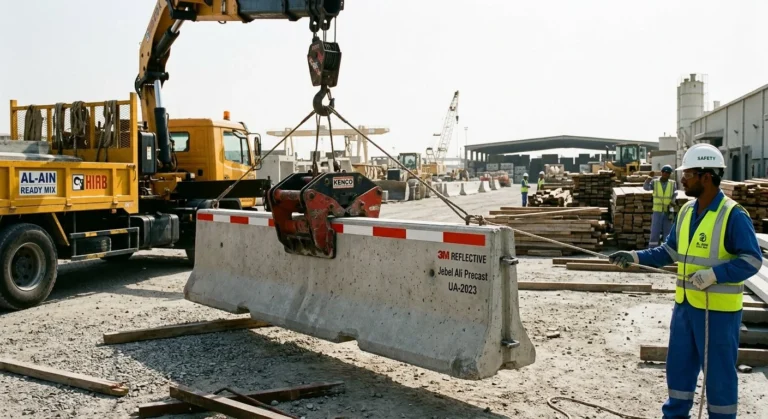
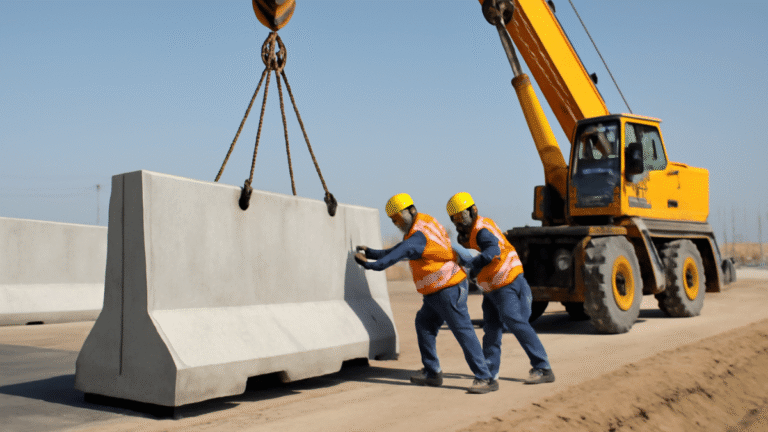
- Zero storage on the island projects. Al Maryah and Al Reem sites rarely have a laydown. Barriers are placed off the trailer, which means the crane and the permit window have to line up exactly.
Our rule for Abu Dhabi island drops (truck counts per load are in the takeoff guide): load in ICAD by 8:30pm, cross after 7pm restrictions lift, place by midnight. Daytime drops between 9am and 3pm work for Khalifa City, Mohammed Bin Zayed City and Al Shamkha.
Al Ain adds 130km of E22 at 120 km/h. Allow a full day per round trip from the Abu Dhabi yards and expect the delivery line to be AED 650 to 950 per truck.
Al Ain and Al Dhafra Differences
The same regulations apply, administered through the Al Ain and Al Dhafra offices. Differences we have met:
- Al Ain inspectors pay close attention to pedestrian routes around works in the town centre and near schools. Have the pedestrian diversion drawn and fenced before the barriers go in.
- Al Dhafra sites (Ruwais, Madinat Zayed, Ghayathi) are usually industrial or oil and gas related and sit behind ADNOC or client gates. The ITC permit applies the moment the works touch a public road, including the access road. Many contractors miss this.
- Lead times for inspections are longer out west. Book the inspection when you book the crane.
The Dubai Habits That Get You Fined in Abu Dhabi
| Dubai habit | Abu Dhabi reality |
|---|---|
| Using the RTA NOC drawing template | Must follow the Abu Dhabi Mobility Traffic Detours Implementation Manual |
| Sub-contractor places barriers under main contractor permit | Permit is non-transferable since January 2026 |
| Plastic barriers at a trench edge “for now” | Listed offence if the trench is deep and beside the road |
| Start the emergency fix, sort the paperwork next week | Notify ITC first, apply within 24 hours if over 12 hours |
| Leave the safety officer at head office | Safety official must be on site |
| Fix non-compliance after the fine | ITC can cancel the permit and refuse extension |
Checklist Before Your First Abu Dhabi Barrier Goes Down
- Permit holder is the entity placing the barriers, or the sub is named on the permit.
- Drawing follows the Abu Dhabi manual, stamped by an approved consultant.
- Barrier type on site matches the barrier type on the drawing. Concrete where it says concrete.
- Every unit connected. Pins in, loops aligned.
- Reflective sheeting fitted before placement.
- Pedestrian and cycle path fenced and signed before the lane closes.
- Safety official on site with the permit printed.
- Project vehicles parked inside the works area, not on the live road.
- Trailer timing clears the heavy vehicle ban windows.
- Mix design, cube results and shop drawing in the site file for the inspector.
FAQ
Is an RTA approved traffic consultant accepted in Abu Dhabi?
Not automatically. The consultant must be registered with Abu Dhabi Mobility to stamp detour drawings in the emirate. Many Dubai consultants hold both registrations. Ask before you appoint.
Can I use Dubai barriers on an Abu Dhabi job?
Yes. There is no emirate-specific barrier type. The barrier needs to match the approved drawing and the manual’s profile and strength requirements. Stock moving from Dubai to Abu Dhabi only needs to clear the truck ban windows on both sides.
What happens if works run past the permit date?
Apply for an extension before the expiry. Under the 2026 amendments, ITC can refuse the extension if there were compliance issues during the permit period. Do not let the permit lapse with barriers still on the road.
Is a permit needed for barriers inside my own plot?
No, if they stay inside the plot boundary. The permit applies to devices in the road right of way. The moment a barrier, cone or sign sits on the public footpath or carriageway, the permit applies.
How is this different from the municipality excavation NOC?
The municipality NOC lets you dig. The ITC permit lets you occupy the road to do it. You need both, and the ITC permit application will ask for the municipality reference.
Working in Abu Dhabi This Quarter?
Send us your detour drawing and we confirm the barrier type, quantity, connection detail and a delivery window that clears the heavy vehicle bans. Free, within 2 hours, WhatsApp +971 58 660 9400. Deliveries across Abu Dhabi, Al Ain and Al Dhafra.