
Concrete Barrier Maintenance in the UAE: How to Inspect, Repair and Replace Damaged Units
Precast concrete barriers are robust, but an installed line is not maintenance-free. Repeated handling, vehicle contact, damaged connectors, accumulated dust and changes to the surrounding work area can affect its condition and visibility.
The purpose of maintenance is not simply to keep barriers presentable. It is to confirm that the installed arrangement continues to match the approved design and that defects are identified before they compromise the work zone or the safety of a future lift.
This guide focuses on barriers already in service. Teams assessing a purchase of second-hand stock can also use the used concrete barrier inspection guide.
Begin with the complete barrier system
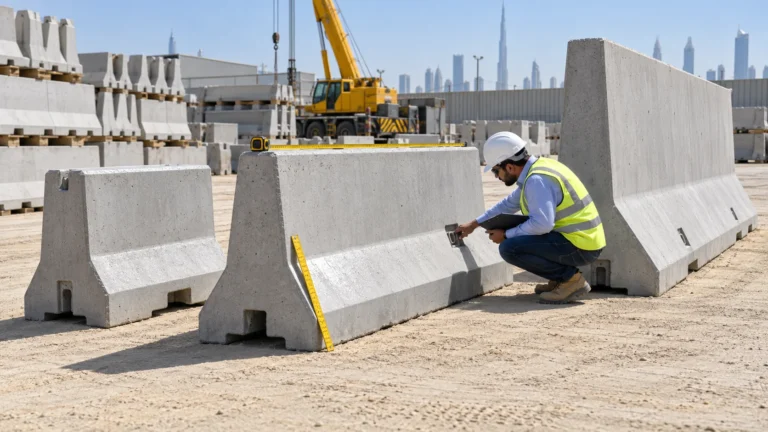
A barrier line includes more than concrete units. Depending on the design, it may incorporate connections, anchors, end treatments, crash cushions, reflectors and a prepared supporting surface. Assessing each concrete block in isolation can miss a damaged joint or a change in alignment that affects the entire system.
Keep the current approved drawings, supplier instructions, installation details, relevant crash-test or performance documents and prior inspection records available to the inspection team. If documentation is missing, raise the issue with the project engineer before assuming that a replacement component is compatible.
What should an in-service inspection cover?
| Component | Signs to check | Response |
|---|---|---|
| Concrete body | New or changing cracks, spalls, exposed reinforcement and impact damage | Record location and extent; refer significant or uncertain damage for competent assessment. |
| Joints and connectors | Missing pins, deformed plates, corrosion, gaps or unusual joint movement | Protect the area and refer to the system supplier and engineer; do not improvise repairs. |
| Anchorage and supporting surface | Loose fixings, surface failure, settlement, tilting or undermining | Assess against approved details and address the cause as well as the defect. |
| Alignment and clearances | Displaced units, abrupt changes, insufficient buffer or encroachment | Check the approved layout and arrange a controlled correction. |
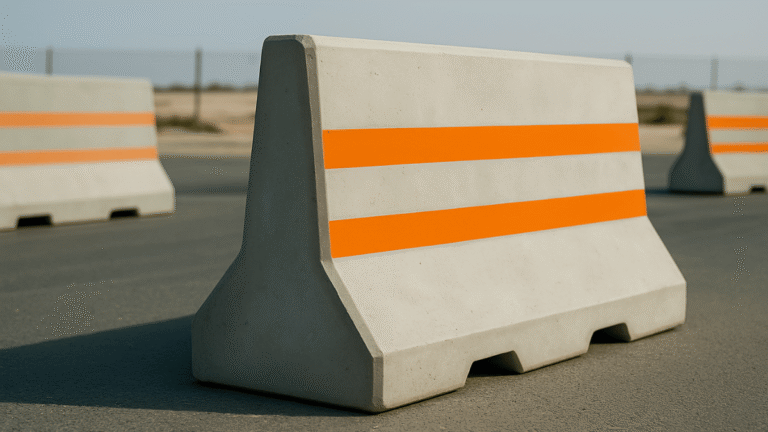
| Reflectors and markings | Missing, dirty, detached or obscured devices | Clean or replace to the approved specification. |
| Ends and transitions | Damage, missing components or unauthorised changes | Treat as a safety-critical defect and escalate immediately. |
| Lifting points | Distortion, damage, corrosion or missing identification before relocation | Do not lift until the correct handling method has been assessed and confirmed. |
Do not use a universal crack width or spall depth as a pass/fail rule. Acceptance limits depend on the barrier design, authority specification, extent and location of damage, reinforcement, connector details and approved repair method.
How often should barriers be inspected?
Set inspection intervals in the traffic management plan, maintenance contract and project quality procedures. A busy highway work zone may require a different routine from a controlled storage yard. In addition to scheduled inspections, consider a check:
- Before a barrier line is brought into service or a new work phase begins.
- After a reported vehicle impact, even if visible damage appears limited.
- Following relocation, lifting or alterations to the connected line.
- After severe weather, flooding, ground movement or a significant accumulation of debris.
- Before a unit is returned to stock or reused on another project.
The frequency and response times should be approved by the party responsible for the site, not copied from an unrelated project.
What to do after a vehicle strike
- Make the area safe. Follow the site’s incident and traffic-control procedures. Protect road users and workers without entering live traffic.
- Notify the responsible parties. Inform the traffic-management team, project engineer and authority or client as required by the permit and contract.
- Record the event. Capture the location, time, vehicle information where available, photographs and the affected length of barrier.
- Examine the system, not just the impact mark. A collision can affect neighbouring units, connectors, anchors, end treatments and the supporting surface.
- Arrange temporary protection or replacement. Use only the measures authorised by the approved traffic plan and responsible engineer.
- Document the decision. Record whether the component is retained, repaired, replaced or quarantined, and obtain the required acceptance before restoring normal operation.
Do not lift or reposition a damaged unit using a suspect anchor. The precast barrier handling guide explains the planning issues, but the actual unit’s manufacturer instructions and site lifting plan take precedence.
Repair or replace: how is the decision made?
| Observed condition | Sensible first action | Decision owner and basis |
|---|---|---|
| Superficial dirt or damaged markings | Clean or replace the approved marking; check visibility | Maintenance team under project procedures. |
| Minor surface defect with no obvious structural damage | Record and refer against the approved acceptance criteria | Competent inspector and engineer, as required by the contract. |
| Crack, spall or exposed steel of uncertain significance | Identify and assess; do not conceal the defect with paint | Project engineer using supplier and authority requirements. |
| Damaged connector, anchor or lifting point | Restrict use and arrange a detailed assessment | System supplier and engineer; replacement may be necessary. |
| Unit displaced or struck by a vehicle | Secure the area and inspect adjacent components | Responsible traffic and engineering team. |
Some project specifications permit particular cosmetic repairs; others may restrict repair or require replacement. Where a damaged unit must be exchanged, compare the proposed replacement with the approved concrete barrier system and profile, not just its external appearance. Patching damaged concrete does not automatically restore tested crash performance, and a repaired connector should not be accepted merely because it looks straight. Use a documented, approved repair procedure and the required acceptance process.
Managing salt, moisture and corrosion exposure
Coastal and industrial environments can expose concrete and embedded steel to conditions that accelerate deterioration. Pay particular attention to damaged concrete cover, corroding connectors, standing water, drainage paths and recurring surface damage. The engineer should assess exposure and specify any necessary durability or repair measures for the actual site. The Northern Emirates project guide discusses planning for different site environments, but the applicable exposure and specification should be confirmed for each installation.
Cleaning can improve both visibility and inspection quality, but aggressive methods or incompatible chemicals may damage coatings, reflectors or concrete. Check the manufacturer’s instructions and the project specification before selecting a cleaning method.
A simple barrier inspection record
| Field | Example entry |
|---|---|
| Project and phase | Warehouse access road, phase 2 |
| Date and inspector | Date, name and role |
| Location or unit reference | Chainage, grid reference or unit ID |
| Component and defect | Connector displaced at joint between identified units |
| Evidence | Photograph reference and relevant measurement, if safely obtainable |
| Immediate control | Area protected in accordance with the approved traffic plan |
| Technical decision | Engineer’s instruction, repair or replacement reference |
| Close-out | Completion date, verification and responsible person |
Use a location reference that remains meaningful after a unit is moved. Photographs should show both a close view of the defect and enough surrounding context to identify the location.
Planning replacement stock
For a long barrier line or a project with several phases, review whether compatible replacement units and connectors can be sourced quickly. Estimate the number of units in each affected length using the barrier quantity takeoff guide, allowing for the actual approved unit lengths and transitions. Compatibility is not guaranteed between products with a similar profile. Confirm the manufacturer’s system designation, unit length, connection arrangement, end treatment and applicable performance evidence.
Use the barrier dimensions and weight guide for preliminary logistics, then verify the actual replacement unit’s data sheet and lifting requirements. If a new alignment is needed, the project team should approve it before placement. The installation method statement guide offers a useful preparation checklist, subject to the current project approvals.
Frequently asked questions
Can a cracked concrete barrier remain in use?
That depends on the nature and location of the crack and the governing acceptance criteria. Record it and obtain a competent assessment; appearance alone is not enough to establish suitability.
Should a barrier be repainted after impact?
Do not paint over an unassessed defect. First inspect the complete system, complete any authorised repair or replacement, and reinstate markings in accordance with the project specification.
Can different manufacturers’ barriers be connected?
Only if the proposed combination is demonstrated to be compatible and accepted for the project. Similar-looking connectors do not establish system performance.
Where can a contractor request replacement units?
Contact Arab Precast with the existing product details, drawings, dimensions, quantity and delivery requirements. Confirm compatibility and the required technical evidence before ordering.