Event Barriers in the UAE: Crowd Control, Permits and Rental Planning for the 2026-27 Season
The UAE event season runs from October through April, and in that period the country hosts marathons, national celebrations, concerts, exhibitions and sporting fixtures that each require a defined perimeter, controlled entry points and, in many cases, separation between crowds and moving vehicles.
Event organisers often treat barriers as a late procurement item. In practice, the barrier plan should be built alongside the event permit, because the layout determines what the authority will approve, and the equipment determines whether the layout can be built within the load-in window.
This guide covers the barrier types used at UAE events, how to match them to the risk, the permit path for events affecting public roads, and the rental economics for the season ahead.
The Three Barrier Categories Used at UAE Events
Pedestrian and Crowd Control Barriers
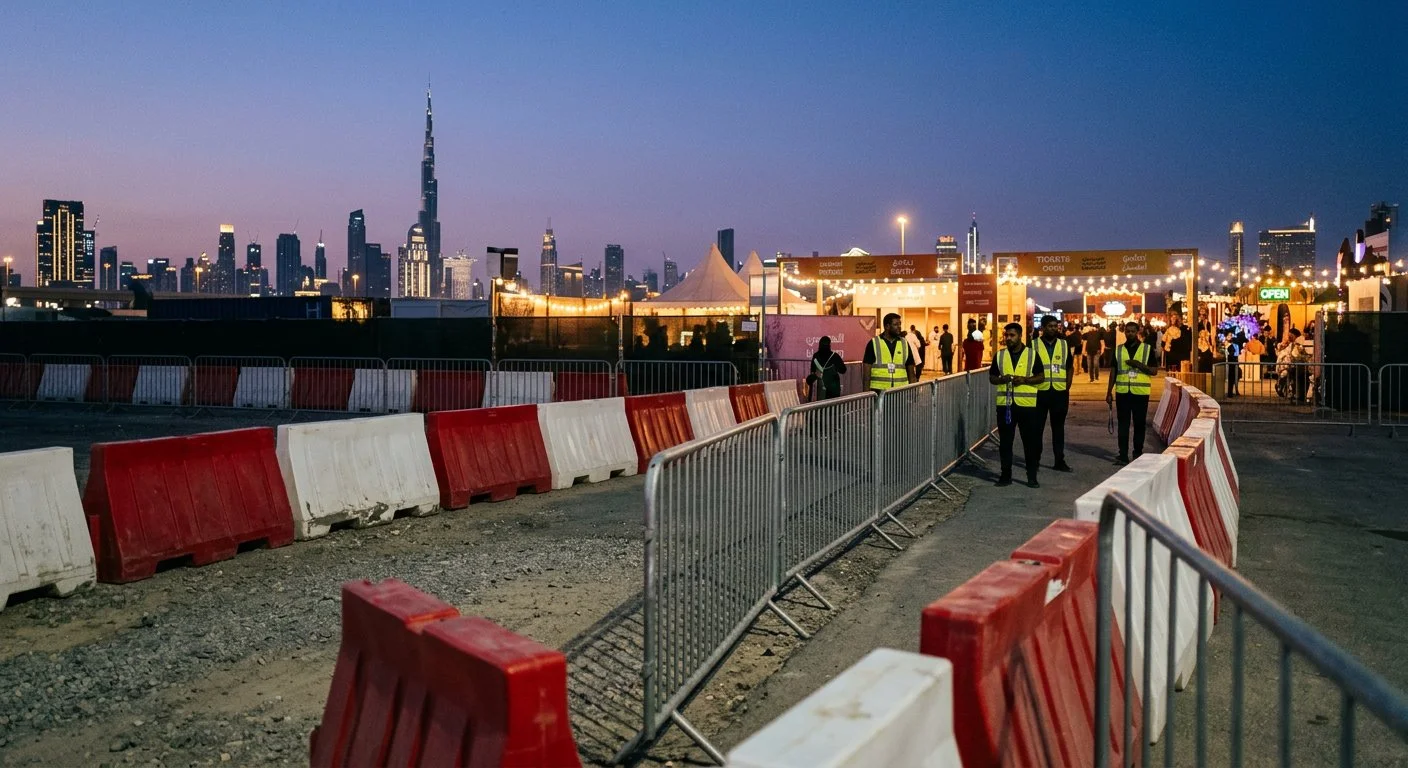
Lightweight barrier units used to guide and contain audiences: queue lines, entry channels, viewing areas, and perimeter marking. They are not vehicle barriers and do not provide impact protection. Their function is orderly management of people, and they are sized and placed accordingly.
Water-Filled Plastic Barriers
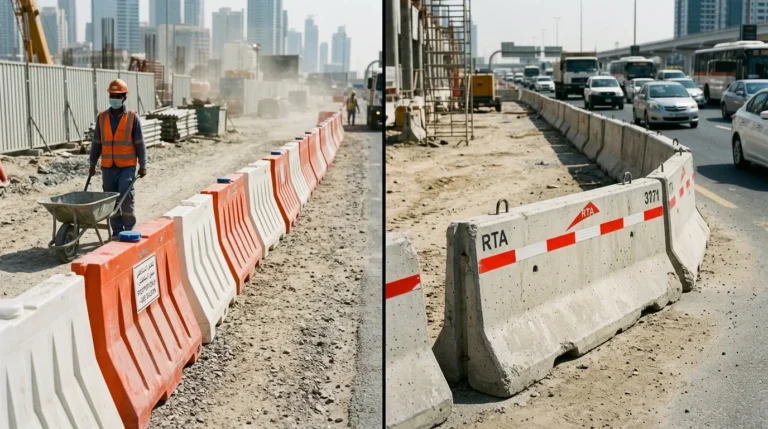
The workhorse for event road closures and temporary lane control. Empty weight of 18 to 22 kg allows personnel to position them by hand, and filling with water brings each unit to 400 to 500 kg, providing a firm line that will absorb a low-speed knock. They are accepted for channelization on roads up to 60 km/h and for internal event traffic, subject to the approved plan.
Precast Concrete Barriers
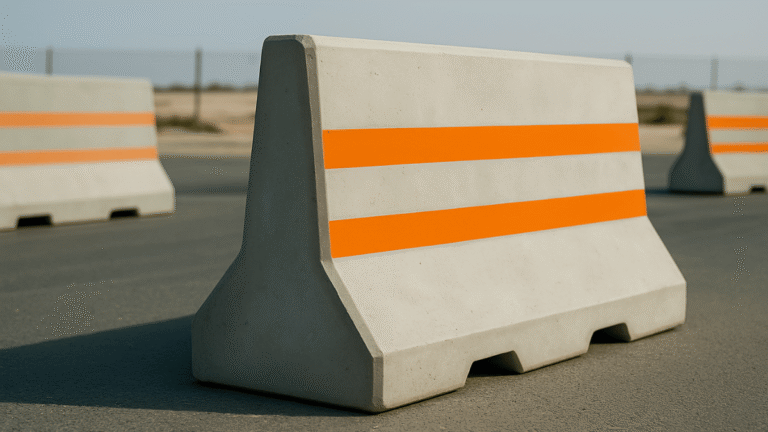
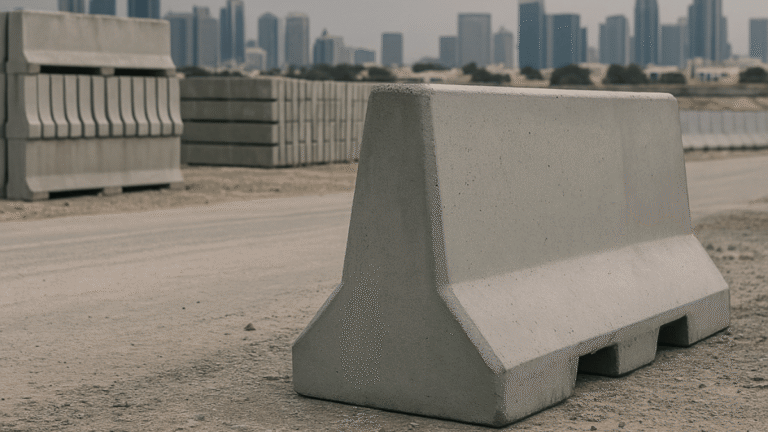
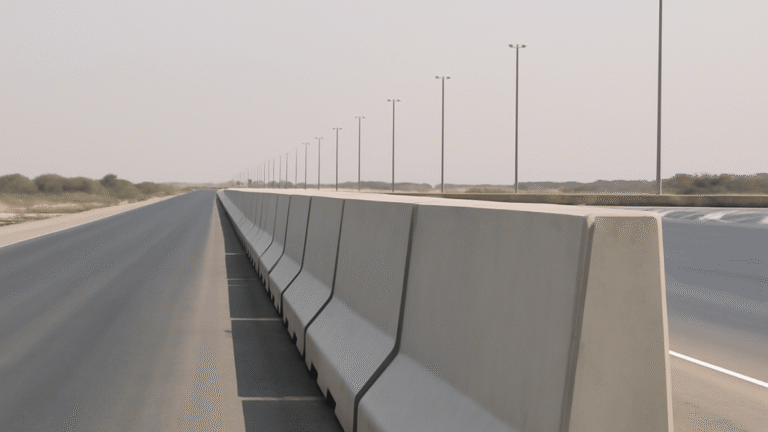
Where a road closure faces live traffic at speed, where the perimeter protects against vehicle intrusion, or where the event runs for an extended period, concrete barriers are the correct unit. They are the same crash-tested units used on roadworks, and the same principles govern their selection and placement, as set out in our comparison of plastic and concrete barrier systems.
For VIP and high-security venues, none of the above qualifies as protection against hostile vehicle intrusion. Those installations require certified anti-ram units, covered in our anti-ram security barriers guide.
Matching the Barrier to the Risk
The correct starting point is the most severe realistic impact at each point on the perimeter, not the total number of barriers required.
| Event Location | Dominant Risk | Appropriate Barrier |
|---|---|---|
| Entry queue and search lanes | Crowd pressure, orderly flow | Pedestrian barriers |
| Internal site paths and parking control | Slow vehicle movement, wayfinding | Water-filled plastic barriers |
| Road closure facing traffic up to 60 km/h | Vehicle intrusion | Water-filled plastic, fully ballasted, per approved plan |
| Road closure facing traffic above 60 km/h | High-speed vehicle intrusion | Precast concrete barriers |
| Perimeter along a carriageway | Vehicle intrusion over multiple days | Precast concrete barriers |
| Stage front, back of house, production areas | crowd separation, equipment protection | Pedestrian or solid barriers per event design |
| VIP arrival and secure zones | Hostile vehicle intrusion | Certified anti-ram barriers to the venue’s security specification |
Where a single event spans categories, the layout mixes systems, and the interfaces between them are where the plan draws scrutiny. A concrete run that transitions to a plastic line should do so behind a protected position rather than in the path of approaching traffic.
The Permit Path for Events Affecting Public Roads
Events that use or affect public roads, footpaths or parking bays require approval through the relevant authority, and the sequence generally follows this pattern.
Event approval. The event itself is approved through the emirate’s event permitting framework, which reviews the overall plan including safety, capacity and traffic management.
Road closure or occupancy approval. Where the event requires road closures, lane reductions, or occupation of the road reserve, a separate approval is required from the roads authority, supported by a traffic management plan showing closures, diversions, barrier lines and signage. For Dubai, this follows the roads authority’s established process for works and events within the right of way. For Abu Dhabi and the northern emirates, the equivalent local authority process applies, with the emirate-specific notes set out in our guide to Sharjah and Northern Emirates requirements.
Police and emergency services coordination. Event plans are reviewed for emergency access and crowd safety. Two requirements repeatedly affect the barrier layout: a maintained emergency vehicle route into and through the site, and unobstructed egress width from high-density areas.
Venue or municipality approvals. Venue-based events address site-level matters with the venue operator and municipality, including surface protection, structural loads and access.
The practical consequence for the barrier plan: design it to be approvable. Confirm the emergency route and the egress widths before finalising the layout, because a layout that blocks either will be returned regardless of how many units it specifies.
Layout Essentials That Draw Inspection Attention
Entry capacity. Entry lanes are sized for the expected arrival rate at peak, not average. Queue barriers should define the lane and the holding area without creating a crush point at the search position.
Emergency egress. Egress routes must remain clear of barriers or be provided with removable sections. Where a run crosses an egress path, the section should be a designed break point that can be released quickly, and the location should be shown on the plan.
Emergency vehicle access. A route capable of accepting an ambulance or fire appliance must be maintained into the event area. For arena and stadium events, the route is usually specified by the authority, and barrier runs are arranged around it.
Line of sight and signage. Barriers define the physical line; signage and lighting direct the crowd. Both should be planned together so that audiences are guided to the correct entry rather than to the nearest barrier.
Wind loading at exposed venues. Water-filled units are stable when ballasted and can shift when empty. At coastal venues and in open desert locations, ballast levels and additional securing should be confirmed before the event, particularly during Shamal periods.
National Day and Marathon Layouts: What Differs
National Day celebrations. These typically involve street-level events with heavy pedestrian concentrations, parade routes and viewing areas, often running across several days in close succession. Layouts tend to be pedestrian-dominant along the route, with concrete or water-filled systems at road interfaces. The key planning point is the repeated build and removal across multiple days and locations, which favours rented units and a rehearsed installation sequence.
Marathon and mass-participation events. Route-based events with moving closures require a large number of units distributed along a route, with each section installed ahead of the runners and removed behind them. Planning is governed by the movement schedule rather than by static layout. Unit quantities follow the route length plus diversion points, and the calculation method in our barrier takeoff guide applies directly to route closure planning.
Concert and festival venues. These concentrate on entry management, perimeter definition and production separation. Vehicle intrusion risk is usually confined to the site boundary and arrivals area, where concrete or certified systems may be required.
Rental Planning and Indicative Costs
For most events, rental is the practical option: the units return to the supplier after the event, storage is not an issue, and the cost is a direct project expense.
| Item | Unit | Indicative Rate (AED) |
|---|---|---|
| Concrete barrier rental, 3 m Jersey | Per unit per day | 15 to 25 |
| Concrete barrier rental, 2 m Jersey | Per unit per day | 12 to 20 |
| Water-filled plastic barrier | Per unit per day | 50 to 100 |
| Delivery and collection | Per truck movement | 200 to 500 |
| Installation and removal, concrete | Per unit | 15 to 30 |
| Reflective markings, if required | Per unit | 25 to 50 |
Minimum rental periods, delivery windows and seasonal availability apply. Where an event programme runs across several months, the purchase and buyback route can be more economical than repeated rentals, and the comparison is set out in our rental versus purchase analysis. Current purchase rates for concrete units are in our 2026 barrier price guide.
Two operational points determine the cost more than the rate card. First, the number of delivery movements: consolidating the requirement into fewer, larger deliveries is the single largest saving available. Second, the load-in and load-out windows: events in constrained city locations often require night deliveries, which should be booked early in the season when availability is at its tightest.
Units returning from an event are inspected and refurbished as required before reissue. What we look for on returned stock is described in our used barrier inspection guide.
Event Barrier Checklist
Before confirming a layout, verify the following.
- The most severe realistic impact at each section of the perimeter is identified
- Barrier category is matched to that impact, not to the budget allocation
- Emergency vehicle access route is maintained and shown on the plan
- Emergency egress is unobstructed or provided with a designed break point
- Entry lane capacity matches peak arrival rate
- Water-filled units will be fully ballasted before the event opens
- Reflective markings and lighting are adequate for the evening programme
- Delivery and collection windows are booked, including any night movements
- Units are inspected at delivery and any damage is recorded before acceptance
The installation sequence itself follows the same discipline as roadworks installation. The steps are set out in our concrete barrier installation guide, and handling requirements, which matter when units are moved repeatedly across a multi-day event, are covered in our barrier lifting and storage guide.
Frequently Asked Questions
What barriers are used for events in Dubai?
Three categories: pedestrian barriers for crowd management, water-filled plastic barriers for temporary lane control and low-speed separation, and precast concrete barriers where a closure faces live traffic or the perimeter runs for several days. Certified anti-ram units are required for high-security venues.
Do I need approval to close a road for an event?
Yes. Events affecting public roads require road closure or occupancy approval from the roads authority, supported by a traffic management plan, in addition to the event permit itself. Emergency access and egress requirements are reviewed as part of that process.
Is it cheaper to rent or buy barriers for an event?
For single or occasional events, rental is normally more economical and avoids storage and maintenance. For event programmes and agencies running multiple events across a season, purchase with a buyback arrangement can be more efficient, and the break-even analysis is set out in our rental versus purchase guide.
How many barriers do I need for a marathon route?
The requirement follows the route length, plus diversion points and holding areas. Calculate the closed length, divide by the unit length, then add allowances for corners, diversions and spares. The four-step method with worked examples is in our barrier takeoff guide.
Can barriers be delivered at night?
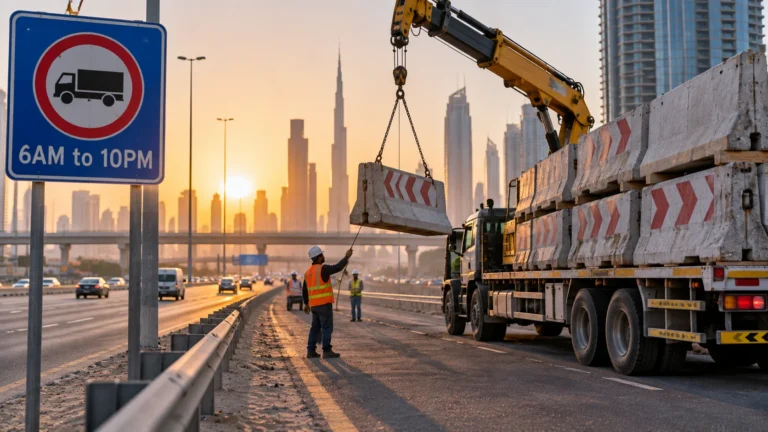
Yes, subject to the movement restrictions in effect for trucks in Dubai and the emirate of delivery, and subject to the event’s load-in schedule. Night movements should be booked well in advance during peak season. Current timing restrictions are summarised in our 2026 truck movement guide.
Securing Barriers for the Season
The season’s peak weeks book out early, particularly for concrete units and night load-in slots. Send us the event dates, the location, the approved or draft layout, and the load-in window, and we will confirm availability, the delivery schedule and the collection plan.
Contact the team through our contact page or WhatsApp +971 58 660 9400. Our standard range for events and construction is on the precast concrete products page, and further planning guides are on our blog.