How to Lift, Move and Store Precast Concrete Barriers Without Damage: Premium Handling Guide for UAE Contractors (2026)
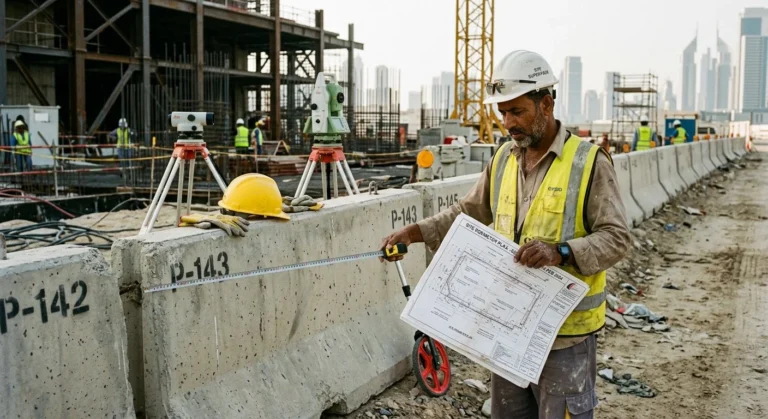
A single chipped corner on a precast concrete barrier may appear minor. In the UAE regulatory environment, it can result in RTA rejection, repainting costs and client dissatisfaction. Across our Jebel Ali facility, we observe that more than 80 percent of barrier damage occurs not during manufacturing, but during lifting, transport and storage on site.
At Arab Precast, we engineer every barrier for structural performance and for safe handling under repetitive lifting conditions. This guide outlines the definitive methodology for lifting, moving and storing precast concrete barriers without compromising integrity, safety or compliance.
Executive Summary: The Cost of Improper Handling
Improper handling of precast concrete barriers in UAE projects leads to three measurable consequences.
First, financial loss. A 3 meter Jersey barrier costing AED 350 to 650 requires AED 80 to 150 for cosmetic repair and AED 25 to 50 for repainting of RTA compliant markings. Corner damage requiring structural assessment may result in complete rejection.
Second, programme delay. RTA and DMT inspectors in Dubai and Abu Dhabi routinely reject barriers with visible cracks, spalling or damaged reflective tape, necessitating replacement and re inspection.
Third, safety risk. A 3 meter barrier weighing 1500 to 2400 kg, if lifted incorrectly, presents a severe hazard to personnel and equipment. OSHA 1926.251 and UAE Municipality safety codes mandate certified lifting methods and trained operators.
This guide provides verified methods, equipment capacity calculations and storage protocols to eliminate these risks.
Search Intent Analysis: Why Contractors Search Handling Methods
Google search analysis for the UAE indicates that queries related to barrier handling reflect primarily informational and commercial investigation intent.
Informational intent: Site engineers and safety officers seek to understand correct lifting points, equipment requirements, centre of gravity and stacking limitations to prevent damage and ensure compliance with safety regulations.
Commercial investigation intent: Procurement and plant managers compare lifting equipment options such as barrier clamps versus forklift slots, evaluate forklift and Hiab capacity against barrier weight, and assess total cost of handling including crane mobilisation and storage space.
Transactional intent: Following evaluation, users search for suppliers whose products include certified lifting anchors, documented weight and handling guides, and buyback programmes for undamaged units.
This article addresses all three intents with engineering data, comparative tables and field proven protocols specific to UAE conditions.
Understanding Barrier Weight and Centre of Gravity
Accurate knowledge of weight is fundamental to safe lifting. Precast concrete barriers in UAE are manufactured to standard dimensions with predictable mass.
| Barrier Type | Length | Height | Base Width | Approximate Weight | Centre of Gravity |
|---|---|---|---|---|---|
| Single Side Small | 2 m | 600 mm | 500 mm | 500 to 600 kg | Central, low |
| Single Side Standard | 3 m | 800 mm | 600 mm | 900 to 1200 kg | Central, low |
| Jersey Standard | 3 m | 1000 mm | 600 mm | 1500 to 1800 kg | Central, 400 mm from base |
| F Type Standard | 3 m | 1067 mm | 600 mm | 1800 to 2400 kg | Central, 450 mm from base |
| Interlocking Heavy Duty | 3 m | 1200 mm | 750 mm | 2400 to 3000 kg | Central, 500 mm from base |
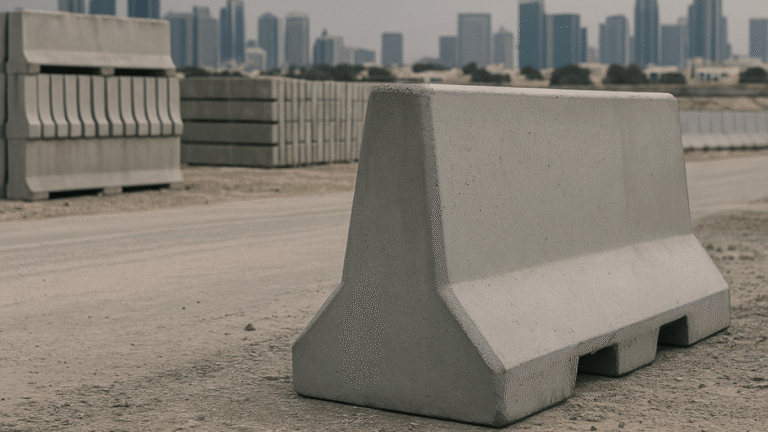
The centre of gravity is located centrally along length and low within the profile, providing inherent stability when lifted vertically. Any lifting method that introduces side loading, dragging or point pressure on corners will compromise this stability and cause chipping.
Full specifications including concrete grade C40 to C50 and reinforcement details are available on our precast concrete barriers product page and precast concrete products range.
Comprehensive definitions of types and manufacturing standards are provided in what are precast concrete barriers complete guide.
Lifting Methods: Comparative Analysis for UAE Sites
Method 1: Automatic Barrier Clamp or Grab — Recommended
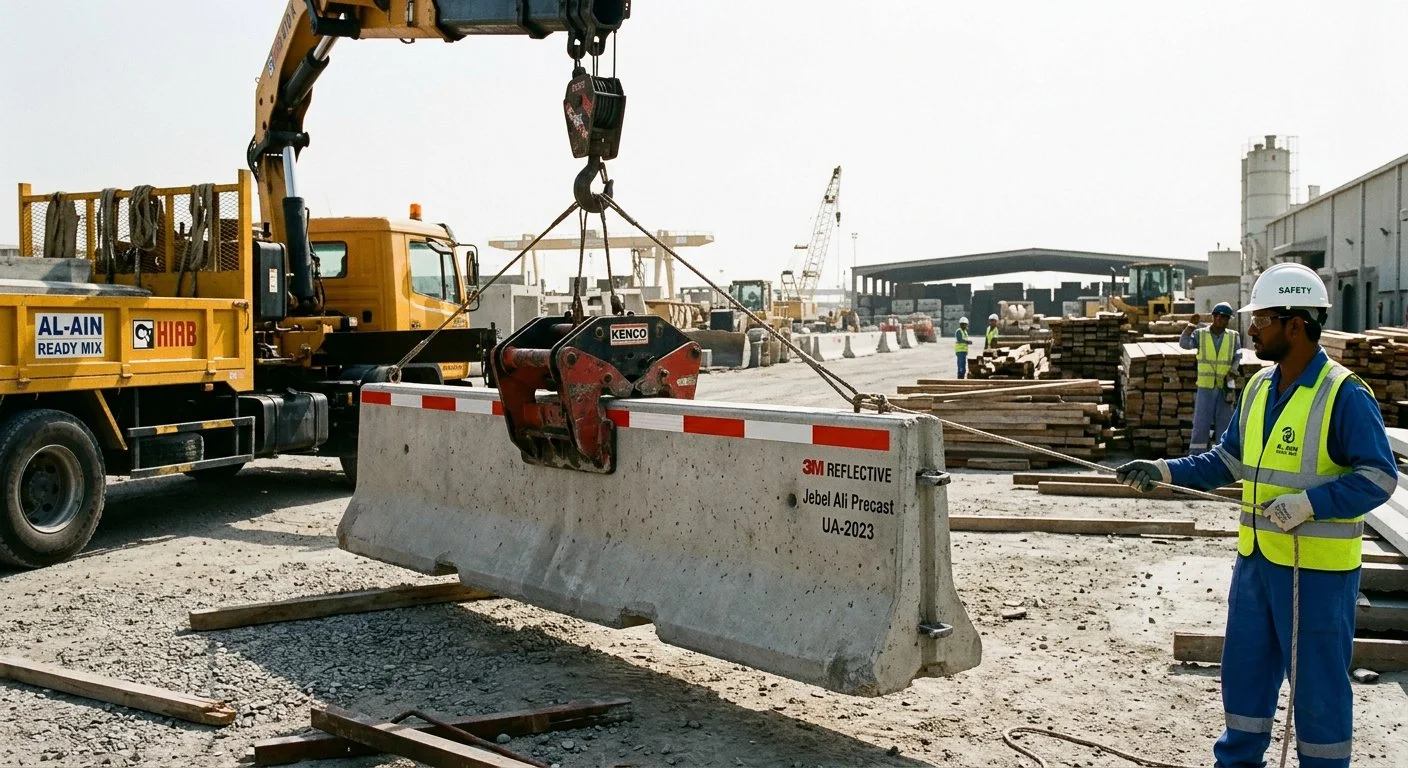
The automatic barrier clamp, commonly known as Kenco Barrier Lift KL12000, is the premium method for repetitive lifting in UAE infrastructure projects.
Operation sequence: Position clamp above centre of barrier, lower fully to collapse unit onto barrier top, raise. The mechanical scissor action grips automatically via elastomer pads that adjust to slope of Jersey or F Type profile. No auxiliary hydraulics required. Once barrier is placed firmly on ground, tension release opens clamp automatically.
Advantages: Full surface contact prevents corner chipping, no manual slinging required, operator remains in cab, lifting time reduced from 4 minutes with chains to 90 seconds, and pads are replaceable for painted barriers.
Capacity: KL12000 model provides 12,000 lbs capacity with 6 to 12 inch grip range, suitable for barriers up to 6 meters. For heavy duty interlocking units, KL30000 provides 30,000 lbs capacity.
This method is mandated by many Tier 1 contractors in Dubai South and Abu Dhabi Midfield projects for its safety and speed.
Method 2: Forklift Slots — Conditional Use
Many UAE standard barriers include cast in forklift slots or drainage scuppers at base, originally designed for drainage, adapted for handling.
When to use: Only when barrier has intact, purpose designed forklift pockets, no visible cracks around slots, and forklift capacity exceeds barrier weight at extended load centre.
Protocol: Inspect slots for damage, align forklift parallel to barrier, centre forks with slots, adjust fork spacing to 24 to 36 inches, insert forks fully through barrier to maximise stability, lift 6 to 12 inches to test stability, then transport with load low and slow.
Limitations: Slots are primarily drainage features, not certified lifting points. Repeated forklift lifting causes micro cracking around slot edges, especially with misaligned forks. Not recommended for F Type above 2 meters length without barrier clamp.
Method 3: Embedded Lifting Anchors with Chains — Factory Standard
Arab Precast barriers include 2 numbers DEHA pin anchors or spherical head anchors cast into top face, rated for 2.5 to 5 tons with factor of safety of 5.0 for repetitive lifting as per WorkSafe NZ and OSHA guidelines for concrete barriers, service lids and counterweights.
Protocol: Use certified chains or straps rated above barrier weight, ensure chains hang at maximum 30 degrees from vertical, connect to fork mounted lifting hook, never lay chains over forks, never stand under load, lift vertically without side loading.
This method provides certified lifting points and is suitable for all barrier types when clamp is unavailable.
Method 4: Chains or Slings Wrapped Around Barrier — Not Recommended
Wrapping chains or nylon slings around barrier profile creates point pressure on corners and edges, causing chipping and surface damage. Slings also reduce forklift capacity and introduce swing risk. This method should be avoided for finished barriers requiring RTA approval and reflective tape preservation.
Comparative Table: Lifting Methods for UAE Contractors
| Lifting Method | Suitable Barrier Types | Equipment Required | Risk of Damage | Speed per Barrier | RTA Acceptance for Finished Barriers |
|---|---|---|---|---|---|
| Automatic Barrier Clamp KL12000 | All Jersey, F Type, Single Side up to 6 m | Hiab or crane with hook | Very low, elastomer pads protect surface | 90 seconds | Preferred, preserves tape and corners |
| Forklift Slots | Barriers with intact slots, up to 3 m | Forklift 5 ton capacity minimum | Moderate, slot edge cracking possible | 2 minutes | Conditional, inspect slots before use |
| Embedded DEHA Anchors with Chains | All types with certified anchors | Crane or Hiab with lifting hook, certified chains | Low when vertical | 3 to 4 minutes | Accepted, factory standard |
| Chains or Slings Wrapped Around | None for finished barriers | Forklift or crane | High, corner chipping and tape damage | 4 to 5 minutes | Not recommended, causes rejection |
Guidance on selecting barrier type by application and handling requirements is available in our how to choose the right precast barrier for your UAE project decision guide.
Equipment Selection Matrix: Matching Weight to Machine Capacity
Selecting inadequate equipment is a primary cause of tipping and barrier damage.
| Barrier Weight | Minimum Forklift Capacity at 600 mm Load Centre | Minimum Hiab Capacity | Recommended Lifting Attachment | Transport per 6 m Truck |
|---|---|---|---|---|
| 500 to 600 kg 2 m single side | 3 ton forklift | 5 ton meter | Forklift slots or DEHA anchor | 12 to 14 units |
| 900 to 1200 kg 3 m single side | 5 ton forklift | 8 ton meter | Barrier clamp or DEHA anchor | 8 to 10 units |
| 1500 to 1800 kg 3 m Jersey standard | 7 ton forklift or 10 ton Hiab | 12 ton meter | Barrier clamp KL12000 mandatory | 6 to 7 units |
| 1800 to 2400 kg 3 m F Type | 10 ton forklift or 12 ton Hiab | 15 ton meter | Barrier clamp KL12000 mandatory | 5 to 6 units |
| 2400 to 3000 kg 3 m heavy duty | Not recommended with forklift | 20 ton meter crane | Barrier clamp KL30000 | 4 to 5 units |
Note: Forklift capacity reduces significantly with extended load centre. A 3 meter barrier at 1500 mm from mast reduces rated capacity by 30 to 40 percent. Always check data plate and consult manufacturer load chart.
Transport planning including truck counts and delivery emirates is detailed in our how many concrete barriers do you need takeoff guide and pricing analysis in precast concrete barrier prices UAE complete guide.
Safe Transport Procedures for UAE Roads
Transport damage often exceeds lifting damage due to inadequate securing.
- Load barriers in upright position, supported at bearing areas, never on side.
- Separate units with timber dunnage 100 mm thick to prevent concrete to concrete contact and allow fork access.
- Secure with ratchet straps over dunnage, not directly over concrete corners.
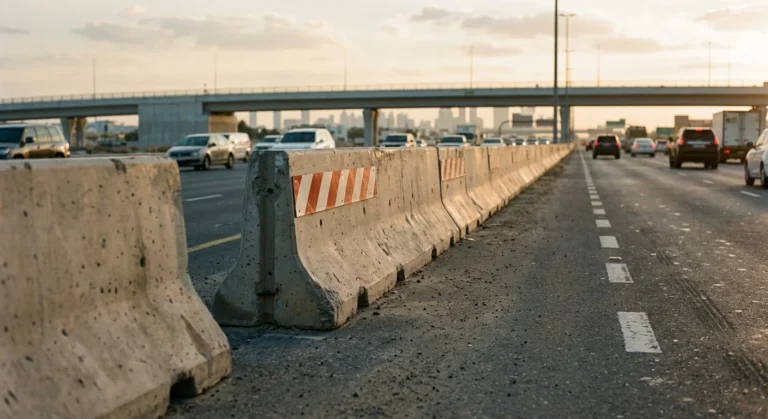
- Protect reflective tape with cardboard or foam during transit, especially for RTA projects on Sheikh Zayed Road and E311.
- Maximum stack of two barriers high during transport, as per Manitoba Infrastructure Specification 1082, to avoid twisting and cracking.
- Verify actual weight before transport. A 3 meter F Type at 2400 kg times 6 units equals 14.4 tons plus truck weight, exceeding many 6 meter truck limits. Use low bed for heavy duty units.
Upon arrival, inspect each barrier for cracks, spalling or tape damage before offloading. Document with photos for RTA record.
Storage and Stacking Best Practices for UAE Yards
Proper storage in Dubai Industrial City, JAFZA and Mussafah yards prevents long term deterioration.
| Storage Factor | Recommended Practice | Rationale |
|---|---|---|
| Ground condition | Hard, level, compacted surface, lean concrete or asphalt | Prevents tilting and differential settlement |
| Dunnage | Timber 100 x 100 mm, two per barrier, aligned vertically between layers | Prevents twisting and allows lifting access |
| Stack height | Maximum 2 barriers high for 3 meter units, maximum 3 high for 2 meter units | Exceeding causes bottom unit cracking and instability |
| Separation | 600 mm aisle between stacks for inspection and lifting | Safety and FIFO access |
| Protection from traffic | Bollards or concrete barriers around storage zone | Prevents forklift collision |
| UV and weather | No additional cover required for concrete, cover reflective tape if stored more than 30 days | Preserves tape adhesion in 50 degree heat |
| FIFO management | Label each stack with date, type and batch ID | Ensures first in first out usage and QA traceability |
Storing barriers close to final installation location minimises multiple handling. Each handling cycle increases damage probability by approximately 5 percent. WorkSafe NZ guidelines recommend lifting into final position directly from delivery trailer where possible, rather than intermediate storage.
For projects involving multiple precast elements, coordinated storage of barriers, precast pole foundations for DEWA approval and precast trench covers with load ratings on shared dunnage optimises yard space and crane utilisation.
Common Handling Mistakes and Financial Impact in UAE
| Mistake | Consequence | Cost Impact AED | Prevention |
|---|---|---|---|
| Dragging barrier across ground | Bottom abrasion, base uneven, RTA rejection | 80 to 150 repair plus re transport | Always lift, never drag |
| Using undersized forklift | Tipping, barrier drop, personnel injury | 2000 to 5000 plus injury liability | Verify capacity at extended load centre |
| Wrapping chains around corners | Corner chipping, tape damage, aesthetic failure | 25 to 50 repaint plus 80 repair | Use barrier clamp or DEHA anchors |
| Stacking 3 high on soft ground | Bottom barrier cracking, stack collapse | 350 to 650 replacement per unit | Hard level surface, max 2 high for 3 m |
| Forcing forks into damaged slots | Slot cracking, fork wedging, extraction delay | 2 hours labour plus repair | Inspect slots, use clamp if damaged |
| No dunnage between units | Concrete to concrete contact, surface spalling | 50 to 100 per unit cosmetic repair | Timber dunnage 100 mm between all layers |
A contractor in Al Quoz reported AED 12,000 in repair costs for 40 barriers due to chain wrapping damage before switching to barrier clamp, which eliminated damage in subsequent 300 unit handling.
Compliance with municipality requirements for lifting points and identification is detailed in municipality regulations for concrete barriers in Dubai and Abu Dhabi and broader application guidance in top uses of precast concrete barriers in UAE.
Why Arab Precast Barriers Are Engineered for Safe Handling
Arab Precast designs handling integrity as a core specification, not an afterthought.
- Certified lifting anchors: 2 numbers DEHA anchors per unit rated 2.5 to 5 tons with factor of safety 5.0 for repetitive lifting, in accordance with precast barrier handling best practices.
- Factory controlled strength: C40 to C50 concrete with 7 day steam curing ensures handling strength of 40 MPa before dispatch, preventing edge breakage during early lifting.
- Precision dimensional tolerance: Plus minus 2 mm ensures uniform bearing on dunnage and prevents point loading.
- Documented weight: Each delivery note includes exact weight per unit for equipment selection, eliminating guesswork.
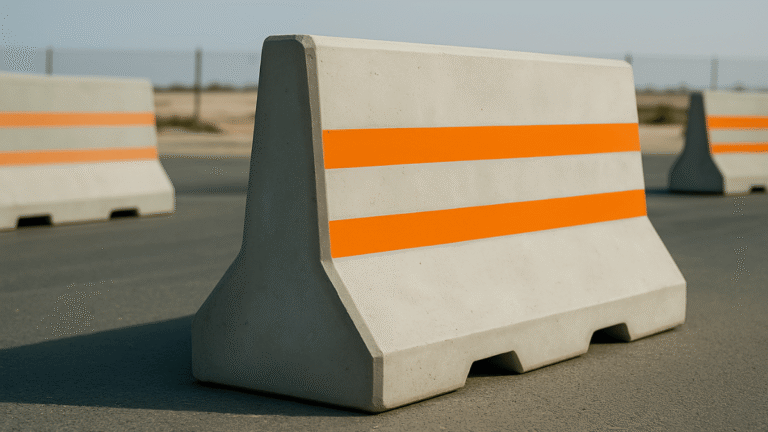
- Protective finish: Optional foam protection for reflective tape during transport for RTA projects.
Our barriers are also designed for integration with other infrastructure elements including pole foundations and trench covers, allowing single supplier logistics and single crane mobilisation.
Frequently Asked Questions
What is the safest method to lift precast concrete barriers in UAE
The automatic barrier clamp such as Kenco KL12000 is the safest and fastest method. It grips via elastomer pads, requires no manual slinging, preserves corners and reflective tape, and allows operator to remain in cab. For barriers without clamp access, use embedded DEHA anchors with certified chains at maximum 30 degrees from vertical.
Can forklift slots be used for all barrier types
No. Forklift slots are primarily drainage features adapted for handling. They are suitable only for barriers up to 3 meters with intact slots and no visible cracks. For F Type and heavy duty interlocking barriers above 1500 kg, barrier clamp is mandatory to prevent slot edge cracking.
How high can precast concrete barriers be stacked in UAE yards
Maximum 2 barriers high for 3 meter units and maximum 3 high for 2 meter units on hard level ground with timber dunnage between layers. Exceeding this height causes bottom unit cracking and instability, especially on sandy ground in Jebel Ali and Al Warsan.
How do I prevent corner chipping during handling
Use barrier clamp with elastomer pads, never wrap chains around corners, ensure dunnage between units during transport and storage, lift vertically without side loading, and protect reflective tape with cardboard. Inspect lifting equipment and barrier for damage before each lift.
What is the cost impact of improper handling
Cosmetic repair costs AED 80 to 150 per unit plus AED 25 to 50 for tape replacement. Structural cracking may result in complete rejection at AED 350 to 850 replacement cost. A single drop incident can incur AED 2,000 to 5,000 in equipment and personnel risk plus project delay.
Conclusion
In UAE infrastructure projects where timelines are aggressive and regulatory scrutiny is stringent, barrier handling integrity directly influences compliance, cost and safety.
Specifying barriers with certified lifting anchors, documented weight and factory applied reflective tape, combined with trained operators and appropriate equipment such as barrier clamps, eliminates the majority of damage and rejection incidents.
Arab Precast recommends incorporating handling requirements into method statements and ITPs, including equipment capacity verification, dunnage provision and FIFO storage management.
To receive a project specific handling plan including equipment recommendation, truck count and stacking layout, please contact our technical team via our contact page or WhatsApp +971 58 660 9400. You may also review our complete portfolio on the Arab Precast homepage and technical resources on our blog.