Concrete Barriers in Al Ain and Al Dhafra: Supply, Delivery and Compliance Guide for Inland Projects
Al Ain and the Al Dhafra region account for a significant share of Abu Dhabi’s infrastructure programme, from the UAE University corridor and the Sanaiya industrial areas to the E66 upgrades and the utilities serving Ruwais and Madinat Zayed.
For contractors working inland, the challenge with concrete barriers is rarely availability. It is logistics. The distances are longer, the delivery windows are stricter, and the authorities in Al Ain apply Abu Dhabi requirements with an additional layer of municipal review. A delivery planned the way you would plan a Dubai drop will lose a day at minimum.
This guide sets out the barrier types suited to inland projects, the approval framework, and the delivery arithmetic from the Dubai and Abu Dhabi industrial areas to sites in Al Ain, Liwa and the Western Region.
The Inland Project Landscape
Three project categories generate most of the barrier demand in the Al Ain and Al Dhafra region.
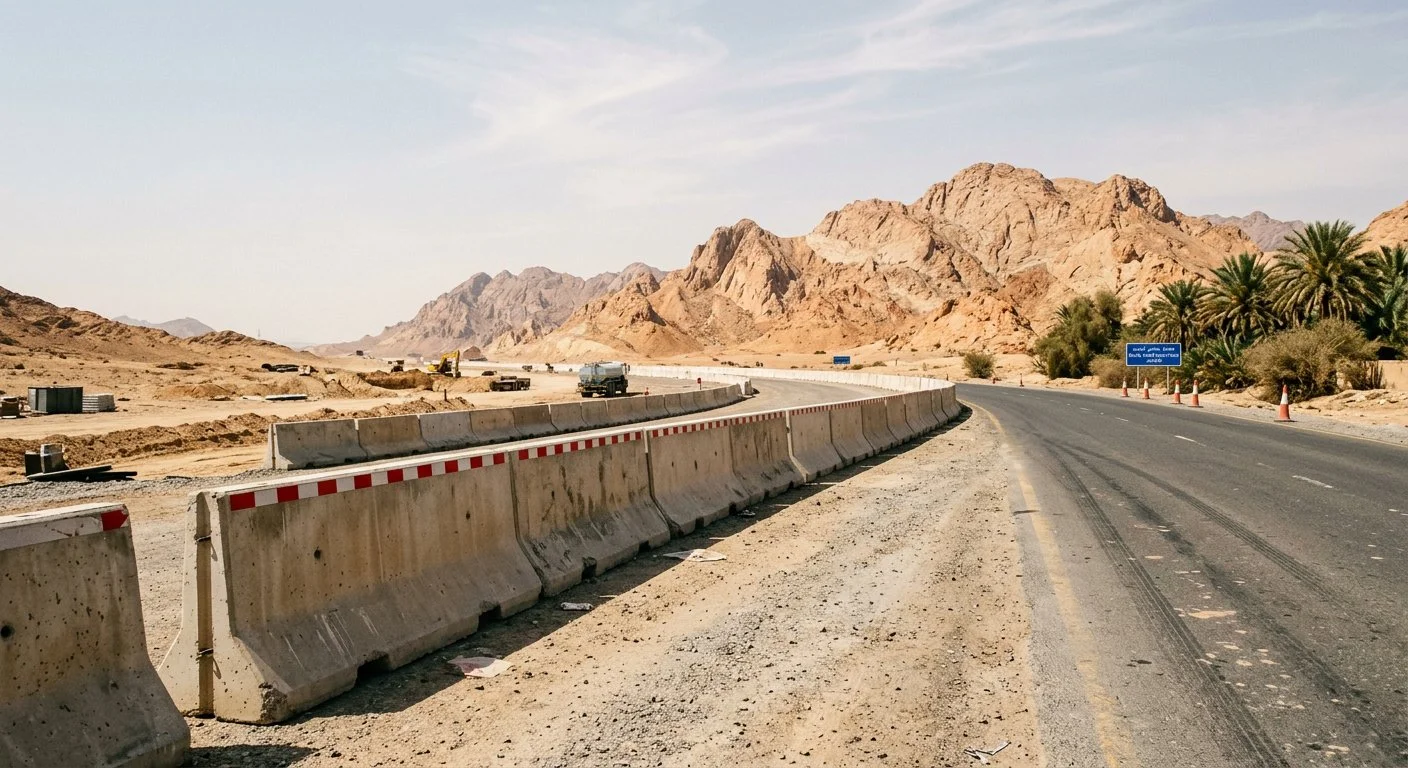
Road upgrades and maintenance. The E66 corridor, the Al Ain to Dubai Road, and the internal road programmes in Al Ain city and the surrounding municipalities regularly require diversions on carriageways operating at 80 to 100 km/h. These works need F-Type or equivalent profile units with the corresponding crash documentation.
Industrial and utility development. Sanaiya, Al Markhaniya and the industrial zones supporting the Western Region oil and gas sector require perimeter barriers, laydown yard containment and long-duration temporary works. Durability and reusability carry more weight than profile speed class here.
Institutional and residential development. The university corridor, government projects and new residential districts require lower-speed containment, hard barricading of excavations, and visual consistency with municipal streetscape requirements.
Authority Framework for Al Ain and Al Dhafra
Barrier installations in the region are governed by Abu Dhabi requirements as applied through the Department of Municipalities and Transport (DMT) and the Al Ain City Municipality, with traffic control elements reviewed alongside the emirate’s road safety framework.
The practical requirements for approval on inland projects are consistent with wider Abu Dhabi practice:
| Requirement | Standard Applied in Al Ain and Al Dhafra |
|---|---|
| Concrete strength | Grade C40 minimum, reinforced; C50 for coastal areas |
| Barrier profile | F-Type for high-speed works; Jersey accepted for lower-speed applications |
| Surface finish | Clean, no visible cracks, honeycombing or spalling |
| Identification | Supplier name, batch ID and grade marked on each unit |
| Documentation | Mix design certificate, compressive strength reports, delivery notes |
| Lifting compatibility | Cast-in lifting anchors or forklift recesses |
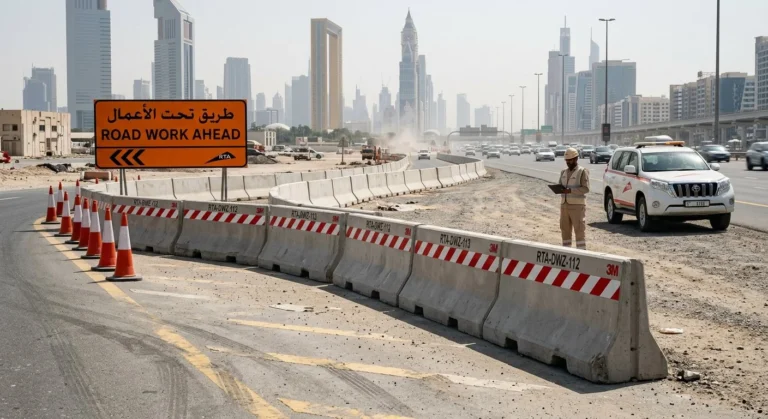
| Reflectors | Reflective markings on road-facing runs per authority requirements |
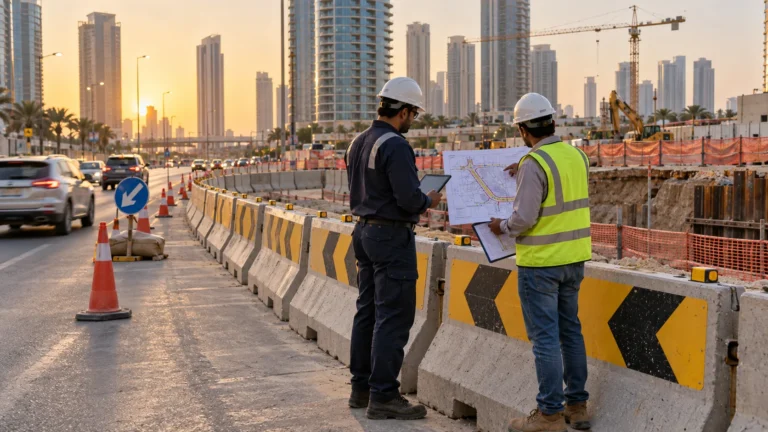
Applications are typically submitted with the traffic management plan, which must show the barrier run, taper, buffer and end treatment. The documentation package we issue with every delivery is prepared for this purpose, and the same framework is described in detail in our municipality regulations guide for Dubai and Abu Dhabi.
Barrier Types Suited to Inland Conditions
Inland conditions in Al Ain and Al Dhafra differ from the coast in ways that matter for selection. Summer temperatures inland routinely exceed those on the coast, dust exposure is higher, and temperature differentials between day and night are greater.
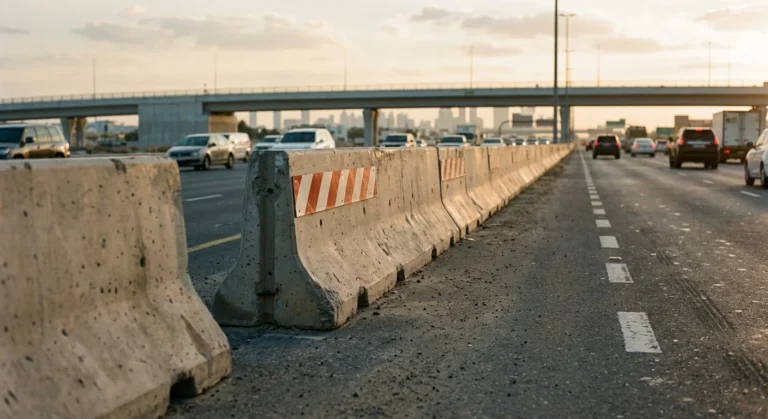
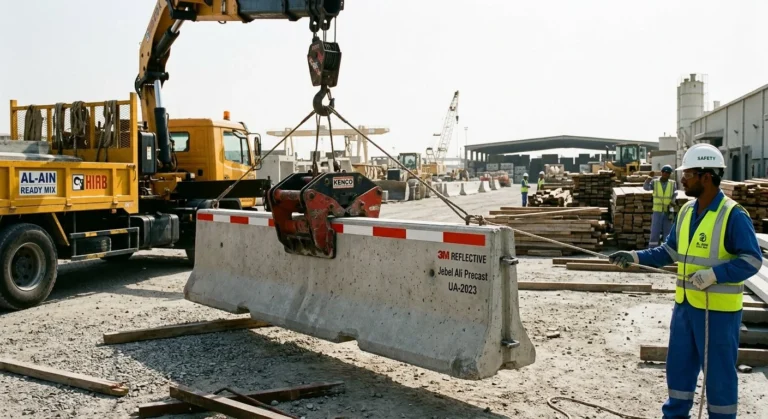
F-Type, 3 m and 4 m units are the correct specification for the E66 and the Al Ain to Dubai Road, where operating speeds and traffic volumes require a crash-tested safety shape. Weights of 1,800 to 2,400 kg per unit govern the crane selection and truck count.
Jersey, 3 m units remain the practical standard for internal roadworks, community projects and diversions below 80 km/h. At 1,200 to 1,600 kg, a single unit is manageable for a Hiab on a 10-tonne truck.
Jersey, 2 m units suit constrained sites in developed areas of Al Ain, where access gates, tree pits and existing utilities limit the space available for placing a 3 m unit.
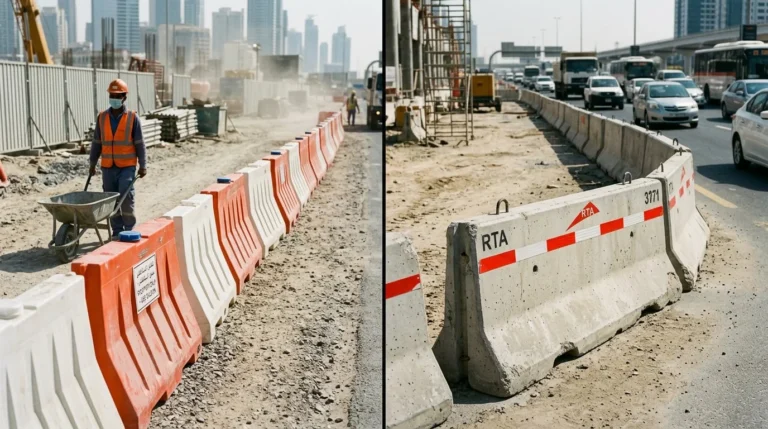
Single-side and double-side units for compound perimeters, laydown yards and hoarding lines on industrial sites, where the requirement is containment rather than public road protection.
Full dimensional and weight data for each type is set out in our Jersey barrier dimensions and weight guide, and profile selection by road class is covered in our F-Type, Jersey and single-slope comparison.
Delivery Logistics from the Industrial Areas to Al Ain
Barriers for Al Ain projects are normally collected or delivered from the Dubai industrial belt, with the principal route running inland via the E66. The following planning figures are drawn from our regular runs and are indicative for dry, unrestricted conditions.
| Destination | Approximate Route | Road Time from Jebel Ali Area | Recommended Delivery Planning |
|---|---|---|---|
| Al Ain city and Sanaiya | E66 via Al Faqa | 1 hour 45 minutes to 2 hours 15 minutes | Single cluster delivery to full site requirement |
| Al Markhaniya and university corridor | E66 into city internal roads | 2 to 2 hours 30 minutes | Deliver outside school and peak hours |
| Jebel Hafeet approaches | E66 and internal mountain access | 2 hours 30 minutes or more | Verify gradient and turning circle for the delivery vehicle |
| Madinat Zayed | E11 and E65 inland | 2 hours 30 minutes to 3 hours | Confirm crane availability at destination before dispatch |
| Ruwais and Western Region | E11 westward | 3 hours 30 minutes or more | Plan as a multi-truck convoy; verify site access permits |
Three planning rules apply to every inland delivery.
Cluster the loads. Delivery cost is charged per truck movement, not per barrier. Combining your full requirement into consecutive truckloads reduces cost and avoids repeat trips for shortfalls. The quantity calculation method is set out in our barrier takeoff guide.
Book the slot against the permit, not the order. For E66 and municipal roadworks, the diversion cannot be placed before the permit window opens. Schedule delivery for the morning of the approved start rather than the day before, unless you have secure storage at site.
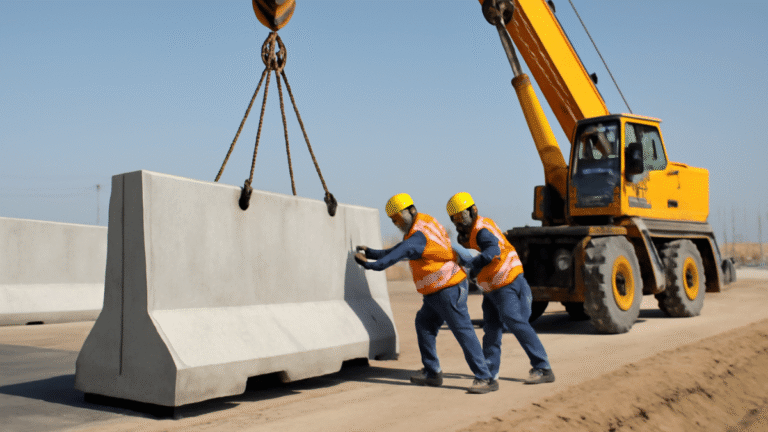
Confirm the offloading equipment at the destination. A 3 m F-Type unit at 2,400 kg requires the correct crane at the correct radius. Where the site cannot receive a Hiab, inform us at order stage so that lifting arrangements are planned with the delivery.
For current restrictions affecting truck movement times in Dubai, which apply to any load departing our yard, refer to our guide on the 2026 truck movement restrictions and barrier delivery.
Indicative Pricing for Inland Projects
Unit pricing is the same as for coastal projects. The variable is delivery distance and truck count.
| Item | Specification | Indicative Price (AED) |
|---|---|---|
| Jersey barrier, 3 m | 810 to 1,000 mm height, C40/50 | 350 to 650 per unit |
| Jersey barrier, 2 m | 800 mm height, interlocking | 300 to 480 per unit |
| F-Type barrier, 3 m | 1,067 mm height | 500 to 750 per unit |
| Delivery to Al Ain | Per 6 m truck or 40 ft flatbed | 650 to 950 per truck |
| Delivery to Madinat Zayed and Ruwais | Per truck | 1,100 to 1,600 per truck |
| Reflective markings | Per unit, factory fitted | 25 to 50 per unit |
Full rate cards, rental alternatives and bulk discount thresholds are set out in our precast concrete barrier prices guide. For projects of uncertain duration, the comparison in our rental versus purchase analysis shows where each option is more economical.
Handling and Storage on Inland Sites
Two site conditions are common inland and both affect barrier condition.
Ground conditions in parts of the region include compacted sabkha and made ground. Barriers placed close to open trenches or on recently backfilled ground can settle, opening joints. Place runs on the road side of the excavation, or on bearing timbers where the surface is uncertain.
Dust and heat affect reflective markings more than the concrete itself. Factory-fitted reflective sheeting should be inspected for adhesion at the time of delivery and covered if the units will be stored at site for more than 30 days. Storage practice, dunnage and stacking limits are covered in our barrier handling and storage guide.
Frequently Asked Questions
Who supplies concrete barriers to Al Ain and the Western Region?
Arab Precast supplies precast concrete barriers to projects across Al Ain, Al Dhafra and the Western Region from our Jebel Ali facility, with delivery by Hiab-equipped trucks and full documentation for municipal submission. Units are cast to C40/50 concrete with Grade 60 reinforcement and factory-fitted reflective markings where specified.
How long does delivery to Al Ain take?
The road time from our yard to Al Ain is approximately 1 hour 45 minutes to 2 hours 15 minutes via the E66, subject to traffic and any truck movement restrictions in effect. We schedule inland deliveries as clustered loads against your permit window rather than as single-unit drops.
Which barrier profile is required for E66 works?
Works on the E66 and comparable roads are typically specified with the F-Type safety shape profile, supported by crash documentation for the required containment class. The controlling document is the consultant’s typical cross-section in the approved traffic management plan.
Can barriers be stored on site before the permit starts?
Yes, provided the storage area is secure, hard-standing and clear of traffic. Barriers should be placed on level ground with timber dunnage, no more than two units high for 3 m lengths, and reflective markings protected if storage exceeds 30 days.
Is rental available for short works in Al Ain?
Yes. Rental is generally the economical choice for works shorter than one month, while purchase with our buyback programme is more efficient for longer programmes. The break-even analysis and current rental rates are set out in our rental versus purchase guide.
Planning Your Al Ain Delivery
For a firm delivery plan, send us the site location, the required quantity by profile and length, the approved or expected permit start date, and any access constraints at the gate. We will confirm the delivery sequence, truck count and offloading arrangement, and hold stock against your programme.
Contact the team through our contact page or WhatsApp +971 58 660 9400. Our standard product range is on the precast concrete products page, and further guides for inland and northern projects are on our blog.