
Top Uses of Precast Concrete Barriers in the UAE — Complete 2026 Guide
The UAE is one of the fastest-growing construction markets in the world. In 2025 alone, over AED 180 billion was invested in infrastructure projects across the seven Emirates. And in almost every one of those projects, precast concrete barriers play a critical role — from highway safety to construction site security, event management to flood protection.
But precast barriers aren’t one-size-fits-all. Different applications require different types, sizes, and specifications. In this guide, we break down the top uses of precast concrete barriers in the UAE, what type of barrier each application needs, how much it costs, and where to source them.
Quick Answer: The five biggest uses of precast concrete barriers in the UAE are: highway lane separation, construction site perimeter protection, temporary traffic management, anti-ram security for high-risk facilities, and flood/drainage control. Barrier costs range from AED 250–900 per unit depending on type and application.
Use #1: Highway & Road Safety Barriers
Share of UAE barrier usage: ~40%
This is by far the largest application for precast concrete barriers in the UAE. With over 4,000 km of federal highways and a rapidly expanding road network connecting Dubai, Abu Dhabi, Sharjah, Ajman, and the Northern Emirates, road safety barriers are in constant demand.
What They Do:
- Separate opposing lanes of high-speed traffic to prevent head-on collisions
- Redirect errant vehicles back onto the roadway using engineered barrier geometry
- Protect roadside hazards like bridge piers, signposts, and utility poles
- Create permanent lane dividers on multi-lane expressways
Barrier Types Used:
| Application | Recommended Barrier | Why |
|---|---|---|
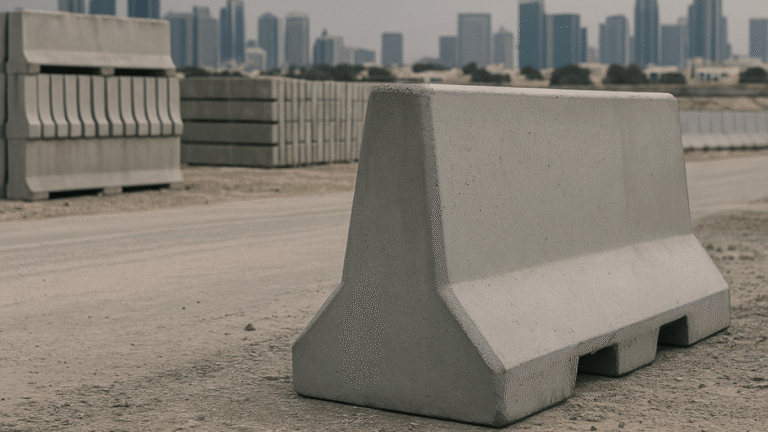
| Highway medians | Double-side Jersey barrier (1000mm height) | Symmetrical impact protection from both directions |
| Road edges | Single-side barrier (800mm height) | One-directional protection, lighter weight |
| Expressway dividers | F-Type barrier (1067mm height) | Steeper lower slope reduces vehicle climbing — RTA mandated on E-roads |
| Bridge parapets | Interlocking barrier (1200mm height) | Continuous connection prevents gaps at elevation |
UAE Examples:
- Sheikh Zayed Road (E11): F-Type and Jersey barriers throughout the entire Dubai–Abu Dhabi corridor
- Emirates Road (E611): Interlocking double-side barriers on median dividers
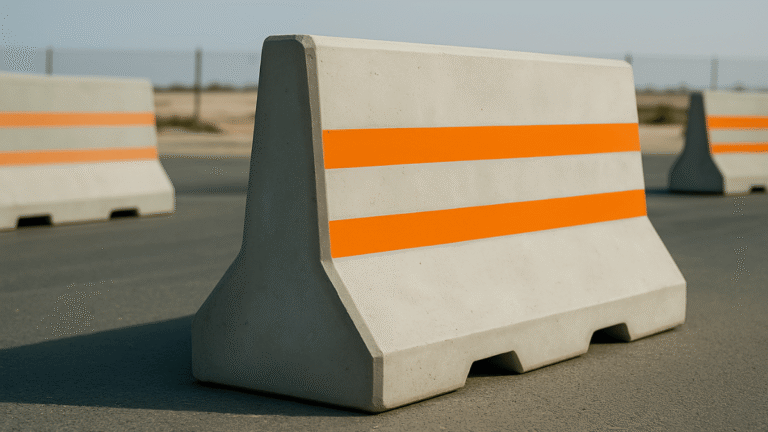
- Dubai Bypass (E311): Jersey barriers with reflective striping for night visibility
- Abu Dhabi–Al Ain Road (E22): F-Type barriers on high-speed sections
Pricing for Highway Barriers:
| Barrier Type | Unit Price (AED) | Typical Order Size |
|---|---|---|
| Jersey barrier (3m) | AED 350–550 | 500–5,000+ units |
| F-Type barrier (4m) | AED 500–850 | 200–3,000+ units |
| Interlocking barrier (3m) | AED 450–800 | 100–2,000+ units |
| Single-side barrier (2m) | AED 250–400 | 300–4,000+ units |
Note: Prices vary based on concrete grade, reinforcement level, quantity, and delivery distance. Get a custom quote →
Municipality Requirements:
Highway barriers in the UAE must comply with RTA specifications (Dubai) and DMT standards (Abu Dhabi). Key requirements include:
- Minimum concrete compressive strength of C40 (40 MPa)
- Steel reinforcement per structural engineering approval
- Surface finish with reflective paint or strips for night visibility
- Batch testing certificates submitted with each delivery
Need the full regulatory breakdown? We cover RTA and DMT barrier requirements in detail in our municipality regulations guide for concrete barriers in Dubai and Abu Dhabi.
Use #2: Construction Site Protection
Share of UAE barrier usage: ~25%
With over 3,500 active construction projects across the UAE at any given time — from skyscrapers in Downtown Dubai to industrial complexes in KIZAD Abu Dhabi — construction site safety is a massive and growing market for precast barriers.
What They Do:
- Create physical perimeters around active construction zones
- Separate workers and pedestrians from heavy vehicle traffic
- Prevent unauthorized access to dangerous areas (excavations, crane zones, material storage)
- Block debris spillage onto adjacent public roads and sidewalks
- Comply with municipal safety regulations that mandate site perimeter barriers
Barrier Types Used:
| Site Type | Recommended Barrier | Reason |
|---|---|---|
| Roadside construction | Portable single-side barriers (800mm) | Easy to relocate as work progresses |
| Excavation sites | Double-side barriers (1000mm) | Protection from both directions |
| Urban high-rise sites | Interlocking barriers (1000mm) | Continuous perimeter, no gaps |
| Industrial/warehouse construction | Heavy-duty barriers (1200mm+) | High-impact vehicle zones |
Why Contractors Prefer Precast Barriers for Construction Sites:
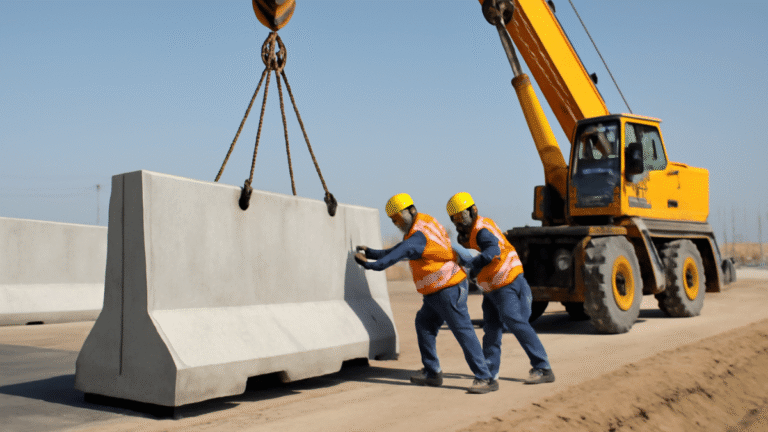
- Instant deployment — no curing time, barriers are ready the moment they arrive on site
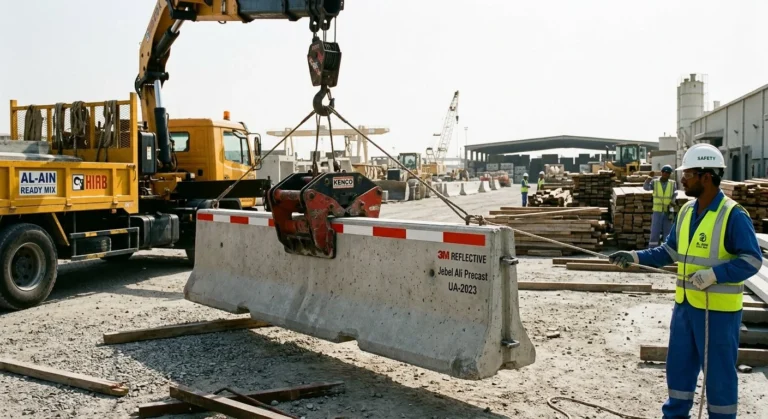
- Relocatable — as construction phases shift, barriers can be lifted and repositioned
- Reusable — the same barriers can serve multiple projects over 10–15 years
- No maintenance — unlike temporary fencing, concrete barriers don’t rust, warp, or degrade
- Municipality-approved — Arab Precast barriers meet all UAE construction site safety codes
Typical Construction Site Barrier Requirements:
| Project Size | Estimated Barriers Needed | Barrier Type |
|---|---|---|
| Small villa/residential (500–2,000 sqm) | 20–50 units | 2m single-side barriers |
| Medium commercial building (2,000–10,000 sqm) | 50–200 units | 3m single or double-side barriers |
| Large tower/infrastructure (10,000+ sqm) | 200–1,000+ units | 3–4m interlocking barriers |
| Industrial warehouse complex | 100–500 units | Heavy-duty 1200mm+ barriers |
Safety Compliance Checklist for UAE Construction Sites:
- Barriers meet minimum height requirement (800mm for roadside, 1000mm for internal sites)
- Reflective markings visible at night
- Lifting hooks or forklift recesses for easy repositioning
- Interlocking connectors for continuous perimeter runs
- Batch ID and supplier certification tags on each unit
- Approved by relevant municipality (Dubai DM, Abu Dhabi DMT, etc.)
Not sure which barrier type fits your construction site? Our guide on how to choose the right precast barrier for your project in the UAE walks you through every decision step by step.
Use #3: Traffic Management & Temporary Diversion
Share of UAE barrier usage: ~15%
The UAE’s road network is constantly being upgraded, maintained, and expanded. Every road closure, lane shift, or detour requires temporary traffic barriers that can be deployed quickly and removed just as fast.
Common Scenarios:
- Road maintenance and resurfacing — closing lanes on Sheikh Zayed Road, Al Khail Road, etc.
- Utility installation — water, gas, electricity, and fiber optic cable trenching
- Event management — road closures for the Dubai Marathon, Abu Dhabi F1, National Day parades, and other large events
- Emergency situations — accident cleanup, flood response, structural repairs
- Municipal works — sidewalk repairs, drainage upgrades, street light installation
Barrier Types Used:
| Scenario | Recommended Barrier | Key Feature |
|---|---|---|
| Lane closure | Portable single-side barriers (600–800mm) | Lightweight, easy to move |
| Long-term detour (1–6 months) | Double-side barriers (1000mm) | More stable for extended deployment |
| Event crowd control | Low-height barriers (600mm) | Visible deterrent without blocking sightlines |
| Emergency response | Interlocking barriers with quick-connect | Rapid deployment, continuous perimeter |
Why Precast Barriers Excel for Temporary Traffic Management:
- No permanent installation required — unlike cast-in-place barriers, precast units are simply placed and removed
- Zero curing time — deployed immediately upon delivery
- Reusable across multiple projects — the same barriers can serve 10+ deployments over their lifespan
- Cost-effective for short-term use — rental options available from AED 15–35 per barrier per day
- Minimal traffic disruption — placement and removal takes minutes per unit
Traffic Management Barrier Pricing:
| Option | Price Range | Best For |
|---|---|---|
| Purchase (standard barriers) | AED 250–500 per unit | Long-term or multi-project use |
| Short-term rental | AED 15–35 per unit per day | Events, emergency response, 1–4 week closures |
| Long-term rental | AED 300–600 per unit per month | Multi-month roadworks, phased construction |
| Buyback program | 40–60% of purchase price | Government and mega-projects |
Use #4: Perimeter & Anti-Ram Security
Share of UAE barrier usage: ~10%
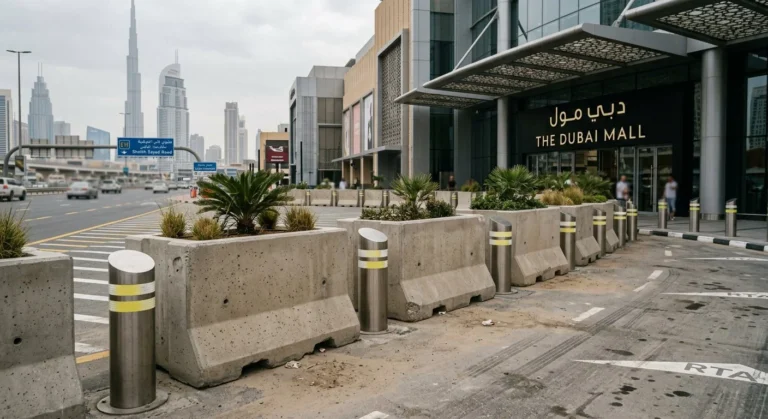
The UAE hosts some of the most critical infrastructure in the Gulf — international airports, seaports, oil & gas facilities, government ministries, military installations, and embassies. These sites require anti-ram concrete barriers rated for vehicle impact protection.
Where Anti-Ram Barriers Are Used:
- Airports — DXB Terminal 3, DWC, Abu Dhabi International Airport perimeter protection
- Seaports — Jebel Ali Port, Khalifa Port, Khor Fakkan access control
- Government buildings — ministries, royal palaces, and official residences
- Military installations — UAE Armed Forces bases and defense facilities
- Oil & gas facilities — ADNOC operations, refineries, and pipeline stations
- Diplomatic zones — embassies and consulates in Abu Dhabi and Dubai
- Critical infrastructure — power plants, water desalination facilities, data centers
Barrier Types Used:
| Security Level | Recommended Barrier | Specifications |
|---|---|---|
| Standard perimeter | Interlocking barriers (1000mm height) | Male-female connection system, C40+ concrete |
| Medium security | Reinforced double-side barriers (1200mm) | Extra rebar, wider base, anti-climb profile |
| High security / anti-ram | Custom heavy-duty barriers (1500mm+) | Blast-rated design, 50+ MPa concrete, deep foundation anchors |
Key Features of Security-Grade Barriers:
- Anti-ram rated — tested to stop vehicles at specific speeds (typically 50–80 km/h)
- Wider base — increased stability prevents tipping under impact
- Interlocking design — creates continuous barrier line with no weak points
- Custom reinforcement — additional steel rebar for higher impact resistance
- Surface treatments — anti-graffiti coating, reflective markings, or aesthetic finishes for public-facing installations
Security barrier specifications vary by facility type and risk level. Contact Arab Precast directly for custom anti-ram barrier designs and certifications.
Use #5: Flood & Drainage Protection
Share of UAE barrier usage: ~5% (and growing rapidly)
After the record rainfall events of 2024–2025 across the UAE, demand for flood protection barriers has surged. Precast concrete barriers are now being deployed for drainage management, stormwater control, and flood defense in vulnerable areas.
Applications:
| Use Case | Barrier Type | How It Works |
|---|---|---|
| Stormwater diversion | Flat-top interlocking barriers (800mm) | Channels water away from roads and buildings |
| Trench excavation support | Heavy-duty trench barriers (1000mm+) | Prevents soil collapse during drainage works |
| Temporary flood walls | Stackable barriers (600–1200mm) | Creates rapid-deployment flood defense perimeters |
| Wadi protection | Reinforced single-side barriers (1200mm+) | Redirects flash flood water in mountainous areas |
| Underground utility protection | Precast trench covers + side barriers | Shields water, gas, and electrical lines |
Why Precast Concrete for Flood Defense:
- Massive weight — stays in place even under high water pressure
- Waterproof — concrete doesn’t absorb or degrade when submerged
- Quick deployment — barriers placed in hours, not days
- Reusable — same barriers redeployed after flood events
- Cost-effective — much cheaper than permanent concrete walls
Recent demand: Following the April 2024 UAE floods, barrier orders for drainage and flood protection increased by over 300% in Dubai and Sharjah. This is now one of the fastest-growing applications for precast concrete in the region.
Use #6: Parking Lots & Access Control
Share of UAE barrier usage: ~5%
Every commercial building, residential community, mall, and industrial facility in the UAE needs controlled access and vehicle flow management. Precast concrete barriers are the most cost-effective solution.
Common Applications:
- Mall and retail parking — lane dividers, pedestrian walkway protection, reserved space marking
- Residential community access — gate barriers, visitor parking perimeters, speed control
- Industrial facility access — truck lane management, loading zone delineation, forklift safety
- Airport parking — multi-level ramp barriers, long-term parking zone dividers
- Hospital and school zones — drop-off/pick-up lane barriers, pedestrian safety perimeters
Barrier Types Used:
| Application | Recommended Barrier |
|---|---|
| Parking lane dividers | Low-height single-side barriers (600mm) |
| Access gates | Standard Jersey barriers (800mm) |
| Loading zones | Interlocking barriers (800mm) |
| Pedestrian walkways | Lightweight portable barriers (600mm) |
Complete Barrier Selection Guide by Application
Not sure which barrier type fits your project? Here’s a quick reference:
| Application | Best Barrier Type | Height | Length | Estimated Cost (AED/unit) |
|---|---|---|---|---|
| Highway medians | F-Type / Jersey | 1000–1067mm | 3–4m | 500–850 |
| Road edges | Single-side Jersey | 800mm | 2–3m | 250–450 |
| Construction sites | Single or double-side | 800–1000mm | 2–3m | 250–500 |
| Traffic diversion | Portable single-side | 600–800mm | 2m | 250–400 |
| Event management | Low portable barriers | 600mm | 1.5–2m | 200–350 |
| Anti-ram security | Reinforced interlocking | 1200–1500mm | 3–4m | 600–1,200 |
| Flood protection | Stackable flat-top | 800–1200mm | 2–3m | 350–700 |
| Parking access | Low single-side | 600mm | 2m | 200–350 |
Need help choosing? Our detailed guide on how to choose the right precast barrier for your UAE project covers every factor from load ratings to municipality compliance.
Why Precast Barriers Outperform Alternatives in the UAE
When choosing barrier types for UAE projects, contractors typically compare three options:
| Factor | Precast Concrete | Cast-in-Place Concrete | Plastic/Water-Filled |
|---|---|---|---|
| Impact Protection | Excellent | Excellent | Poor to Moderate |
| Installation Speed | Hours | Days–weeks | Minutes |
| Durability (years) | 30–50 | 20–30 | 2–5 |
| Weather Resistance | Superior (handles 50°C+ heat) | Good (curing issues in heat) | Poor (UV degradation) |
| Reusability | Yes — multiple deployments | No — permanent | Limited |
| Municipality Approval | Pre-approved designs available | Requires individual engineering sign-off | Limited acceptance |
| Total Cost Over 10 Years | Lowest | Moderate | Highest (frequent replacement) |
Want a deeper technical comparison? Read our full breakdown of precast vs cast-in-place concrete barriers in the UAE.
FAQ — Top Uses of Precast Concrete Barriers
What are the most common uses of precast concrete barriers in the UAE?
The five biggest applications are: highway and road safety (40% of usage), construction site protection (25%), temporary traffic management (15%), perimeter and anti-ram security (10%), and flood/drainage protection (5% — growing rapidly).
Can I rent concrete barriers for short-term projects in the UAE?
Yes. Arab Precast offers both short-term rental (AED 15–35 per barrier per day) and long-term rental (AED 300–600 per barrier per month) options. Rental is ideal for events, temporary road closures, and phased construction projects.
What type of barrier is best for highway projects?
F-Type barriers are the standard for UAE highways. They’re RTA-approved, feature a steeper lower slope that reduces vehicle climbing during impact, and are mandatory on many federal roads. Jersey barriers are also widely used for general highway applications.
Are precast concrete barriers approved by Dubai RTA and Abu Dhabi DMT?
Yes. Arab Precast’s standard barrier designs are pre-approved by Dubai RTA and comply with Abu Dhabi DMT requirements. We provide complete documentation including engineering drawings, test certificates, and mix design reports for authority submission.
How long do precast concrete barriers last in the UAE’s climate?
Precast concrete barriers have a design life of 30–50 years in the UAE. They resist extreme heat (50°C+), UV exposure, coastal salt air, and heavy rainfall — making them ideal for the region’s harsh conditions.
Can precast barriers be used for flood protection?
Yes. After the 2024–2025 flood events, demand for precast concrete barriers as temporary flood walls and stormwater diversion channels has grown significantly. Stackable flat-top barriers (800–1200mm) are most commonly used for flood defense applications.
Do you deliver barriers across all 7 Emirates?
Yes. Arab Precast delivers to Dubai, Abu Dhabi, Sharjah, Ajman, Ras Al Khaimah, Fujairah, and Umm Al Quwain. Standard delivery is within 2–5 business days depending on quantity and location.
Ready to Source Barriers for Your Project?
At Arab Precast, we manufacture and supply municipality-approved precast concrete barriers for every application listed above. Whether you need 10 barriers for a small construction site or 10,000 for a highway project, we deliver on time, on spec, on budget.
- ✅ RTA & DMT approved standard designs
- ✅ Grade 40+ concrete with full certification
- ✅ Custom sizes available for unique requirements
- ✅ Rental and purchase options to fit your budget
- ✅ Delivery across all 7 Emirates within 2–5 days
- ✅ Professional installation services available
📞 Call us: +971 58 660 9400
📧 Email: info@arabprecast.ae
💬 WhatsApp: Chat with our team