F-Type vs Jersey vs Single-Slope Barrier in the UAE: Which Profile Does Your Project Actually Require?
A consultant in Abu Dhabi recently returned a contractor’s traffic management plan with a single comment: “Incorrect profile for design speed.” The contractor had priced Jersey barriers along a 100 km/h section of expressway. The correct unit was F-Type. The difference per unit was roughly AED 150. The cost of remobilising 400 units, with crane and traffic management already in place, was considerably higher.
In the UAE, the profile of a concrete barrier is not a stylistic preference. It is a safety geometry that is matched to the operating speed of the road and confirmed in the consultant’s typical cross-section drawing. Selecting the wrong profile is one of the most common reasons for plan rejection at RTA and DMT.
This guide explains the three profiles in current UAE use, where each is accepted, and how to confirm the correct selection before you order.
The Three Profiles in UAE Use Today
Jersey Profile
The Jersey profile is the original two-angle safety shape developed in the United States in the 1950s. It has a low vertical toe at the base, a lower slope of approximately 55 degrees, and a steeper upper face. On impact, the vehicle’s wheel is lifted along the lower slope and the body is redirected along the upper face, returning the vehicle to the carriageway.
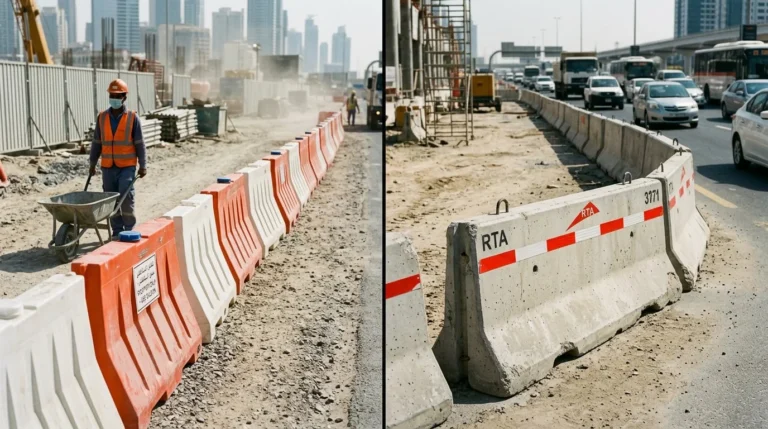
In the UAE, the Jersey profile is the standard stock item and the default for work zones, temporary diversions and general construction applications. It is widely accepted for roads operating below 80 km/h.
F-Type Profile
The F-Type profile is a refinement of the Jersey shape, developed by the US Federal Highway Administration. The key difference is the position of the break point between the two slopes, which sits lower on the face. This gentler first contact reduces the lift imparted to modern passenger vehicles with lower profiles, lowering the risk of rollover at highway speeds.
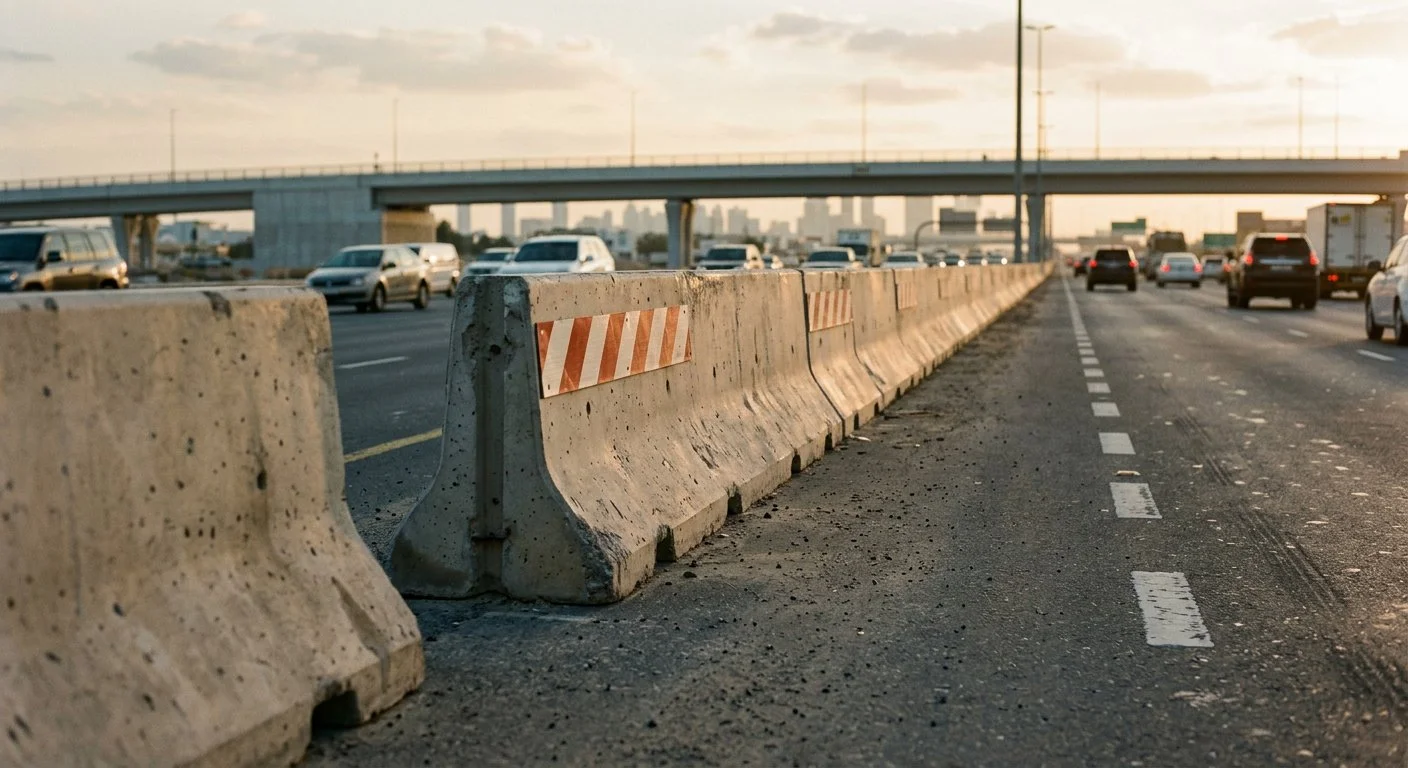
In the UAE, RTA and Abu Dhabi DMT specify the F-Type profile for high-speed applications, including expressway medians and permanent installations on roads operating at 80 km/h and above. Where the project consultant’s cross-section drawing calls for a safety shape on a main road, the F-Type is normally the intended unit.
Single-Slope Profile
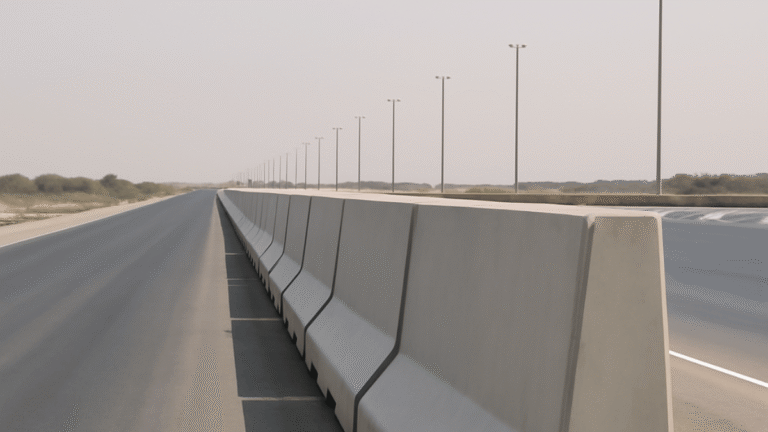
The single-slope barrier, also known as the constant-slope profile, uses one continuous face angle of approximately 10 degrees from base to top, with no break point. The principal advantage is tolerance to resurfacing: as asphalt overlays accumulate on a road over its service life, the effective height of a two-angle barrier reduces and its redirection geometry changes, whereas the single-slope face continues to present the same contact angle.
Single-slope units are specified in the UAE for permanent medians on roads with a planned resurfacing cycle, and for locations where long-term maintenance access to the median is restricted.
Profile Comparison: UAE Specifications
The following table reflects standard units produced for the UAE market with C40/50 concrete and Grade 60 reinforcement.
| Specification | Jersey Profile | F-Type Profile | Single-Slope Profile |
|---|---|---|---|
| Face geometry | Two-angle, break at approximately 330 mm | Two-angle, break at approximately 255 mm | One constant angle, approximately 10 degrees |
| Standard height | 810 mm to 1,000 mm | 1,067 mm | 810 mm |
| Standard base width | 600 mm | 600 to 700 mm | 560 mm |
| Standard length | 2 m and 3 m | 3 m and 4 m | 3 m |
| Weight, 3 m unit | 1,200 to 1,600 kg | 1,800 to 2,400 kg | 1,600 to 2,000 kg |
| Rollover risk at highway speed | Moderate | Low | Low |
| Authority preference in UAE | Work zones, roads below 80 km/h | RTA and DMT high-speed roads and permanent medians | Permanent medians with resurfacing cycles |
The complete range of profiles, finishes and lifting arrangements we produce is listed on our precast concrete barriers product page, with full dimensional data in our Jersey barrier dimensions and weight guide.
Matching Profile to Road Class in the UAE
The selection follows the posted or design speed of the road at the barrier location.
| Road Class | Typical Speed | Required Profile | Notes |
|---|---|---|---|
| Local and community roads | 30 to 40 km/h | Jersey, single-side or plastic channelizer | Pedestrian risk dominates; containment requirement is low |
| Collector and service roads | 60 km/h | Jersey profile | Standard stock unit; verify with TMP drawing |
| Primary roads and urban highways | 80 km/h | F-Type on traffic-facing runs | Confirm taper, flare and buffer with RTA requirements |
| Expressways, E11, E311, E611 | 100 km/h and above | F-Type for permanent and long-duration works | Crash-tested profile mandatory; anchoring per drawing |
| Permanent medians with resurfacing plans | Variable | Single-slope or F-Type | Single-slope preserves redirection geometry across overlays |
If the consultant’s drawing specifies a containment class rather than a profile name, the profile is confirmed against the crash test certificate that demonstrates that class. The two work together, and neither is a substitute for the other.
Understanding Crash Test Standards Behind the Profile
The profile is only one part of the safety case. The barrier system is accepted on the basis of crash testing to a recognised standard.
BS EN 1317 is the European standard and is widely referenced in UAE specifications. It defines containment levels, with N2 and N3 the common requirements for high-speed roads, together with working width and vehicle intrusion classes.
MASH (Manual for Assessing Safety Hardware) is the US standard and appears frequently on infrastructure and government projects in the UAE. Test Level 3 is the usual benchmark for high-speed applications.
Two points are frequently misunderstood. First, a profile drawing is not a crash test certificate; the unit must be demonstrably tested in the configuration supplied, including the connection detail and run length. Second, connection matters: RTA treats unconnected barriers as individual units, while a pinned, interlocked run is assessed as a continuous system and receives containment credit accordingly.
The regulatory framework, including documentation and approval sequencing for Dubai and Abu Dhabi, is set out in our guide to municipality regulations for concrete barriers in Dubai and Abu Dhabi. Broader project requirements are covered in our concrete road barriers contractor’s blueprint.
Cost Comparison by Profile
Indicative 2026 UAE pricing, ex-works, excluding delivery and installation.
| Profile | Standard Unit | Price Range per Unit (AED) | Price per Linear Metre (AED) | Typical Order Size |
|---|---|---|---|---|
| Jersey, 3 m | 810 to 1,000 mm height | 350 to 650 | 120 to 215 | 100 to 5,000 units |
| F-Type, 3 m | 1,067 mm height | 500 to 750 | 165 to 250 | 200 to 3,000 units |
| F-Type, 4 m | 1,067 mm height | 650 to 850 | 165 to 215 | 100 to 1,000 units |
| Single-Slope, 3 m | 810 mm height | 450 to 700 | 150 to 235 | 100 to 2,000 units |
Bulk discounts apply from 51 units upward, reaching 15 to 25 percent on orders above 500 units. Current rates, rental alternatives and delivery tariffs are detailed in our precast concrete barrier prices guide.
Selection Matrix by Project Type
| Project Situation | Recommended Profile | Why |
|---|---|---|
| Construction site perimeter | Jersey, 2 m or 3 m | Standard stock, repositionable across phases |
| Service road diversion under 60 km/h | Jersey, 3 m | Accepted profile, lowest unit cost |
| Diversion on road at 80 km/h or above | F-Type, 3 m | Matches high-speed containment requirement |
| Permanent expressway median | F-Type, 4 m to drawing | Crash-tested profile for the design speed |
| Median scheduled for future resurfacing | Single-slope | Preserves redirection geometry across overlays |
| Compound or laydown yard | Jersey or single-side | Containment requirement is low; cost efficiency governs |
| Security perimeter at a facility | Not a traffic profile | Requires certified anti-ram units; see our anti-ram security barriers guide |
For projects where the application is still being defined, the decision framework in our guide to choosing the right barrier for your project walks through application, speed and site conditions in sequence.
Five Selection Errors We See Every Quarter
1. Pricing Jersey against an F-Type specification. The unit rates differ by 30 to 45 percent. Verify the profile in the BOQ before submitting the commercial bid.
2. Using terminology from other markets. “K-rail” is a California term encountered on US-specification projects. It refers to a narrower-base safety shape and is not automatically equivalent to the F-Type on the drawing. Confirm by profile dimensions, not by name.
3. Assuming all 3 m barriers are interchangeable. Weights range from 1,200 kg to 2,400 kg depending on profile and reinforcement. Crane capacity, truck counts and delivery pricing all follow the weight, as set out in our barrier weight and handling analysis.
4. Ignoring the connection detail. A correct profile supplied without its specified connection hardware will not be accepted as a system. Confirm the pin, interlock or bolt-through arrangement at order stage.
5. Ordering before the permit is approved. Profile changes after delivery are expensive. Place the order against the approved TMP rather than the draft, and plan the delivery slot accordingly, particularly during the current Dubai truck movement restrictions.
Frequently Asked Questions
Which profile does RTA specify for UAE highways?
For high-speed roads, RTA specifications lean to the F-Type safety shape for permanent medians and long-duration works. The Jersey profile is accepted for lower-speed work zones and construction applications. The controlling document is the project consultant’s typical cross-section, supported by the crash test certificate for the specified containment class.
Is the F-Type barrier the same as a K-rail?
No. K-rail is a California profile with a narrower base of approximately 480 mm and a lower unit weight. The F-Type uses the FHWA safety shape at a 600 to 700 mm base. On international projects the two are sometimes used interchangeably in conversation, which is why selection should be confirmed against dimensions and the test certificate rather than the name.
When is a single-slope barrier the correct choice?
Where the median is permanent and resurfacing is planned within the barrier’s service life. The constant face angle continues to redirect vehicles correctly even after the road level rises, whereas a two-angle profile loses height and changes behaviour as overlays accumulate.
Does the profile affect the price per linear metre?
Yes, but by less than the unit price suggests. Jersey at 3 m runs AED 120 to 215 per linear metre, while F-Type runs AED 165 to 250. Over a long run the difference is material but modest relative to the cost of rejection and reinstatement.
Can profiles be mixed on one project?
Yes, and it is common practice. A typical RTA diversion uses the F-Type on the traffic-facing main run, with Jersey or 2 m units at access gates and corners. The TMP drawing will show the transitions, and the connection details must be compatible at each change.
Placing Your Order Correctly the First Time
Send us three documents and we will confirm the profile, quantity and delivery plan within two hours for projects over 100 linear metres: the typical cross-section from the consultant, the approved TMP drawing or its draft, and the site location with access constraints.
Where the profile is still open, we will recommend based on road speed, duration and resurfacing plans, and supply the crash test documentation and dimensional drawings required for submission.
Contact the technical team through our contact page or WhatsApp +971 58 660 9400. Our complete portfolio is available on the Arab Precast homepage, with further technical guides on our blog.