Jersey Barrier Dimensions and Weight in the UAE: The Spec Card Your Crane Operator Wants Before He Quotes
A QS in Al Ain emailed us a BOQ last month. Line 4.2: “Supply precast concrete jersey barrier, 3m.” Nothing else. No height, no weight, no profile. The crane sub priced it on 900kg a unit. The barriers that fit the RTA diversion weighed 1,500kg. The 25 tonne crane he booked could not reach the far lane at that load. Two days lost arguing about who pays for the 50 tonner.
“Jersey barrier” is not a size. It is a shape. Here is every dimension that matters for the barriers actually sold in the UAE, with the weights, the truck counts and the crane maths.
The Shape First, Then the Numbers
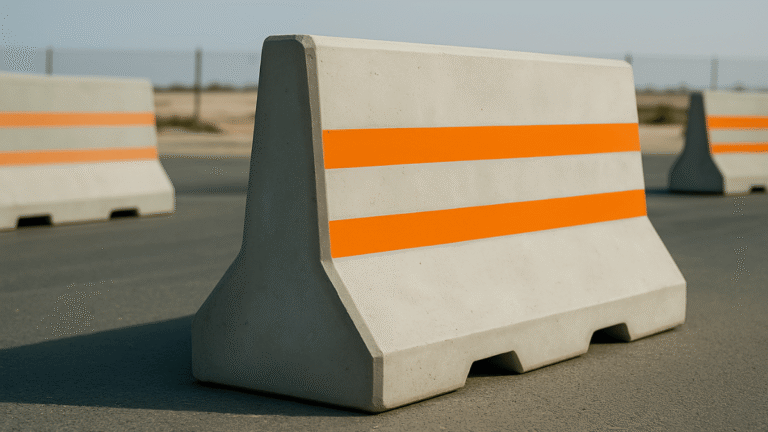
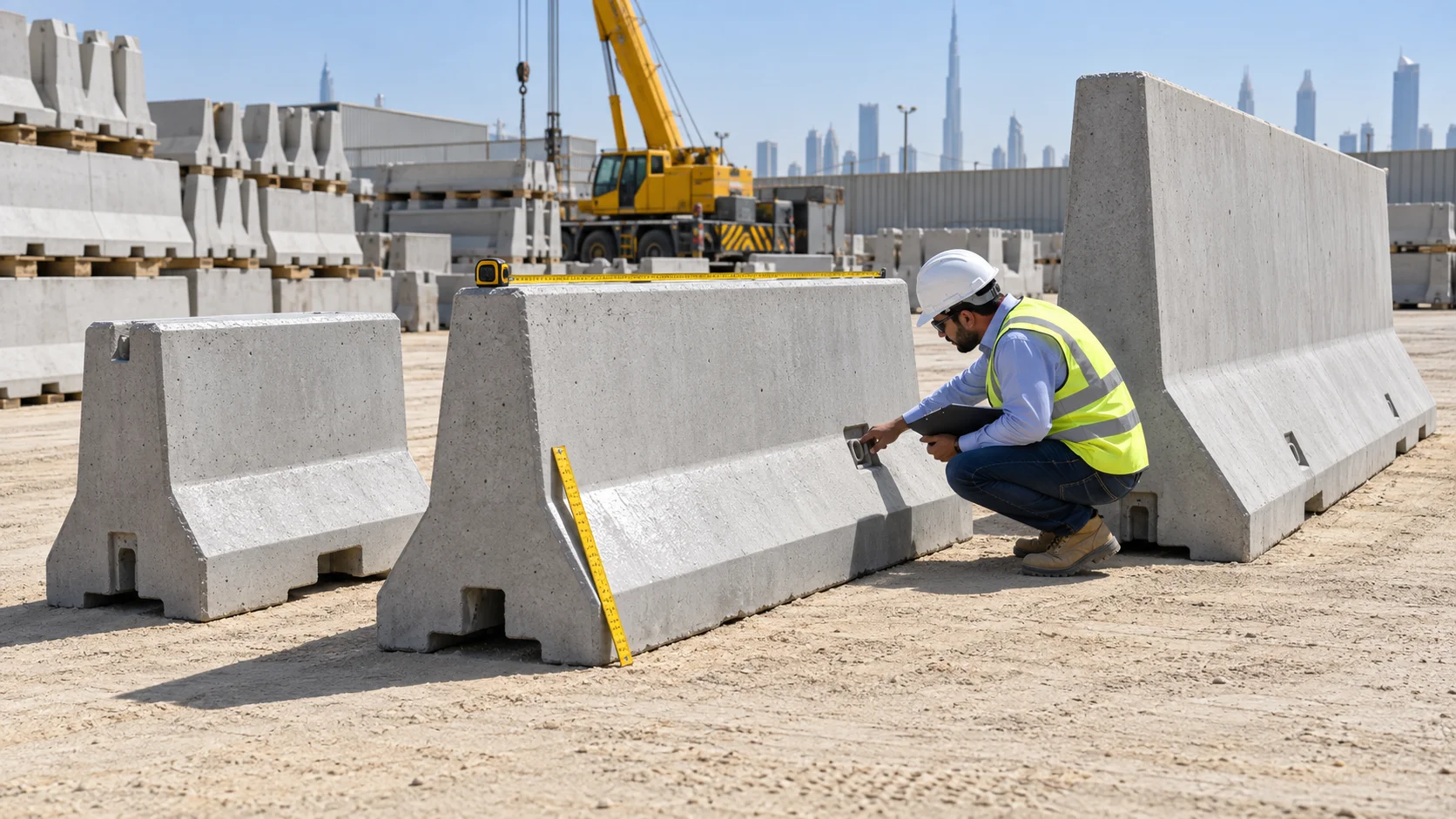
A jersey barrier has a sloped face designed to lift a car’s wheel and steer it back into the lane rather than stop it dead. The classic New Jersey profile is 810mm tall with a 75mm vertical kerb at the bottom, a 55 degree lower slope, then a steeper 84 degree upper face. The F-type profile is the same idea with a lower break point, 255mm instead of 330mm from the ground, which reduces rollover for small cars. On a UAE highway RTA and Abu Dhabi DMT lean to the F-type for permanent medians. For temporary works both are accepted.
Single-sided barriers have one sloped face and a flat back. They sit against a hoarding or an excavation edge. Double-sided have the slope on both faces for medians and two-way diversions.
What this means for you: height is largely fixed by the profile, length is what you choose, and weight follows from both.
The UAE Size Table
These are the sizes we cast (see the barrier product range) and the sizes you will meet from other UAE yards. Weights assume normal-weight C40/50 concrete at about 2,400kg per cubic metre and a standard reinforcement cage. Lightweight or hollow units exist but are rare on road work.
| Unit | Length | Height | Base width | Top width | Weight range | Typical use |
|---|---|---|---|---|---|---|
| Mini / temporary | 1.5m | 600 to 800mm | 400 to 500mm | 150 to 200mm | 300 to 500kg | Car parks, event lines, forklift handling |
| Standard 2m interlocking | 2.0m | 800 to 1,000mm | 450 to 600mm | 150 to 200mm | 750 to 900kg | Site perimeters, service road diversions under 60 km/h |
| Standard 3m jersey | 3.0m | 810 to 1,000mm | 600 to 650mm | 150 to 200mm | 1,200 to 1,600kg | RTA and DMT diversions, median work, long runs |
| F-type highway | 3.0 to 4.0m | 1,067mm | 600 to 700mm | 200 to 230mm | 1,800 to 2,400kg | Permanent highway medians, 100 km/h plus |
| Tall double-sided | 2.0 to 4.0m | 1,200 to 1,500mm | 800 to 1,000mm | 200 to 250mm | 2,000 to 3,500kg | Anti-glare medians, security lines, HVM supplements |
| Anti-ram / T-wall | 3.0m | 1,800 to 3,600mm | 1,000 to 1,500mm | 200 to 300mm | 4,500 to 6,000kg | SIRA and DCD security perimeters |
Round your estimates up, not down. A 3m unit with a full cage, lifting inserts and a wet surface in August weighs more than the brochure says.
Which Length to Order
1m to 1.5m: only where a forklift is the lifting plant, or where you need to thread a line between tree pits and lamp posts. Too many joints for a traffic diversion. Each joint is a weak point and a gap risk.
2m: the site barrier. Light enough for a Hiab on a 10 tonne truck, 12 to 14 units a load, and short enough to turn a tight corner without cutting. Our default for hoarding lines, laydown yards and anything inside a plot.
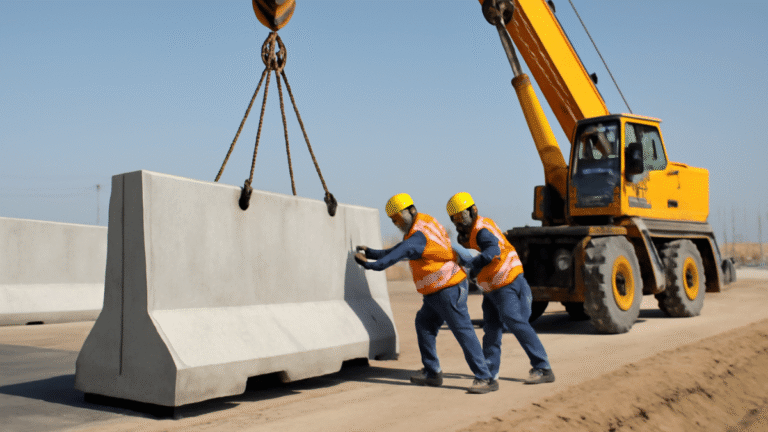
3m: the road barrier. Fewer joints, better alignment, better containment along a run. Heavier handling: a Hiab on a 10 tonne truck manages 2 or 3 per lift radius before the stabilisers argue. Most RTA diversions over 60 km/h are 3m runs with 2m units only at the flares and gates.
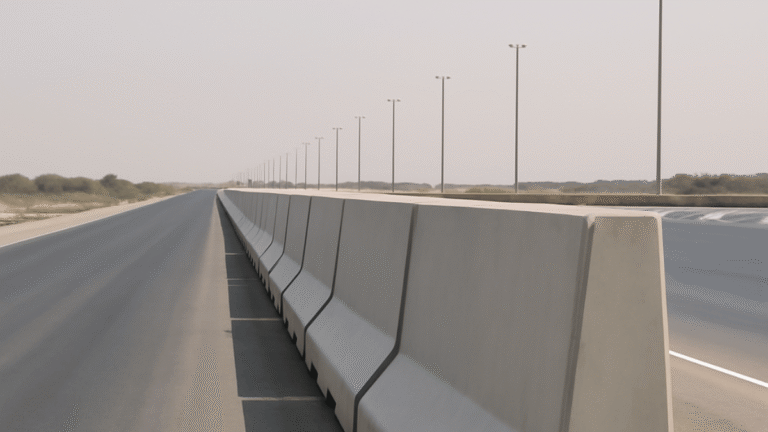
4m: permanent medians cast to a highway drawing. Not a stock item. Allow 3 to 4 weeks lead time and a 50 tonne crane.
The arithmetic for a run is in our takeoff guide. The short version: a 300m run is 100 units of 3m or 150 units of 2m, before corners, gates and flares.
Weight Decides Three Things
1. The crane
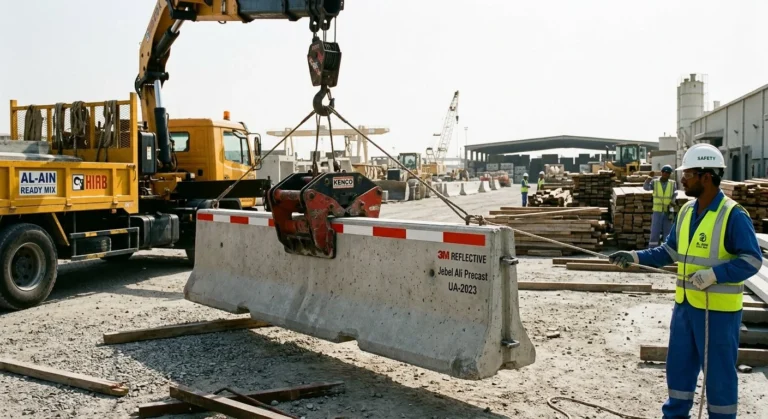
Crane capacity falls fast with radius. Rough field numbers our riggers use for a dry, level site:
| Unit weight | Hiab on 10 tonne truck | 25 tonne mobile | 50 tonne mobile |
|---|---|---|---|
| 800kg (2m) | Up to 8m radius | Up to 18m | Any normal site radius |
| 1,500kg (3m) | Up to 5m radius | Up to 12m | Up to 20m |
| 2,400kg (F-type) | Not recommended | Up to 8m | Up to 16m |
| 5,500kg (T-wall) | No | Up to 5m | Up to 11m |
Placing a 3m barrier in the far lane of a 3-lane carriageway from the hard shoulder is a 12m to 14m reach. That is 50 tonne territory. Price the crane from the furthest unit, not the nearest.
2. The truck
A 40ft flatbed in the UAE runs to about 24 to 26 tonnes of payload before you argue with the weighbridge at the border or on E311.
- 2m units at 850kg: 12 to 14 per load, deck length permitting.
- 3m units at 1,500kg: 6 to 7 per load, usually stacked two high on timber.
- F-type at 2,400kg: 5 to 6 per load, single layer or two high with proper dunnage.
- T-walls at 5,500kg: 4 per load.
Our handling guide covers how to stack them without spalling the edges.
3. The ground
A 3m barrier at 1,500kg on a 600mm base puts roughly 8 kN per linear metre on the ground. Compacted sub-base and asphalt do not care. Freshly backfilled trench does. Barriers on a soft verge over a DEWA cable trench will settle and the joints will open. Put them on the asphalt side of the trench, or on a bearing timber.
Lifting Inserts and Connections
Every unit should have cast-in lifting points rated for the unit weight with a safety factor of at least 4. Two inserts per unit for 2m and 3m, four for F-type and T-wall. Barriers with no lifting points, or with a single hook eye in the top, are refurbished stock from an unknown source. Our used barrier inspection guide covers what else to check. Ask what cage is inside.
Connections you will meet in the UAE:
- Pin and loop: a steel loop at each end, a pin dropped through two mated loops. Fast, strong, and the loops stay aligned when the ground is not quite level. Our standard.
- Male and female interlock: a tongue cast into one end, a groove in the other. Quick for site lines, weaker in a crash because the joint only resists shear.
- Bolt-through: two plates and threaded bar through the end faces. Used on permanent medians.
RTA WZTM treats unconnected barriers as individual blocks. Connected barriers act as a system and get credit for containment. If your TMP says “connected concrete barrier”, every unit on the run needs a pin in it.
Reflectors, Paint and Height
RTA requires reflective panels on barriers in the ROW. The usual spec is Class 2 or better reflective sheeting, alternating red and white chevrons for permanent and yellow and black for construction, fitted at 400mm to 600mm above the ground. On a 810mm barrier that is the top third of the sloped face. Fit them before the crane lifts the barrier, not after. The 7 mistakes RTA fines for are listed in our RTA fine trap guide.
Paint colour does not change the dimension but it changes the price (full ranges in the 2026 price guide): unpainted grey is standard, yellow and black bands add AED 25 to 45 a unit at the yard.
Jersey vs K-Rail vs F-Type: Same Family, Different Numbers
Contractors coming from US or Saudi projects ask for K-rail. K-rail is California’s name for a 20ft (6.1m) jersey profile at 810mm. In the UAE you will not find 6.1m stock. The 3m jersey is the practical equivalent. F-type is the taller cousin with a different slope break, used where the specification says permanent highway median.
If your drawing says K-rail, ask the consultant whether they mean the profile or the length before you order. Nine times out of ten they mean “3m jersey, connected.”
Quick Spec Card: Save This
| 2m interlocking | 3m jersey | F-type | |
|---|---|---|---|
| Height | 800 to 1,000mm | 810 to 1,000mm | 1,067mm |
| Base width | 450 to 600mm | 600 to 650mm | 600 to 700mm |
| Weight | 750 to 900kg | 1,200 to 1,600kg | 1,800 to 2,400kg |
| Units per 100m | 50 | 34 | 34 (25 if 4m) |
| Units per 40ft trailer | 12 to 14 | 6 to 7 | 5 to 6 |
| Lifting | Hiab or forklift | Hiab close, mobile crane far | Mobile crane |
| Connection | Interlock or pin | Pin and loop | Pin and loop or bolt |
| Suits | Site lines, roads under 60 km/h | RTA and DMT diversions | Permanent highway medians |
Checklist for Your BOQ Line
- State the profile: single-sided, double-sided jersey or F-type.
- State the length and tolerance: “3,000mm, plus or minus 10mm.”
- State height and base width, not just “standard.”
- State the connection type and that every unit is to be connected.
- State the reflector spec and colour.
- State concrete grade (C40/50 is the UAE norm for road barriers) and cover (40mm minimum for exposed concrete in this climate).
- State the unit weight so the crane sub can price it.
- State delivery location and whether crane offload is included.
FAQs
How tall is a standard jersey barrier in the UAE?
810mm is the classic New Jersey height and most 3m stock sits between 810mm and 1,000mm. F-type units are 1,067mm. If a drawing says 1m barrier, confirm whether it means height or length. Both readings are common.
How much does a 3 metre concrete barrier weigh?
Between 1,200kg and 1,600kg for a standard jersey profile. F-type units at 3m weigh 1,800kg or more. Ask for the certified weight on the delivery note.
How many 3m barriers fit on one truck?
Six to seven on a standard 40ft flatbed, limited by payload, not deck length.
Can a Hiab place 3m barriers?
Yes at short radius. Within about 5m of the truck, a Hiab on a 10 tonne chassis handles 1,500kg comfortably. Beyond that, book a mobile crane.
Are 2m and 3m barriers interchangeable in one run?
Yes if they share the same connection type and height. Mixed runs are normal: 3m for the straight, 2m at flares, corners and gates.
Need the Weight Certificate?
Send your BOQ line or drawing and we return the unit weight, crane recommendation and truck count within 2 hours. WhatsApp +971 58 660 9400.