Municipality Regulations for Concrete Barriers in Dubai & Abu Dhabi — 2026 Contractor Guide
If you’re a contractor, site engineer, or project manager working in the UAE, you know one thing for certain: municipal approval is non-negotiable. Whether you’re building a highway in Abu Dhabi or securing a construction zone in Dubai, your concrete barriers must meet very specific local authority regulations — or face rejection, fines, and project delays.
In this guide, we break down every regulation, specification, document, and approval process you need to know for concrete barriers in Dubai and Abu Dhabi — the two most active construction zones in the country. We’ll also cover the other five emirates, share tips to avoid common approval mistakes, and show you exactly how to get your barriers approved in the fastest way possible.
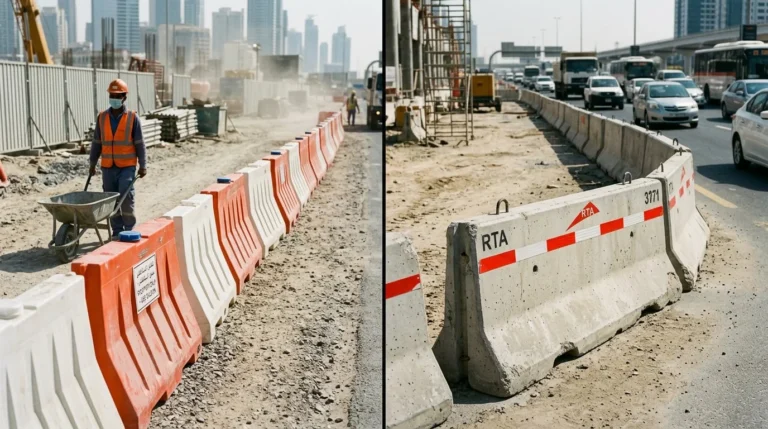
Quick Answer: In Dubai, concrete barriers must comply with RTA (Roads and Transport Authority) and Dubai Municipality specifications — minimum height 800mm, C40 concrete, reflective markings, and approved engineering drawings. In Abu Dhabi, DMT (Department of Municipalities and Transport) requires C40+ reinforced concrete, batch ID marking, crane/forklift compatibility, and full QA documentation. Arab Precast’s standard designs are pre-approved for both emirates, reducing approval time to 1–3 business days.
Why Municipality Regulations Matter
You can have the strongest, most precisely engineered barrier on site — but if it doesn’t follow municipal specifications, your project may face:
- Work stoppage — inspectors can halt your project until barriers are replaced
- Financial penalties — fines range from AED 5,000 to AED 50,000 per violation
- Forced removal — non-compliant barriers must be torn down and replaced at your cost
- Reputation damage — repeated violations can exclude you from future government tenders
- Safety liability — non-compliant barriers that fail during an accident can lead to criminal charges
Municipality regulations exist to:
- Standardize safety across all construction and road projects in the UAE
- Ensure visibility and durability in extreme weather conditions (50°C+ summer heat, heavy rain, coastal salt)
- Maintain road and site aesthetics — barriers must look professional and be properly marked
- Prevent unsafe materials — only certified concrete grades and reinforcement are permitted
Barrier Regulations in Dubai (RTA & DM)
In Dubai, two authorities regulate the use of concrete barriers. Understanding which one governs your project is the first step to compliance.
Authority 1: Roads and Transport Authority (RTA)
Responsible for:
- Permanent barriers along highways, roads, and bridges
- Approving design specs and drawings for road safety applications
- Requiring crash test compliance (where applicable)
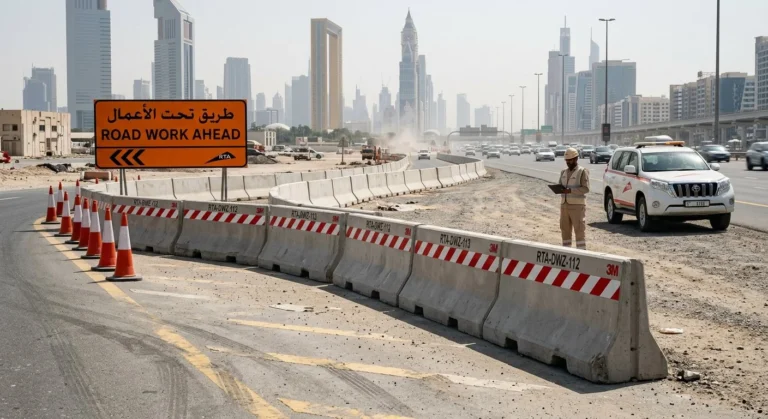
- Specifying reflective marking standards for night visibility
- Reviewing barrier placement plans for major road projects
Projects requiring RTA approval:
- Sheikh Zayed Road (E11) barrier installations
- Al Khail Road (E44) median dividers
- Emirates Road (E611) edge protection
- Dubai Bypass (E311) construction zone barriers
- Any barrier within 50 meters of a public roadway
Authority 2: Dubai Municipality (DM)
Responsible for:
- Temporary concrete barriers at construction sites
- Public safety zones near residential and commercial developments
- Aesthetic and surface finish requirements for urban areas
- Site safety inspections and compliance audits
- Approving barriers for internal project roads (not connected to public highways)
Projects requiring DM approval:
- Building construction site perimeters
- Internal road barriers within private developments
- Temporary barriers for utility work on municipal roads
- Barriers in residential communities and commercial districts
Key Dubai RTA/DM Specifications (2026)
| Specification | RTA Requirement | DM Requirement |
|---|---|---|
| Minimum height | 1000mm for highways, 800mm for urban roads | 800mm for construction sites |
| Standard length | 3m or 4m (modular) | 2m or 3m |
| Base width | 600mm minimum for stability | 500mm minimum |
| Concrete grade | C40 (40 MPa) minimum | C40 minimum |
| Steel reinforcement | Grade 60 rebar, 10–16mm diameter | Grade 60 rebar, minimum 10mm |
| Surface finish | Smooth, painted with white/yellow/black stripes | Clean finish, no visible cracks |
| Reflective markings | Mandatory for all road-facing barriers | Required for night-work zones |
| Interlocking system | Required for continuous installations over 100m | Recommended for long perimeters |
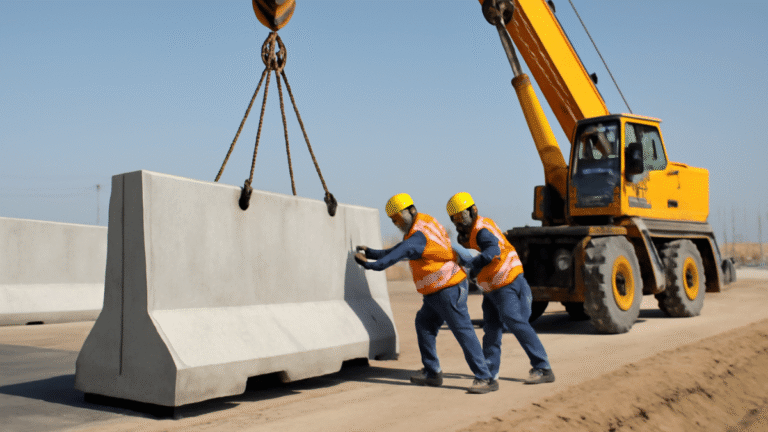
| Lifting points | Crane-compatible hooks or forklift recesses | Forklift recesses mandatory |
| Supplier identification | Batch ID + company name stamped on each unit | Batch ID tag required |
| Crash test rating | Required for highway barriers (BS EN 1317 N2 or higher) | Not required for construction sites |
Dubai Barrier Approval Process
| Step | Action | Timeline | Authority |
|---|---|---|---|
| 1 | Submit engineering drawings and specifications | 1–3 days | RTA or DM |
| 2 | Provide concrete mix design certificate | Included with step 1 | RTA or DM |
| 3 | Provide compressive strength test reports | Included with step 1 | RTA or DM |
| 4 | Authority reviews and approves/rejects | 2–5 days | RTA or DM |
| 5 | On-site inspection after barrier placement | 1–2 days after installation | RTA or DM |
| 6 | Final approval issued | 1 day after inspection | RTA or DM |
Total timeline with pre-approved designs: 3–7 business days
Total timeline with custom designs: 7–15 business days
Pro tip: Arab Precast provides pre-approved standard barrier designs that bypass the engineering review stage entirely. With our documentation package, most projects get approved in 3–5 business days instead of the standard 7–15.
Barrier Regulations in Abu Dhabi (DMT)
In Abu Dhabi, The Department of Municipalities and Transport (DMT) is the single authority governing all concrete barrier installations — for both permanent and temporary applications.
DMT’s Key Responsibilities:
- Overseeing traffic safety infrastructure across the emirate
- Approving barrier types used for road upgrades, civil works, and urban sites
- Inspecting project sites for regulation compliance
- Approving both precast and cast-in-place concrete solutions
- Maintaining a registered supplier list — only approved manufacturers can supply barriers for DMT projects
- Enforcing Abu Dhabi Building Code requirements for all construction materials
Common DMT Requirements (2026)
| Requirement | DMT Specification |
|---|---|
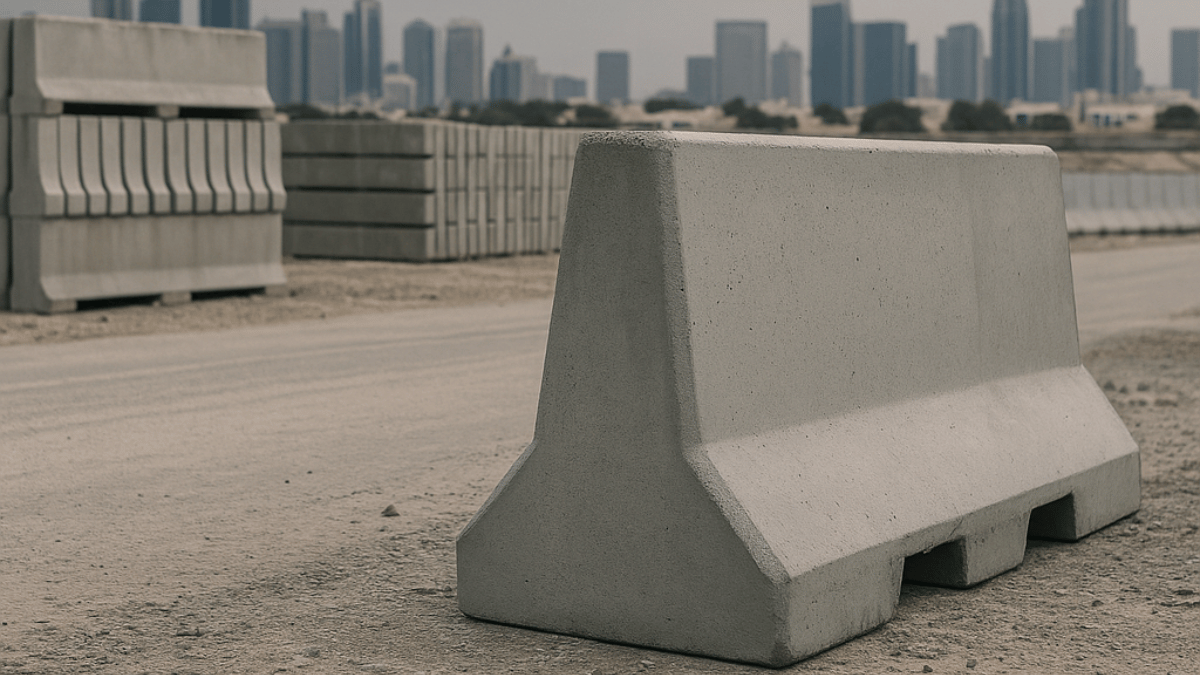
| Approved barrier types | Jersey, F-Type, single slope, interlocking, bin blocks |
| Concrete strength | Minimum Grade 40 reinforced concrete (C40) |
| Steel reinforcement | Grade 60 rebar, minimum 12mm diameter for highway barriers |
| Surface finish | Clean, smooth finish with no visible cracks, honeycombing, or spalling |
| Dimensional tolerance | ±5mm for length, ±3mm for height, ±5mm for width |
| Mobility features | Barriers must be crane-compatible (lifting hooks) or forklift-compatible (recesses) |
| Identification marking | Supplier name, batch ID, manufacturing date, and concrete grade stamped on each unit |
| Documentation required | Load test results, mix design approvals, QA/QC reports, delivery certificates |
| Reflective markings | White or yellow reflective paint/strips on road-facing surfaces |
| Crash test compliance | BS EN 1317 N2 minimum for highway installations |
Abu Dhabi Barrier Approval Process
| Step | Action | Timeline |
|---|---|---|
| 1 | Verify supplier is on DMT’s approved manufacturer list | 1 day |
| 2 | Submit barrier specifications and engineering drawings | 1–2 days |
| 3 | Provide quality assurance documentation (mix design, test reports) | Included with step 2 |
| 4 | DMT reviews submission | 3–5 days |
| 5 | On-site inspection after delivery | 1–2 days |
| 6 | Final approval and project sign-off | 1 day after inspection |
Total timeline with approved supplier: 5–10 business days
Total timeline with new supplier: 10–20 business days (includes supplier registration)
Arab Precast is a DMT-registered supplier with pre-approved barrier designs. This means your project skips the supplier registration step entirely, saving 5–10 days in the approval process.
Regulations for the Northern Emirates (Sharjah, Ajman, RAK, Fujairah, Umm Al Quwain)
Each of the remaining five emirates has its own municipal authority. Here’s what you need to know:
Sharjah Municipality
| Requirement | Specification |
|---|---|
| Authority | Sharjah Municipality + Sharjah Roads and Transport Authority |
| Barrier standards | Follows RTA-style specifications with additional aesthetic requirements |
| Urban area rules | Barriers in Sharjah city center must have clean, painted finishes (grey or white) |
| Industrial zone rules | Standard RTA-compliant barriers accepted |
| Documentation | Engineering drawings + test certificates + supplier registration |
| Approval timeline | 3–7 business days |
Ajman Municipality
| Requirement | Specification |
|---|---|
| Authority | Ajman Municipality and Planning Department |
| Barrier standards | Accepts RTA and DMT pre-approved designs with local registration |
| Coastal requirements | Barriers within 2km of the coast must use salt-resistant concrete mix (C45+) |
| Documentation | Standard RTA/DMT documents accepted |
| Approval timeline | 2–5 business days |
Ras Al Khaimah Municipality
| Requirement | Specification |
|---|---|
| Authority | Ras Al Khaimah Municipality |
| Barrier standards | Similar to Abu Dhabi DMT requirements |
| Mountain zone requirements | Barriers in wadi or mountain areas must be anti-flood rated (1200mm+ height, reinforced base) |
| Documentation | Engineering drawings + compressive strength reports |
| Approval timeline | 3–7 business days |
Fujairah Municipality
| Requirement | Specification |
|---|---|
| Authority | Fujairah Municipality |
| Barrier standards | RTA-compliant designs accepted |
| Coastal requirements | Strict salt-resistance standards due to Indian Ocean exposure — C50 concrete recommended |
| Documentation | Standard + additional corrosion resistance certificate |
| Approval timeline | 3–7 business days |
Umm Al Quwain Municipality
| Requirement | Specification |
|---|---|
| Authority | Umm Al Quwain Municipality |
| Barrier standards | Accepts RTA pre-approved designs |
| Documentation | Simplified — engineering drawings + batch ID + test certificates |
| Approval timeline | 2–4 business days (fastest of all emirates) |
Municipality-Approved Barrier Types
Here are the most common barrier types accepted across all UAE municipalities, with their typical applications:
| Barrier Type | RTA Approved | DMT Approved | Northern Emirates | Best For |
|---|---|---|---|---|
| Jersey Barriers (Precast) | ✅ Yes | ✅ Yes | ✅ Yes | Highway and expressway dividers |
| F-Type Barriers | ✅ Yes (mandatory on E-roads) | ✅ Yes | ✅ Yes | High-speed roads, median barriers |
| Single Slope Barriers | ✅ Yes | ✅ Yes | ✅ Yes | Urban roads, turning points, tight spaces |
| Interlocking Concrete Barriers | ✅ Yes | ✅ Yes | ✅ Yes | Construction zones, continuous perimeters |
| Bin Blocks | ✅ Yes | ✅ Yes | ✅ Yes | Utility separation, flood control, storage |
| Custom-Fabricated Reinforced Barriers | ⚠️ Case-by-case | ⚠️ Case-by-case | ⚠️ Case-by-case | Unique height/load requirements |
All Arab Precast standard barrier designs are pre-approved by RTA and DMT, meaning they can be used immediately without additional engineering review. Custom designs require individual submission but we handle the entire approval process on your behalf.
Complete Document Checklist for Barrier Approval
Both Dubai and Abu Dhabi municipalities typically request the following documents. Having these ready before your inspection can save days or weeks:
Mandatory Documents (All Emirates)
| Document | Description | Who Provides It |
|---|---|---|
| 📄 Engineering drawings | Detailed barrier dimensions, cross-sections, and reinforcement layout | Manufacturer (Arab Precast provides pre-approved drawings) |
| 🧪 Concrete mix design certificate | Shows the exact concrete composition, water-cement ratio, and additives | Manufacturer’s quality control lab |
| 📷 Product photos | Before-delivery photos showing barrier condition, surface finish, and markings | Manufacturer or supplier |
| 🛠️ Installation method statement | Step-by-step plan for how barriers will be placed on site | Contractor or project engineer |
| 🧾 Product batch IDs | Unique identifier for each batch of barriers delivered | Manufacturer (stamped on each unit) |
| 📋 Quality control & test reports | Compressive strength tests (7, 14, and 28-day results), rebar tensile strength tests | Manufacturer’s testing lab |
Additional Documents for Dubai RTA
| Document | When Required |
|---|---|
| 🚗 Crash test certificate | For highway barriers (BS EN 1317 N2 or higher rating) |
| 📐 Site layout plan | Showing exact barrier placement locations |
| 🎨 Reflective marking specification | Detailing paint type, color, and strip dimensions |
| 📝 Traffic management plan | For barriers on active roadways |
Additional Documents for Abu Dhabi DMT
| Document | When Required |
|---|---|
| Supplier registration certificate | Proof that the manufacturer is on DMT’s approved list |
| Statistical quality control report | Showing consistent production quality across multiple batches |
| Third-party inspection report | Independent verification of barrier specifications |
| Delivery and handling plan | Showing how barriers will be transported and placed without damage |
At Arab Precast, we pre-package all mandatory documents and submit them directly to municipality engineers upon request. For RTA and DMT projects, our standard documentation package includes engineering drawings, mix design certificates, compressive strength reports, batch IDs, and installation guidelines — everything you need for approval in one delivery.
Common Mistakes That Delay Approval (And How to Avoid Them)
Based on our experience with hundreds of projects across the UAE, here are the 7 most common mistakes contractors make when dealing with municipality barrier regulations:
❌ Mistake 1: Using Non-Standard Dimensions
The problem: Ordering barriers that don’t match RTA/DMT standard sizes (e.g., 2.5m length, 900mm height when 1000mm is required).
The consequence: Automatic rejection during inspection. Barriers must be removed and replaced.
How to avoid it: Always use standard sizes (2m, 3m, 4m lengths; 800mm, 1000mm, 1200mm heights) unless you have specific engineering approval for custom dimensions.
❌ Mistake 2: Missing Reflectors or Paint Stripes
The problem: Barriers delivered without the required reflective markings or painted visibility stripes.
The consequence: RTA inspectors will fail your site. Repainting takes 1–2 days and delays your project.
How to avoid it: Specify reflective markings at the time of order. Arab Precast applies RTA-compliant white/yellow paint stripes and reflective strips as a standard option.
❌ Mistake 3: No Lifting Hooks for Crane Handling
The problem: Barriers without built-in lifting points require external clamps or slings, which inspectors consider unsafe.
The consequence: Failed safety inspection, work stoppage until lifting points are added or barriers are replaced.
How to avoid it: Order barriers with crane-compatible lifting hooks or forklift recesses. This is a mandatory requirement for all DMT and most RTA projects.
❌ Mistake 4: Lack of Surface Finish
The problem: Raw, unfinished concrete surfaces with visible form marks, honeycombing, or spalling.
The consequence: Automatic rejection. Municipalities require clean, smooth finishes for aesthetic and safety reasons.
How to avoid it: Specify smooth form-finish when ordering. Arab Precast’s precision steel molds produce barriers with a clean, uniform surface that passes inspection on the first attempt.
❌ Mistake 5: No Supplier ID or Batch Documentation
The problem: Barriers delivered without manufacturer identification stamps or batch tracking numbers.
The consequence: Inspectors can’t verify the source or quality of the barriers. Project approval is delayed until documentation is provided.
How to avoid it: Work with suppliers who stamp batch IDs and company names directly on each unit and provide complete documentation packages. Arab Precast does this as standard practice.
❌ Mistake 6: Not Checking Coastal Requirements
The problem: Using standard concrete mix in coastal areas (Dubai Marina, Abu Dhabi Corniche, Fujairah) without salt-resistant additives.
The consequence: Barriers degrade faster than expected, fail inspection, and require premature replacement.
How to avoid it: For any project within 5km of the coast, specify C45+ concrete with anti-corrosion treatment. Arab Precast offers coastal-grade concrete as an upgrade option.
❌ Mistake 7: Submitting Documentation After Delivery
The problem: Waiting until barriers are on-site to start the approval paperwork.
The consequence: Project delays of 5–15 days while authorities review your submission.
How to avoid it: Submit all documentation before delivery. Arab Precast provides complete documentation packages with every order so you can submit them to the municipality in advance.
Case Study: Successful Barrier Approval in Dubai Silicon Oasis
The Challenge
A contractor working on a roadside infrastructure upgrade in Dubai Silicon Oasis needed 300 meters of temporary safety barriers for a 6-month project. The barriers had to:
- Comply with RTA specifications for a road adjacent to a public highway
- Be removable and relocatable as construction phases progressed
- Pass Dubai Municipality inspection within 48 hours of installation
- Stay within a tight budget of AED 80,000 for the entire barrier scope
The Arab Precast Solution
| Action | Detail | Timeline |
|---|---|---|
| Barrier selection | RTA-approved interlocking barriers (3m length, 1000mm height) with forklift recesses | Day 1 |
| Documentation package | Engineering drawings, mix design certificates, compressive strength reports, batch IDs | Day 1 (pre-packaged) |
| Delivery | 100 barrier units delivered on 3 truckloads | Day 3 |
| On-site placement | Barriers positioned using forklifts (no crane needed) | Day 3–4 |
| Municipality inspection | RTA and DM inspectors visited site | Day 5 |
| Approval issued | Project greenlit with zero non-conformances | Day 6 |
The Results
- ✅ Total cost: AED 65,000 — AED 15,000 under budget
- ✅ Approval in 6 days — 50% faster than the industry average of 12 days
- ✅ Zero non-conformances — all barriers passed inspection on the first attempt
- ✅ Barriers relocated 3 times during the project — forklift recesses made repositioning effortless
- ✅ Full buyback at project end — contractor recovered AED 32,500 (50% of purchase price)
The lesson: Speed, compliance, and proper documentation made all the difference. Working with a supplier who provides pre-approved designs and complete documentation packages saved this contractor both time and money.
How Arab Precast Makes Municipality Compliance Easy
At Arab Precast, we don’t just manufacture barriers — we ensure they meet every municipal requirement so your project gets approved on the first attempt:
| Service | What We Provide |
|---|---|
| Pre-approved designs | RTA and DMT standard barrier designs that bypass engineering review |
| Complete documentation | Engineering drawings, mix design certificates, test reports, batch IDs |
| Direct authority submission | We submit documentation to municipality engineers on your behalf |
| On-site inspection support | Our team is available to answer inspector questions during site visits |
| Custom design approval | For unique requirements, we handle the full engineering submission process |
| Coastal-grade concrete | C45+ anti-corrosion mix for projects near the sea |
| Reflective markings | RTA-compliant paint stripes and reflective strips applied at the factory |
| Lifting points | Crane hooks or forklift recesses built into every barrier |
| Supplier registration | Already registered with RTA, DMT, and all Northern Emirates authorities |
Not sure which emirate’s regulations apply to your project? Contact our compliance team for a free consultation. We’ll review your project scope, identify the correct authority, and provide a complete compliance checklist within 24 hours.
FAQ — Municipality Regulations for Concrete Barriers
Do I need RTA approval for barriers on internal roads in Dubai?
Yes. If the barriers face public access or roadways — even internal roads within a private development — they require RTA or Dubai Municipality compliance. The only exception is fully enclosed construction sites with no public access, which only need DM approval.
Can I submit my own barrier design for municipality approval?
Yes, but it must be supported by structural engineering drawings, load test results, and material certification. The review process for custom designs takes 5–15 business days compared to 1–3 days for pre-approved standard designs. We recommend using standard designs whenever possible.
Do Abu Dhabi authorities accept used barriers?
Sometimes. If used barriers meet the surface finish, batch ID, and test certification criteria, DMT may approve them. However, each used batch requires individual inspection and documentation. Arab Precast offers certified used barrier stock with full documentation, which DMT accepts without additional review.
How long does municipality approval take in the UAE?
| Emirate | Standard Timeline | With Pre-Approved Designs |
|---|---|---|
| Dubai (RTA) | 5–10 business days | 2–4 business days |
| Dubai (DM) | 3–7 business days | 1–3 business days |
| Abu Dhabi (DMT) | 5–10 business days | 2–5 business days |
| Sharjah | 3–7 business days | 1–3 business days |
| Ajman | 2–5 business days | 1–2 business days |
| RAK | 3–7 business days | 2–4 business days |
| Fujairah | 3–7 business days | 2–4 business days |
| Umm Al Quwain | 2–4 business days | 1–2 business days |
What happens if my barriers fail municipality inspection?
If barriers fail inspection, you’ll receive a non-conformance report listing the specific issues. You typically have 7–14 days to correct the problems and request re-inspection. Common corrective actions include:
- Adding reflective markings (1–2 days)
- Applying surface finish treatments (2–3 days)
- Replacing undersized barriers (5–7 days for delivery)
- Providing missing documentation (1–2 days)
Repeated failures can result in fines, work stoppages, or removal from approved contractor lists.
Are there different regulations for temporary vs. permanent barriers?
Yes. Permanent barriers (installed for more than 6 months) require full engineering approval, crash test certification (for roadways), and compliance with all municipal specifications. Temporary barriers (less than 6 months) have simplified requirements — typically just batch ID, surface finish, and basic safety documentation.
Which emirate has the strictest barrier regulations?
Abu Dhabi (DMT) has the most comprehensive regulations, requiring supplier registration, statistical quality control reports, and third-party inspection certificates. Dubai (RTA) is second, with strict crash test requirements for highway barriers. The Northern Emirates generally have more streamlined processes and accept RTA/DMT pre-approved designs.
Ready to Get Your Barriers Approved?
WheWhether you’re working in Dubai, Abu Dhabi, or any of the other five emirates, Arab Precast ensures your precast concrete barriers meet every municipal requirement from day one.
We provide a full compliance package with every order, including pre-approved RTA and DMT designs, complete documentation (engineering drawings, mix design certificates, and test reports), and direct authority submission support. If you’re still navigating the selection process, our step-by-step guide on how to choose the right barrier for your project breaks down every decision factor — from sizing and reinforcement to delivery logistics.
For larger infrastructure needs, you can also browse our complete range of precast concrete products, including pole foundations, trench covers, and signage blocks, all manufactured to the same rigorous quality standards.
📞 Call us: +971 58 660 9400
📧 Email: info@arabprecast.ae
💬 WhatsApp: Chat with our compliance team